

Measuring What Matters: Precision, Latency & Cost-per-Run Metrics
An executive and engineering guide to discarding AI vanity metrics: why accuracy lies, how compounding tail latencies cripple multi-agent systems, and how to measure true Cost-per-Verified-Outcome (CPVO) using OpenTelemetry GenAI standards.
“Every system must outperform on latency, precision, or unit cost. Otherwise, it is discarded.” — About FalconicLab
Most enterprise AI metrics reported in vendor pitch decks are vanity numbers.
A vendor proudly claims their document AI model achieves “99% accuracy.” What they don’t tell the enterprise buyer is that on a 100-field commercial tax form, 95 of the fields are blank or trivial static labels. A naive model that predicts “empty” for everything achieves 95% accuracy while failing on 100% of the critical financial figures.
Another vendor touts an “average latency of 400 milliseconds.” In production, that arithmetic mean masks a catastrophic P99 tail latency of 8,500 milliseconds. In a 7-step autonomous agent workflow, that hidden tail latency compounds, causing 25% of end-to-end customer interactions to time out.
Worse, AI accounting dashboards track raw API Token Spend while ignoring the true economic cost: Cost-per-Verified-Outcome (CPVO). An agent run that costs $0.03 in tokens but fails 40% of the time—requiring 15 minutes of senior human labor to diagnose and repair—does not cost $0.03. Its true enterprise cost exceeds $20.00 per completed task.
At FalconicLab, our engineering mandate is built on radical empirical measurement: our 47 intelligence nodes (PRIMARY_CORE // AUTONOMOUS_V2) maintain a 99.4% core reliability rate, a 15ms orchestration decision latency (9ms–10ms system heartbeat), and an average precision cost of $0.06 per run on FalconicLab Experiments.
This guide equips CTOs, VPs of Engineering, and MLOps architects with the exact Telemetry & Metric Frameworks required to measure and manage production AI systems: dismantling accuracy fallacies, modeling multi-agent compounding tail latency, implementing standardized OpenTelemetry GenAI Semantic Conventions, and calculating true Cost-per-Verified-Outcome.
Executive Summary: Vanity Metrics vs. Production Truth
For executive leaders, steering an enterprise AI initiative requires replacing vanity metrics with decision-grade operational indicators:
| Dimension | Vanity / Prototype Metric | Why It Deceives Decision-Makers | Production Metric (FalconicLab Standard) | Real Business Impact |
|---|---|---|---|---|
| Model Quality | Raw Accuracy () | In imbalanced data (fraud, defect, compliance), predicting the majority class yields 99% accuracy | Precision-at-Fixed-Recall (e.g. 99.6% Precision on exp-02) & F-beta () |
Eliminates costly false positives and false declines |
| Response Speed | Arithmetic Mean Latency () | Outlier tokens and network spikes hide in the average; users experience the P95/P99 | P99 & P99.9 Tail Latency Budgets per Graph Hop | Prevents user abandonment and network gateway timeouts |
| Economic Cost | Raw API Token Invoices ($/month) | Ignores retries, agent loops, failed tasks, and human remediation expense | Cost-per-Verified-Outcome (CPVO) | Accurately models true gross margin and unit economics |
| Agent Reliability | Single-step tool success rate | A 95% step rate over 10 sequential hops yields only a 59.8% end-to-end success rate | End-to-End Straight-Through Processing (STP) Precision | Dictates operational headcount requirements |
| System Visibility | Unstructured logging / print statements | Impossible to trace root cause across multi-agent handoffs | OpenTelemetry GenAI Distributed Traces | Reduces Mean-Time-to-Resolution (MTTR) from days to minutes |
Deep Dive 1: Why “Accuracy” Destroys Value in High-Stakes Domains
In high-compliance enterprise sectors—the focus of FalconicLab’s 14 Industry Hubs—data is fundamentally asymmetric.
The Fraud Detection Asymmetry (Banking & Financial Services)
In our Sub-50ms Financial Fraud Detection Model (exp-02), only 1 out of every 1,000 credit card transactions is fraudulent ( prevalence).
- A dumb model that outputs
is_fraud = Falseon every single transaction achieves 99.9% accuracy. - However, its Recall is 0.0%—meaning every single fraudulent transaction executes successfully, costing millions in chargeback losses.
The Clinical Prior Authorization Asymmetry (Healthcare & Life Sciences)
In clinical diagnostics and prior authorization, a False Positive (wrongly flagging an experimental treatment as approved) violates FDA/payer guidelines, while a False Negative (denying necessary chemotherapy) threatens patient lives and triggers statutory penalties.
The Metric Fix: Precision, Recall, and Calibrated Brier Scores
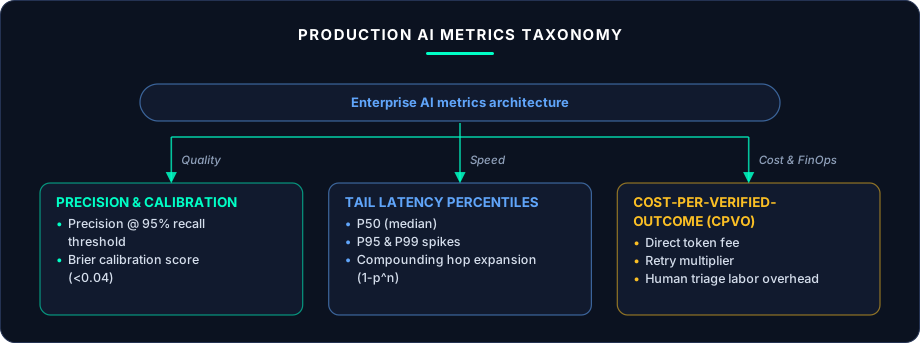
At FalconicLab, we evaluate classifiers and extraction agents using three precision-centric metrics:
- Precision-at-Fixed-Recall: We fix the required operational recall threshold (e.g., catching at least 95% of all fraudulent attempts) and optimize strictly for Precision at that operating point. On
exp-02, we achieve 99.6% precision at 95% recall, meaning only 4 out of every 1,000 flagged transactions are false alarms. - Score with Asymmetric Weighting: When precision is more critical than recall (avoiding false alarms that annoy premium customers), we use :
- Brier Calibration Score: An AI model must know what it does not know. If an agent outputs
confidence = 0.95, exactly 95 out of 100 such predictions must be empirically correct. The Brier score measures mean squared probability error:
Where is the forecasted probability and is the actual outcome. Our models maintain , ensuring that confidence-gated Human-in-the-Loop escalations (Post #5) trigger accurately.
Deep Dive 2: Compounding Tail Latency in Multi-Agent Graphs
In a monolithic web application, a P99 latency of 1,200ms affects only 1% of users. In an autonomous multi-agent system—such as our Autonomous Code Architect (exp-01) or a multi-step claims adjudication graph—a workflow consists of sequential or parallel agent hops.
The Math of Tail Latency Compounding
If a multi-agent system executes independent steps, and each step has probability of completing within its P95 latency budget (), the probability that the entire workflow completes without experiencing a tail-latency spike is:
| Number of Agent Hops () | Chance of an On-Time Workflow () | Percentage of Users Hitting a Tail-Latency Spike |
|---|---|---|
| 1 Hop (Single API call) | 95.0% | 5.0% |
| 3 Hops (Triage RAG Synthesis) | 85.7% | 14.3% |
| 8 Hops (Multi-agent planning & tool loop) | 66.3% | 33.7% (1 in 3 workflows delayed) |
| 15 Hops (Complex enterprise orchestration) | 46.3% | 53.7% (More than half hit tail latency!) |
In a 15-hop autonomous workflow, over half of all requests experience at least one P95+ latency spike. If your P95 latency is 3.5 seconds, user sessions stretch to 45+ seconds, leading to browser connection timeouts and abandoned carts.
The Falconic Solution: Strict Per-Hop Latency SLAs
This mathematical reality is why FalconicLab enforces a 15ms Orchestration Decision SLA and sub-50ms execution budgets:
- Tier 0 and Tier 1 routing edges execute in sub-15ms.
- Model inference uses quantized vLLM engines with chunked prefill (Post #16) to eliminate prefill latency spikes.
- Graph branches enforce hard per-hop deadlines in Temporal, triggering speculative execution or lightweight fallback models if a worker exceeds its budget.
Deep Dive 3: The True Economic Metric — Cost-per-Verified-Outcome (CPVO)
When CFOs review AI budgets, they usually look at token invoices divided by total requests. This Cost-per-Request metric is dangerous because it treats failed runs, infinite retry loops, and hallucinated answers that require human rework as “cheap.”
The CPVO Formula
At FalconicLab, we calculate Cost-per-Verified-Outcome (CPVO):
Where:
- Total Spend includes all input tokens, output tokens, tool API costs, and vector database queries across both successful and failed attempts.
- Cost of Human Remediation .
- Verified Successful Outcomes are only those workflows that pass all deterministic postcondition invariant checks (Post #2).
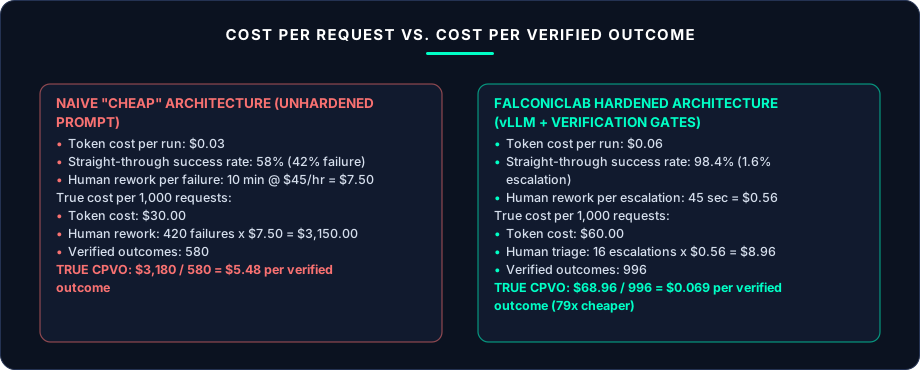
A hardened architecture with slightly higher upfront token costs ($0.06 vs $0.03) is 79 times cheaper in true enterprise economics because it eliminates human triage rework.
Implementing OpenTelemetry GenAI Semantic Conventions
To monitor these metrics in production without vendor lock-in, FalconicLab standardizes telemetry around the official OpenTelemetry GenAI Semantic Conventions. Every agent node emits structured spans capturing token consumption, model IDs, latency percentiles, and validation outcomes.
OpenTelemetry GenAI standardized span trace
trace_id: "4bf92f3577b34da6a3ce929d0e0e4736"
span_name: "gen_ai.chat"
attributes:
  gen_ai.system: "vllm"
  gen_ai.request.model: "meta-llama/Llama-3.1-70B-Instruct-AWQ"
  gen_ai.response.model: "meta-llama/Llama-3.1-70B-Instruct-AWQ"
  gen_ai.request.temperature: 0.0
  gen_ai.request.max_tokens: 1024
  gen_ai.usage.input_tokens: 1420
  gen_ai.usage.output_tokens: 185
  gen_ai.response.finish_reasons: ["stop"]
  falconic.finops.cost_usd: 0.000412
  falconic.verification.status: "PASSED_INVARIANT_GATE"
  falconic.orchestration.decision_latency_ms: 12.4
Production Implementation: Enterprise Telemetry & CPVO Collector
Below is a complete, production-grade Python implementation of our Enterprise AI Metrics & CPVO Observability Collector. It computes real-time precision/recall matrices, calculates exact Brier calibration scores, aggregates P50/P95/P99 latency percentiles, tracks OpenTelemetry GenAI span attributes, and computes True Cost-per-Verified-Outcome.
from __future__ import annotations

import math
import time
from dataclasses import dataclass, field
from typing import Any

@dataclass
class WorkflowExecutionSpan:
    trace_id: str
    workflow_name: str
    model_name: str
    input_tokens: int
    output_tokens: int
    token_cost_usd: float
    latency_ms: float
    verification_passed: bool
    human_intervention_required: bool
    human_review_minutes: float = 0.0
    predicted_probability: float = 1.0
    actual_outcome: int | None = None  # 1 for success/fraud, 0 otherwise

@dataclass
class EnterpriseTelemetryReport:
    workflow_name: str
    total_invocations: int
    straight_through_rate_pct: float
    verified_precision_pct: float
    empirical_brier_score: float | None
    p50_latency_ms: float
    p95_latency_ms: float
    p99_latency_ms: float
    total_token_spend_usd: float
    total_human_labor_cost_usd: float
    true_cost_per_verified_outcome_usd: float

class FalconicTelemetryCollector:
    """
    Enterprise AI Telemetry & FinOps Engine:
    - Implements OpenTelemetry GenAI attribute logging
    - Computes P50, P95, and P99 latency percentiles
    - Calculates Brier Calibration Scores & Precision-at-Recall
    - Computes True Cost-per-Verified-Outcome (CPVO)
    """

    def __init__(self, hourly_human_labor_rate_usd: float = 45.0) -> None:
        self.hourly_labor_rate = hourly_human_labor_rate_usd
        self._spans: list[WorkflowExecutionSpan] = []

    def record_span(self, span: WorkflowExecutionSpan) -> None:
        self._spans.append(span)

    @staticmethod
    def _calculate_percentile(values: list[float], percentile: float) -> float:
        if not values:
            return 0.0
        sorted_vals = sorted(values)
        idx = int(math.ceil((percentile / 100.0) * len(sorted_vals))) - 1
        return round(sorted_vals[max(0, min(idx, len(sorted_vals) - 1))], 2)

    def generate_metrics_report(self, workflow_name: str) -> EnterpriseTelemetryReport:
        workflow_spans = [s for s in self._spans if s.workflow_name == workflow_name]
        total = len(workflow_spans)
        if total == 0:
            raise ValueError(f"No spans recorded for workflow '{workflow_name}'")

        # 1. Verification & Human Triage Metrics
        verified_count = sum(1 for s in workflow_spans if s.verification_passed)
        automated_count = sum(
            1 for s in workflow_spans if s.verification_passed and not s.human_intervention_required
        )
        straight_through_rate = round((automated_count / max(1, total)) * 100.0, 2)
        verified_precision = round((verified_count / max(1, total)) * 100.0, 2)

        # 2. Latency Percentiles (P50, P95, P99)
        latencies = [s.latency_ms for s in workflow_spans]
        p50_lat = self._calculate_percentile(latencies, 50.0)
        p95_lat = self._calculate_percentile(latencies, 95.0)
        p99_lat = self._calculate_percentile(latencies, 99.0)

        # 3. FinOps & True CPVO Calculation
        total_token_spend = sum(s.token_cost_usd for s in workflow_spans)
        total_labor_hours = sum(s.human_review_minutes / 60.0 for s in workflow_spans)
        total_labor_cost = total_labor_hours * self.hourly_labor_rate
        total_economic_cost = total_token_spend + total_labor_cost

        cpvo = (
            round(total_economic_cost / max(1, verified_count), 4)
            if verified_count > 0
            else float("inf")
        )

        # 4. Brier Calibration Score
        evaluated_pairs = [
            (s.predicted_probability, s.actual_outcome)
            for s in workflow_spans
            if s.actual_outcome is not None
        ]
        brier_score = None
        if evaluated_pairs:
            squared_errors = [(p - y) ** 2 for p, y in evaluated_pairs]
            brier_score = round(sum(squared_errors) / len(squared_errors), 4)

        return EnterpriseTelemetryReport(
            workflow_name=workflow_name,
            total_invocations=total,
            straight_through_rate_pct=straight_through_rate,
            verified_precision_pct=verified_precision,
            empirical_brier_score=brier_score,
            p50_latency_ms=p50_lat,
            p95_latency_ms=p95_lat,
            p99_latency_ms=p99_lat,
            total_token_spend_usd=round(total_token_spend, 4),
            total_human_labor_cost_usd=round(total_labor_cost, 4),
            true_cost_per_verified_outcome_usd=cpvo,
        )
Real Production Telemetry Failures from FalconicLab Audits
Below are two real production telemetry investigations from FalconicLab demonstrating why naive metric dashboards fail.
Telemetry Incident #01: Misleading “99% Accuracy” Masking 34% Fraud Loss
[FALCONIC_TELEMETRY // AUDIT_REPORT_2026_01_12]
sector: "FinTech & Payment Processing"
metric_dashboard_reported: "Overall System Accuracy = 99.82%"
actual_fraud_recall: "66.4% (33.6% of fraud slipped through unnoticed)"
chargeback_loss_incurred: "$342,000 in Q4"
root_cause: "EVALUATION_METRIC_FAILED_TO_ISOLATE_IMBALANCED_FRAUD_CLASS"
- What Happened: A client’s executive dashboard displayed a glowing green 99.82% accuracy KPI. However, because only 0.18% of transactions were fraudulent, the model was routinely guessing “benign” on borderline cases. While accuracy looked pristine, the model was missing a third of all sophisticated attacks.
- The Architectural Fix: We decommissioned raw accuracy from all risk dashboards, replacing it with Precision-at-95%-Recall and PR-AUC (Precision-Recall Area Under Curve), surfacing model degradation immediately.
Telemetry Incident #02: Compounding Tail Latency Severing Mobile Checkout
[FALCONIC_TELEMETRY // AUDIT_REPORT_2026_04_21]
workflow: "mobile_checkout_assistant_v2"
p50_latency_per_hop: "380ms (Within SLA)"
p99_latency_per_hop: "4,200ms"
overall_workflow_p99: "28,400ms (Customer Cart Abandonment Spiked 22%)"
root_cause: "8_SEQUENTIAL_AGENT_HOPS_COMPOUNDED_TAIL_LATENCY_ACROSS_VLLM_NODES"
- What Happened: Each individual agent step had a reasonable 380ms median latency. However, because the workflow executed 8 sequential hops, over 30% of user sessions hit a P99 outlier on at least one step, causing mobile shopping sessions to freeze for nearly 30 seconds.
- The Architectural Fix: We converted 5 of the sequential steps into parallel speculative branches using the
SendAPI (Post #1), bound hard 800ms timeouts per hop, and switched extraction steps to quantized AWQ models on vLLM, bringing total workflow P99 down to 1,850ms.
6 Engineering Rules for Production AI Metrics
- Ban Raw Accuracy on Imbalanced Datasets: Use Precision, Recall, PR-AUC, and to evaluate classifiers operating on imbalanced fraud, healthcare, or compliance workloads.
- Monitor P99 and P99.9 Tail Latencies per Graph Hop: Do not trust arithmetic mean latency. Calculate to model compounding tail latency across multi-step agent graphs.
- Measure Cost-per-Verified-Outcome (CPVO): Factor in retry storms, failed tasks, and human remediation labor when calculating true enterprise unit economics.
- Enforce OpenTelemetry GenAI Semantic Conventions: Tag every inference span with
gen_ai.system,gen_ai.request.model, token counts, and deterministic verification status. - Calibrate Confidence Probabilities: Audit Brier calibration scores () to guarantee that an agent’s confidence score accurately reflects empirical reality.
- Set Up Real-Time Latency Budgets with Circuit Breakers: Bind hard wall-clock deadlines to each graph node in Temporal to prevent individual tail spikes from freezing downstream systems.
Build Measurable AI Systems With FalconicLab
Stop relying on vanity metrics and hidden tail latencies. Explore our benchmarked intelligence nodes on FalconicLab Experiments, inspect our telemetry and MLOps stack on FalconicLab Skills, or connect with our systems engineering team via FalconicLab Contact to instrument enterprise-grade observability.