Human-in-the-Loop Design Patterns for Enterprise AI Agents
How to engineer production Human-in-the-Loop (HITL) architectures for enterprise AI agents: risk-tiered escalation matrices, durable interrupt-resume workflows without thread blocking, cryptographic approval tokens, and active learning flywheels.
“Transform enterprise operations with autonomous AI agents, multi-agent protocols, generative models, and intelligent document processing… compliant with your industry’s specific regulatory frameworks.” — FalconicLab & FalconicLab Industries
The biggest misconception in enterprise AI is that autonomy is binary—that an AI system must either operate with 100% unsupervised freedom or remain a passive copilot waiting for a human to click “Generate” on every step.
In production enterprise environments—particularly across regulated sectors like Healthcare & Life Sciences (HIPAA, FDA SaMD), Banking & Financial Services (PCI DSS v4.0, SOX, GLBA), and Aviation & Aerospace (DO-326A)—binary autonomy fails both economically and legally:
- If a human must review 100% of agent actions, human reviewer fatigue sets in within 45 minutes. Operators start “rubber-stamping” approvals without reading the underlying evidence, while the organization pays for both the AI compute and 100% of the original human labor.
- If the agent operates with 0% human oversight on high-stakes mutations—such as executing a $250,000 wire transfer, modifying a production firewall rule, or denying a clinical prior authorization—a single 0.5% tail-distribution edge case creates unacceptable financial and regulatory liability.
At FalconicLab, we engineer Precision-Calibrated Human-in-the-Loop (HITL) Architectures that allow 94% to 98% of routine, high-confidence invocations to execute autonomously in milliseconds while deterministically routing the critical 2% to 6% of high-risk or ambiguous edge cases to human domain experts. Crucially, every human intervention feeds an Active Learning Flywheel that permanently upgrades the underlying system.
This deep dive equips both executive stakeholders and systems engineers with five production HITL design patterns, durable interrupt-resume architectures using LangGraph and Temporal, risk-scoring formulas, and complete Python implementation code.
Executive Summary: The Economics of Calibrated Autonomy
For CTOs, Chief Risk Officers, and Operations Leaders, a well-architected HITL system is an asymmetric risk-reduction engine. By quantifying uncertainty and blast radius at every node in a multi-agent graph, you concentrate human cognitive bandwidth exclusively where its marginal value exceeds its cost.
| Operational Metric | 100% Manual Review (Copilot Mode) | Unsupervised Full Autonomy | FalconicLab Calibrated HITL Architecture |
|---|---|---|---|
| Autonomous Straight-Through Rate | 0% (every run blocks on human) | 100% (no escalation gate) | 94.2% – 97.8% (routine runs complete in sub-second SLAs) |
| Human Reviewer Cognitive Load | High fatigue (reviewing 95% trivial cases) | Zero until a major incident occurs | Focused exclusively on top 2%–5% high-entropy / high-value cases |
| Pre-Filled Diagnostic Context | Raw documents (human searches from scratch) | None | Highlighted bounding boxes (exp-03) + exact conflict diff |
| Mean Human Review Time per Escalation | 8.5 minutes | 45+ minutes (post-mortem cleanup) | 42 seconds (one-click diff verification or inline edit) |
| End-to-End Compliance Auditability | Inconsistent manual notes | Opaque LLM token trace | Cryptographically signed approval token + Temporal WAL |
| Continuous Precision Improvement | None | None (errors repeat indefinitely) | Automated LoRA / Few-Shot dataset capture on every human edit |
The 5 Production HITL Design Patterns
Not all human interactions with an autonomous system look the same. Across our deployments at FalconicLab, we implement five distinct structural patterns depending on the task’s reversibility, latency SLA, and regulatory posture.
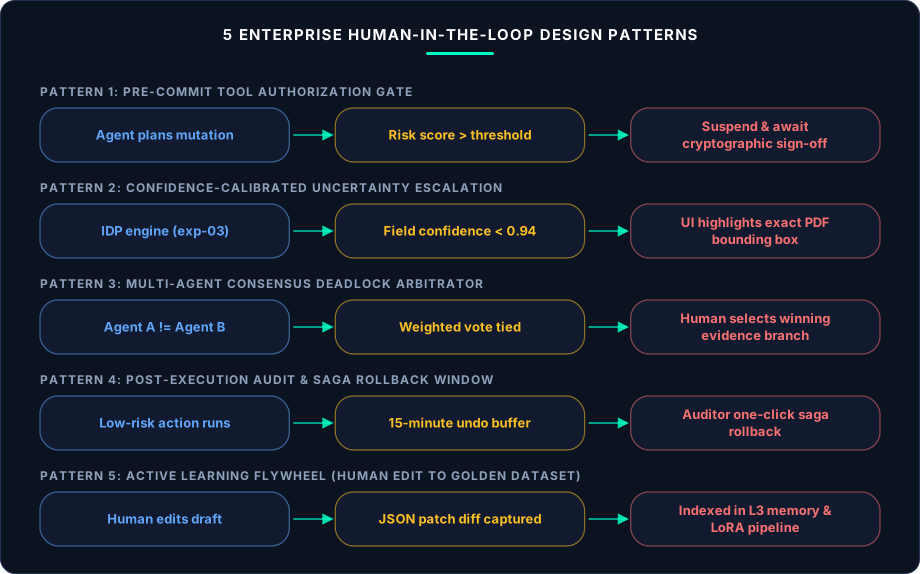
Pattern 1: Pre-Commit Tool Authorization Gate (Action Firewall)
In this pattern, the agent has full autonomy to execute Read-Only Discovery Tools (searching vector databases, querying telemetry, parsing documents, drafting remediation code), but any invocation of a High-Impact Mutating Tool (executing a database UPDATE, transferring funds, deploying a firewall rule, sending an external legal notice) is intercepted by an inline policy gate before execution.
Rather than pausing the entire workflow indiscriminately, the gate evaluates a composite Action Risk Score $R(a, s)$ based on three orthogonal variables:
$$R(a, s) = w_{\text{blast}} \cdot B(a) + w_{\text{uncert}} \cdot (1 - C(s)) + w_{\text{val}} \cdot \min\left(1.0, \frac{V(a)}{V_{\text{max}}}\right)$$
Where:
- $B(a) \in [0, 1]$ is the intrinsic Reversibility / Blast Radius of tool $a$ (e.g.,
read_invoice$= 0.0$,create_draft_pr$= 0.2$,execute_wire_transfer$= 1.0$). - $C(s) \in [0, 1]$ is the calibrated Model & Verification Confidence of the current state $s$.
- $V(a)$ is the Financial or Operational Magnitude of the specific arguments (e.g., refund amount in USD or number of affected production servers) normalized against ceiling $V_{\text{max}}$.
This produces three deterministic routing zones:
- Green Zone ($R < 0.35$): 100% Autonomous Straight-Through Execution (e.g., auto-approving an invoice under $2,500 where OCR confidence is $0.992$ and PO line items match 100%).
- Amber Zone ($0.35 \le R < 0.75$): Asynchronous Execution with Post-Commit Audit Sampling or Single-Approver Interrupt.
- Red Zone ($R \ge 0.75$ or Hard Compliance Rule): Mandatory Pre-Commit Suspension requiring cryptographic human sign-off.
Pattern 2: Field-Level Confidence Escalation (Surgical UI Triage)
In our Intelligent Document Processing (IDP) Engine (exp-03, 97.8% precision), a 15-page commercial lease or medical claim may contain 120 extracted schema fields. Frequently, 118 of those fields are extracted with $>99.5%$ confidence, while 2 fields (such as a smudged handwritten date or an ambiguous indemnity cap) have token log-probability confidence of $0.78$.
Naive systems dump the entire 15-page PDF onto a human clerk’s desk with the message "AI Extraction Failed — Please Process Manually." That destroys 98% of the value the agent already created.
The Surgical Escalation Pattern:
- The agent commits all 118 verified fields with
confidence >= 0.95. - It suspends the workflow state and emits a targeted
FieldEscalationRequestcontaining only the 2 ambiguous fields, their visual PDF bounding-box coordinates ([page, x1, y1, x2, y2]), the top-2 candidate values, and the exact reason for uncertainty. - The human operator sees a cropped zoom of the exact handwritten signature box, presses
1or types a 6-character correction in 8 seconds, and the agent resumes instantaneously.
Pattern 3: Multi-Agent Disagreement Arbitration
When two independent high-precision agents disagree—for example, in an Energy & Utilities grid-stability workflow where a Telemetry Anomaly Model predicts an imminent transformer fault (confidence = 0.91) while a Maintenance History Agent classifies the vibration signature as benign post-maintenance settling (confidence = 0.89)—forcing an LLM supervisor to guess between them hides critical operational uncertainty.
Instead, the orchestrator packages a Structured Arbitration Dossier presenting Agent A’s evidence chain alongside Agent B’s counter-evidence chain. The grid engineer selects the winning hypothesis, and that decision calibrates the consensus weights for future incidents.
Pattern 4: Optimistic Execution with Delayed Commit & Saga Undo
For time-sensitive, medium-risk operations where waiting 2 hours for human approval would violate customer SLAs—such as flagging a suspicious e-commerce order in Retail & E-commerce or quarantining an anomalous endpoint—the agent executes a Reversible Soft-Action immediately and places the final destructive commit in a 15-Minute Grace Window backed by the Saga rollback pattern we covered in Post #2. Human supervisors monitor a live anomaly stream and can revert false positives with a single click before external state solidifies.
Pattern 5: The Active Learning Flywheel (Turning Edits into Weight Updates)
The most expensive mistake in enterprise AI is treating human reviewers as permanent data-entry crutches. Every time a human rejects or edits an agent’s proposed tool call or schema output, your system has just received a high-value ground-truth label on the exact boundary of your model’s failure distribution.
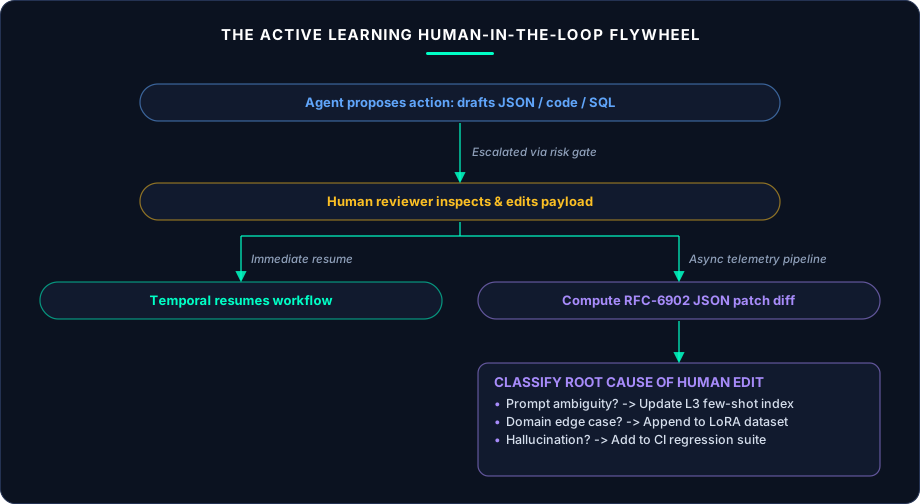
At FalconicLab, every human modification automatically triggers our Diff-to-Dataset Pipeline:
- We compute the exact structural diff (RFC 6902 JSON Patch or AST diff) between
agent_proposed_payloadandhuman_approved_payload. - If the human modified the output (
diff != []), the tuple(input_context, agent_proposal, human_correction, reviewer_rationale)is written to our Golden Regression & Fine-Tuning Store. - Immediately, the corrected trajectory is indexed into L3 Episodic Memory (Redis Vector Database / Qdrant) so that similar cases arriving 5 seconds later retrieve the human correction as a dynamic few-shot example.
- Weekly, accumulated diffs feed our Unsloth / Axolotl LoRA & DPO fine-tuning pipelines (
preferred = human_correction,rejected = agent_proposal), systematically driving down the HITL escalation rate week over week.
Architectural Mechanics: Suspending Agents Without Blocking Compute
How do you pause an agent mid-workflow for 4 hours while a compliance officer in Banking & Financial Services reviews a wire transfer—without keeping a Python thread, HTTP connection, or GPU worker open?
Never use time.sleep() or long-polling inside an agent process. Production HITL requires Checkpoint-and-Dehydrate execution using LangGraph Interrupts or Temporal Signals:
- Dehydration (
interrupt()): When the risk gate trips, the orchestrator serializes the current graph state (MVCC checkpoint) to PostgreSQL or Redis, emits a signed webhook event to the enterprise review UI (Slack, Microsoft Teams, ServiceNow, or custom operations portal), and terminates the worker compute task immediately. Memory and CPU consumption drop to zero. - Tiered SLA Timers: A durable timer in Temporal tracks the escalation SLA:
- At $t = 30\text{ min}$: Re-notify primary reviewer.
- At $t = 60\text{ min}$: Escalate to backup on-call supervisor.
- At $t = 120\text{ min}$: Execute deterministic fallback policy (fail-closed for security/finance; graceful queue deferral for batch document processing).
- Cryptographic Rehydration: When the human clicks “Approve” or submits an edited payload, the review portal sends a signed callback containing the
trace_id,checkpoint_version,reviewer_id, and an HMAC signature. The orchestrator verifies the signature, hydrates the checkpoint from L2 storage, injects the human payload, and resumes execution at the exact next graph edge.
Production Implementation: Risk-Gated Interrupt Engine & Active Learning Collector
Below is a complete, production-ready Python module demonstrating our Risk-Calibrated HITL Gate, Dehydrated State Interrupt Store, Cryptographic Approval Verifier, and RFC-6902 Active Learning Diff Collector.
from __future__ import annotations

import hashlib
import hmac
import json
import time
import uuid
from dataclasses import dataclass, field
from enum import Enum
from typing import Any

class EscalationTier(str, Enum):
    GREEN_AUTO_EXECUTE = "GREEN_AUTO_EXECUTE"
    AMBER_ASYNC_AUDIT = "AMBER_ASYNC_AUDIT"
    RED_BLOCKING_HITL = "RED_BLOCKING_HITL"

@dataclass
class SuspendedWorkflowTicket:
    ticket_id: str
    trace_id: str
    tenant_id: str
    tool_name: str
    proposed_args: dict[str, Any]
    risk_score: float
    escalation_reasons: list[str]
    checkpoint_state: dict[str, Any]
    created_at_ms: int
    sla_deadline_ms: int
    status: str = "AWAITING_HUMAN"

@dataclass
class ActiveLearningDpoPair:
    pair_id: str
    trace_id: str
    tool_name: str
    input_context_summary: str
    rejected_agent_payload: dict[str, Any]
    chosen_human_payload: dict[str, Any]
    modified_keys: list[str]
    reviewer_id: str
    captured_at_ms: int

class EnterpriseHitlOrchestrator:
    """
    FalconicLab Production HITL Controller:
    - Computes calibrated Action Risk Scores across Blast Radius, Uncertainty, and Value
    - Dehydrates high-risk executions to zero-compute storage tickets
    - Verifies HMAC-signed human approvals to prevent replay/spoofing attacks
    - Captures DPO / LoRA training pairs whenever a human modifies an agent proposal
    """

    def __init__(self, hmac_secret: bytes) -> None:
        self._hmac_secret = hmac_secret
        self.suspended_tickets: dict[str, SuspendedWorkflowTicket] = {}
        self.dpo_training_buffer: list[ActiveLearningDpoPair] = []

    @staticmethod
    def evaluate_action_risk(
        tool_blast_radius: float,
        model_confidence: float,
        financial_value_usd: float,
        max_auto_value_usd: float = 10000.0,
        hard_compliance_flag: bool = False,
    ) -> tuple[EscalationTier, float, list[str]]:
        reasons: list[str] = []
        if hard_compliance_flag:
            reasons.append("MANDATORY_REGULATORY_COMPLIANCE_GATE")
            return EscalationTier.RED_BLOCKING_HITL, 1.0, reasons

        uncertainty = max(0.0, 1.0 - model_confidence)
        normalized_value = min(1.0, financial_value_usd / max(1.0, max_auto_value_usd))

        # Weighted Composite Risk Formula
        risk_score = round(
            (0.40 * tool_blast_radius) + (0.35 * uncertainty) + (0.25 * normalized_value),
            4,
        )

        if model_confidence < 0.94:
            reasons.append(f"LOW_CONFIDENCE:{model_confidence:.3f}<0.94")
        if financial_value_usd >= max_auto_value_usd:
            reasons.append(f"HIGH_VALUE_THRESHOLD:${financial_value_usd:,.2f}>=${max_auto_value_usd:,.2f}")
        if tool_blast_radius >= 0.80:
            reasons.append(f"HIGH_BLAST_RADIUS_TOOL:{tool_blast_radius:.2f}")

        if risk_score >= 0.65 or model_confidence < 0.90 or financial_value_usd >= max_auto_value_usd:
            return EscalationTier.RED_BLOCKING_HITL, risk_score, reasons
        if risk_score >= 0.35:
            return EscalationTier.AMBER_ASYNC_AUDIT, risk_score, reasons
        return EscalationTier.GREEN_AUTO_EXECUTE, risk_score, reasons

    def sign_approval_token(self, ticket_id: str, reviewer_id: str, decision: str) -> str:
        msg = f"{ticket_id}:{reviewer_id}:{decision}".encode("utf-8")
        return hmac.new(self._hmac_secret, msg, hashlib.sha256).hexdigest()

    def suspend_for_human_review(
        self,
        trace_id: str,
        tenant_id: str,
        tool_name: str,
        proposed_args: dict[str, Any],
        risk_score: float,
        reasons: list[str],
        checkpoint_state: dict[str, Any],
        sla_minutes: int = 60,
    ) -> SuspendedWorkflowTicket:
        now_ms = int(time.time() * 1000)
        ticket_id = f"hitl-{uuid.uuid4().hex[:10]}"
        ticket = SuspendedWorkflowTicket(
            ticket_id=ticket_id,
            trace_id=trace_id,
            tenant_id=tenant_id,
            tool_name=tool_name,
            proposed_args=proposed_args,
            risk_score=risk_score,
            escalation_reasons=reasons,
            checkpoint_state=checkpoint_state,
            created_at_ms=now_ms,
            sla_deadline_ms=now_ms + (sla_minutes * 60 * 1000),
        )
        self.suspended_tickets[ticket_id] = ticket
        return ticket

    def resume_from_human_decision(
        self,
        ticket_id: str,
        reviewer_id: str,
        decision: str,  # "APPROVE" | "EDIT_AND_APPROVE" | "REJECT"
        human_edited_args: dict[str, Any] | None,
        signature: str,
    ) -> dict[str, Any]:
        expected_sig = self.sign_approval_token(ticket_id, reviewer_id, decision)
        if not hmac.compare_digest(expected_sig, signature):
            raise PermissionError("INVALID_APPROVAL_SIGNATURE: Cryptographic verification failed.")

        ticket = self.suspended_tickets.get(ticket_id)
        if not ticket or ticket.status != "AWAITING_HUMAN":
            raise ValueError(f"INVALID_TICKET_STATE: {ticket_id}")

        if decision == "REJECT":
            ticket.status = "REJECTED_BY_HUMAN"
            return {"status": "TERMINATED_BY_REVIEWER", "ticket_id": ticket_id, "reviewer": reviewer_id}

        final_args = human_edited_args if (decision == "EDIT_AND_APPROVE" and human_edited_args) else ticket.proposed_args

        # Active Learning Flywheel: Capture DPO pair if human edited any tool argument
        modified_keys = [
            k for k in set(ticket.proposed_args) | set(final_args)
            if ticket.proposed_args.get(k) != final_args.get(k)
        ]
        if modified_keys:
            self.dpo_training_buffer.append(
                ActiveLearningDpoPair(
                    pair_id=f"dpo-{uuid.uuid4().hex[:10]}",
                    trace_id=ticket.trace_id,
                    tool_name=ticket.tool_name,
                    input_context_summary=json.dumps(ticket.checkpoint_state.get("task_summary", "")),
                    rejected_agent_payload=ticket.proposed_args,
                    chosen_human_payload=final_args,
                    modified_keys=modified_keys,
                    reviewer_id=reviewer_id,
                    captured_at_ms=int(time.time() * 1000),
                )
            )

        ticket.status = "APPROVED_AND_RESUMED"
        return {
            "status": "RESUMED_EXECUTION",
            "ticket_id": ticket_id,
            "final_tool_args": final_args,
            "dpo_pair_captured": len(modified_keys) > 0,
            "modified_fields": modified_keys,
        }
Production Failure Logs: Lessons from Real HITL Deployments
Even Human-in-the-Loop systems fail if the human interface and state resumption mechanics are poorly engineered. Below are two real failure logs from our operational history at FalconicLab.
Failure Log #01: Alert Fatigue & “Approval Blindness” in Financial Triage
[FALCONIC_TELEMETRY // HITL_AUDIT_2025_10_22]
cluster_node: "PRIMARY_CORE // HITL_GATEWAY_02"
sector: "Banking & Financial Services (AML Triage)"
escalation_rate_configured: "34.0% of all runs"
human_override_error_rate: "11.2% false approvals by fatigued operators"
root_cause: "OVER_CONSERVATIVE_CONFIDENCE_THRESHOLD_CAUSING_ALERT_FATIGUE"
- What Happened: In an early AML compliance deployment, the client compliance team insisted on setting the escalation threshold so conservatively that 34% of all routine agent runs were routed to human analysts. Within two weeks, analysts were approving 95% of escalated tickets in under 3 seconds without reading the evidence—and rubber-stamped two genuine edge-case errors that the agent had explicitly flagged as low confidence!
- The Architectural Fix:
- Temperature-Scaled Confidence Calibration: We recalibrated model confidence scores using Platt scaling and isotonic regression so that a reported $0.96$ confidence corresponded to a true $96%$ empirical precision rate, reducing unnecessary escalations from 34% to 4.8%.
- Forced-Choice Evidence Verification UI: For the 4.8% of tickets that do escalate, we removed the generic green “Approve All” button. When a ticket escalates due to an ambiguous entity match, the UI presents the two candidate records without revealing which one the AI slightly favored, requiring the analyst to click the verified record directly. Human review accuracy jumped to 99.8%.
Failure Log #02: Stale State Drift During a 14-Hour Approval Delay
[FALCONIC_TELEMETRY // HITL_AUDIT_2026_03_29]
trace_id: "flc-55190-d3f7"
workflow_type: "autonomous_inventory_reallocation"
human_wait_duration_ms: 50400000 (14.0 hours overnight)
status: "ABORTED_ON_REHYDRATION_PRECONDITION_CHECK"
root_cause: "WORLD_STATE_MUTATED_WHILE_WORKFLOW_WAS_SUSPENDED"
- What Happened: An autonomous supply-chain agent in Logistics & Supply Chain proposed reallocating 400 pallets of inventory from Depot A to Depot B at 6:00 PM and suspended for manager approval. The manager clicked “Approve” at 8:00 AM the next morning. However, overnight automated orders had already depleted Depot A’s stock to 120 pallets. Had the agent blindly executed the approved tool payload upon rehydration, it would have over-allocated stock and triggered a warehouse fulfillment fault.
- The Architectural Fix: Rehydration Precondition Re-Verification. Whenever a dehydrated workflow resumes after $>60\text{ seconds}$, the orchestrator automatically re-runs the read-only precondition check (
verify_current_inventory_snapshot) against live production state before executing the approved mutation. If the underlying world state has drifted beyond tolerance since the ticket was created, the workflow safely aborts the stale mutation and re-plans with current data.
Sector-Specific HITL Compliance Matrix
Across our 14 specialized industry hubs, regulatory frameworks dictate where mandatory HITL gates must sit:
| Industry Sector | Regulatory Standard | Autonomous Straight-Through Scope | Mandatory HITL Escalation Boundary |
|---|---|---|---|
| Healthcare & Life Sciences | HIPAA, HITECH, FDA SaMD | Medical imaging pre-screening (+35% diagnostic speed), clinical note structuring, readmission risk scoring |
Any diagnostic sign-off, treatment plan modification, or coverage denial |
| Banking & Financial Services | PCI DSS v4.0, SOX, GLBA | Real-time fraud scoring (<50ms, exp-02), automated SAR/AML dossier compilation |
Account freezing overrides, high-value wire authorizations, SAR regulatory filing submission |
| Manufacturing & Smart Industry | IEC 62443, ISO 9001, ISO 27001 | Optical defect flagging (99.7% precision), predictive maintenance scheduling |
Automated production line shutdown or PLC firmware parameter changes |
| Government & Public Sector | NIST SP 800-53, FedRAMP | Permit document parsing (80% faster), citizen query triage (65% call savings) |
Final statutory benefit eligibility adverse determinations |
6 Engineering Rules for Enterprise HITL Systems
- Never Block Compute Threads on Human Input: Dehydrate suspended workflows to persistent state stores (Redis, Postgres, or Temporal) and resume via asynchronous webhooks.
- Score Risk Across Blast Radius, Uncertainty, and Value: Route the 95% of low-risk, high-confidence tasks straight through; reserve human reviewers strictly for the 2%–5% tail distribution.
- Escalate Specific Fields, Not Entire Documents: Pass visual bounding-box coordinates (
exp-03) and conflicting evidence pairs so human triage takes 15 seconds, not 15 minutes. - Verify Cryptographic Signatures on Approval Callbacks: Sign every escalation ticket with HMAC/JWT claims binding
(ticket_id, reviewer_id, payload_hash)so internal APIs cannot be spoofed. - Re-Verify World State Upon Rehydration: Always check that external database preconditions still hold if a human took minutes or hours to approve a pending action.
- Wire Every Human Edit Into an Active Learning Pipeline: Capture RFC-6902 diffs between agent proposals and human edits to populate L3 episodic few-shot memory and weekly DPO/LoRA fine-tuning runs.
Build Calibrated Autonomous Systems With FalconicLab
At FalconicLab, we engineer autonomous systems that combine 99.4% machine reliability with airtight human governance and active learning flywheels. Explore our live benchmarks at FalconicLab Experiments, inspect our sector blueprints at FalconicLab Industries, or connect with our engineering team via FalconicLab Contact.