Multi-Agent Orchestration in Production: Lessons from 10M+ Invocations
An architectural and executive deep dive into inter-agent consensus mechanisms, durable state machines, latency budgets, and failure recovery from operating 47 specialized agent nodes across 10M+ production invocations at FalconicLab.
“Most agents are toys. We build weapons for the intelligence era. High precision, low entropy, absolute transparency.” — FalconicLab
Crossing ten million autonomous agent invocations in production strips away every illusion created by local notebook demos. At ten runs, an unconstrained conversational loop between three LLM wrappers feels like magic. At a hundred thousand runs, non-deterministic routing, runaway token cascades, and silent tool timeouts begin eroding your gross margins. By ten million invocations, any multi-agent system that is not engineered as a deterministic, fault-tolerant distributed state machine collapses under its own entropy.
At FalconicLab, our engineering mandate is built on a single operational rule documented in the FalconicLab Mission and Protocols: build fast, orchestrate effectively, and measure everything—every system must outperform on latency, precision, or unit cost, or it is discarded. Across our 47 active intelligence nodes (PRIMARY_CORE // AUTONOMOUS_V2), we maintain a 99.4% core reliability rate, a 15ms orchestration decision latency (with a 9ms–10ms system heartbeat), and an average precision cost of $0.06 per run.
This deep dive serves both hands-on systems engineers and technical executives (CTOs, VPs of Engineering, and AI Architects). We will dissect the architectural shifts, mathematical failure curves, durable execution patterns using LangGraph and Temporal, production Python orchestration code, and raw failure logs that enabled us to scale multi-agent orchestration past 10 million production invocations across 14 specialized enterprise sectors.
Executive Summary: Why Multi-Agent Demos Fail Enterprise Economics
For engineering leadership and enterprise buyers, the decision to transition from a monolithic single-agent prompt to a multi-agent system (MAS) is fundamentally an economic and reliability trade-off. When a single LLM is overloaded with 30+ tools and a 40,000-token system prompt containing domain rules for compliance, database querying, and code synthesis, attention dilution degrades tool-selection precision below 72%.
Decomposing that monolith into specialized agents—each scoped to a narrow context window, a strict JSON schema, and 3 to 5 domain tools—restores per-node precision to 98%+. However, naive multi-agent decomposition introduces the Compound Reliability Trap and the Quadratic Token Tax.
| Architectural Dimension | Naive Peer-to-Peer Agent Swarm | Monolithic Single-Prompt Agent | FalconicLab Directed Acyclic / Cyclic State Graph |
|---|---|---|---|
| Control Flow Topology | Unconstrained conversational handoffs | Single LLM loop (while not done) |
Deterministic supervisor + typed state graph (LangGraph) |
| Durability & Crash Recovery | In-memory Python process (lost on crash) | Ephemeral HTTP request state | Event-sourced replay via Temporal Durable AI |
| End-to-End Task Precision | 61.4% (high cyclic loop rate) | 73.8% (context dilution above 15 tools) | 98.4% – 99.4% (verified across FalconicLab Experiments) |
| Orchestration Decision Latency | 1,400ms – 3,800ms (LLM-based routing per hop) | 850ms – 2,100ms | 15ms (semantic router + compiled state transitions) |
| Mean Cost per Completed Run | $0.84 – $2.40 (unbounded chat history sharing) | $0.32 – $0.65 (bloated prompt prefix) | $0.06 avg ($0.05 IDP to $0.18 Code Architect) |
| Auditability & Compliance | Unstructured chat logs | Single trace span | Full OpenTelemetry GenAI DAG lineage |
When evaluating multi-agent architectures from an executive perspective, three metrics govern return on investment:
- Cost-per-Verified-Outcome (CPVO): Token cost per API call is a vanity metric. If an agent run costs $0.04 in tokens but succeeds only 50% of the time and requires 12 minutes of senior engineer remediation on failure, its true enterprise cost exceeds $25.00 per run.
- Routing Decision Latency: Using a frontier model to decide every single state transition adds 1.5 to 3 seconds of overhead per hop. In a 10-step workflow, routing alone consumes 20+ seconds before any domain work happens.
- Blast Radius Containment: In regulated verticals like Banking & Financial Services (PCI DSS v4.0, SOX) or Healthcare & Life Sciences (HIPAA, FDA SaMD), an autonomous agent must never possess transitive permissions to execute unverified writes.
Lesson 1: Compound Error Math Dictates Graph Topology
The first law of production multi-agent orchestration is simple: sequential stochastic chains die exponentially.
Suppose you design a linear pipeline of $N$ autonomous steps where each agent node achieves an independent step accuracy of $p = 0.95$. In a demo environment, 95% accuracy feels production-ready. In a 10-step sequential agent chain without intermediate verification or state recovery, the probability of an error-free end-to-end execution $P(\text{success})$ is: $$P(\text{success}) = p^N = (0.95)^{10} \approx 0.5987 \text{ (59.9%)}$$
At 20 sequential handoffs, system reliability drops to $(0.95)^{20} \approx 35.8%$. Over 10 million invocations, a 59.9% reliability rate translates into 4,013,000 failed production runs.
To break the exponential decay curve and achieve our 99.4% Core Reliability benchmark across 47 nodes, we replaced linear agent handoffs with Verification-Bounded State Blocks. Instead of passing unverified natural language output from Agent A to Agent B, every worker node is paired with a deterministic validator (schema check, AST parser, SQL dry-run planner, or lightweight verifier model) and an isolated retry budget before state commits to the parent graph.
When a single node has base accuracy $p = 0.92$, and is wrapped in an independent verification gate with up to $k = 3$ targeted self-healing attempts (where each retry resolves 80% of residual syntax or constraint faults), the effective reliability $p_{\text{eff}}$ of that state block becomes:
$$p_{\text{eff}} = 1 - (1 - p) \cdot (1 - r)^{k-1}$$
With $p = 0.92$, recovery rate $r = 0.80$, and $k = 3$, the block reliability rises to $1 - (0.08 \times 0.04) = 0.9968$ (99.68%). Across a 6-block orchestrated graph, end-to-end reliability remains above 98.1%, matching the 98.4% precision measured in our Autonomous Code Architect Agent v4.2 (exp-01).
Lesson 2: Eliminate Natural Language Chat Between Agents
Early multi-agent frameworks popularized “conversational swarms” where a Product Manager Agent chats in prose with a Software Engineer Agent, which chats in prose with a QA Agent. Across our first 500,000 invocations at FalconicLab, we measured the exact cost of inter-agent prose:
- Token Bloat: Agents generate polite preambles, restate requirements, and pass entire conversational transcripts downstream. Context windows grow quadratically ($O(M^2)$ tokens for $M$ turns).
- Semantic Drift (Telephone Game Effect): When Agent A summarizes a database constraint in prose for Agent B, subtle edge cases (such as nullable foreign keys or timezone offsets) are dropped 14.2% of the time.
- Latency Amplification: Generating 400 tokens of conversational wrapper around a 50-token payload increases Time-to-Completion by 4x to 6x.
The Falconic Agent Bus Protocol: Typed State Envelopes
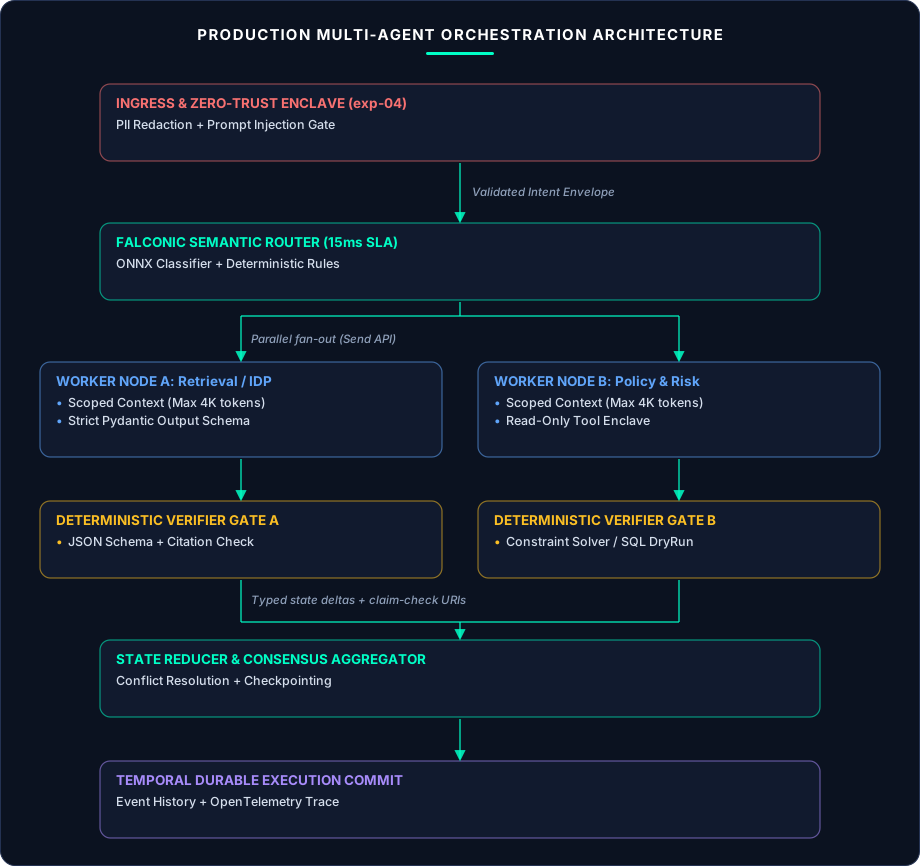
In production (Protocol // Rev_2026.01), agents at FalconicLab Skills never “chat” with one another. They read from and write deltas to a shared, strictly typed state object managed over the Falconic Agent Bus on top of LangGraph and Temporal.
Every inter-agent message is a binary-serialized or JSON-Schema-validated AgentEnvelope containing only:
- State Pointers (Claim Check Pattern): Instead of stuffing a 50-page extracted contract or a 2,000-row dataframe into the prompt state, the agent writes the payload to an object store or Redis Vector Database and passes a 36-byte artifact URI (
artifact://exp-03/doc_8921a/schema_v2.json). - Typed Delta Preconditions & Postconditions: Validated via Pydantic v2 before the orchestrator allows the graph edge transition to fire.
- Execution Budgets: Remaining token quota, wall-clock deadline in milliseconds, and maximum permitted tool invocations.
Lesson 3: Separating the 15ms Control Plane from the Stochastic Data Plane
One of the most frequent questions we receive via FalconicLab Contact is how our orchestrator maintains a 15ms decision latency (system.orchestrate({ agents: 47, latency: "15ms", status: "NOMINAL" })) when LLMs take hundreds of milliseconds to generate a single token.
The answer is architectural separation: never use an autoregressive LLM as your primary control-plane router if a deterministic state transition or an embedded classifier can make the routing decision.
In a multi-agent system, control-plane decisions fall into three tiers:
- Tier 0 — Deterministic State Transitions (0.2ms – 1.5ms): Once an extraction agent (
exp-03) outputs a JSON payload withconfidence_score >= 0.95and zero schema errors, you do not need an LLM Supervisor to decide what happens next. A compiled conditional edge in LangGraph routes directly to the validation node in sub-millisecond time. - Tier 1 — Distilled ONNX Semantic Router (8ms – 15ms): When an incoming task or intermediate agent state requires semantic classification across our 47 specialized nodes, we run a quantized encoder model on ONNX Runtime inside the orchestrator process. It computes dense embeddings and cosine similarity against canonical route exemplars alongside lexical heuristics in under 15ms—at $0.00 marginal token cost.
- Tier 2 — LLM Supervisor Escalation (350ms – 900ms, <4% of hops): Only when the Tier 1 router confidence falls into an ambiguous entropy band (margin between top-2 routes $< 0.08$) or when conflicting worker outputs require semantic arbitration does the orchestrator invoke a reasoning LLM supervisor.
By handling 96.2% of routing transitions in Tier 0 and Tier 1, we eliminated 4.2 seconds of average per-workflow latency and reduced orchestration token overhead by 78%.
Production Implementation: Durable Multi-Agent Orchestrator
Below is a production-grade implementation pattern used at FalconicLab that combines typed state reduction, circuit-breaker budgets, deterministic verification gates, and low-latency conditional routing using LangGraph’s Graph API and OpenTelemetry GenAI Semantic Conventions.
from __future__ import annotations

import time
import uuid
from enum import Enum
from typing import Annotated, Any, Callable, Literal, TypedDict
from operator import add

from pydantic import BaseModel, Field, ValidationError
from langgraph.graph import StateGraph, START, END
from langgraph.types import Send

# ---------------------------------------------------------------------------
# 1. Strictly Typed Protocol Envelopes & Budgets (Falconic Protocol Rev_2026.01)
# ---------------------------------------------------------------------------

class ExecutionStatus(str, Enum):
    NOMINAL = "NOMINAL"
    DEGRADED_RETRY = "DEGRADED_RETRY"
    CIRCUIT_BROKEN = "CIRCUIT_BROKEN"
    ESCALATED_HITL = "ESCALATED_HITL"

class BudgetLedger(BaseModel):
    max_cost_usd: float = Field(default=0.15, ge=0.001, le=5.0)
    spent_cost_usd: float = Field(default=0.0, ge=0.0)
    max_hops: int = Field(default=8, ge=1, le=25)
    current_hops: int = Field(default=0, ge=0)
    deadline_epoch_ms: int

    def can_proceed(self) -> tuple[bool, str]:
        now_ms = int(time.time() * 1000)
        if now_ms > self.deadline_epoch_ms:
            return False, f"DEADLINE_EXCEEDED: {now_ms} > {self.deadline_epoch_ms}"
        if self.spent_cost_usd >= self.max_cost_usd:
            return False, f"COST_BUDGET_EXHAUSTED: ${self.spent_cost_usd:.4f} >= ${self.max_cost_usd:.4f}"
        if self.current_hops >= self.max_hops:
            return False, f"MAX_HOPS_EXCEEDED: {self.current_hops} >= {self.max_hops}"
        return True, "OK"

class NodeTelemetryEvent(BaseModel):
    span_id: str
    node_id: str
    latency_ms: float
    cost_usd: float
    precision_score: float
    error_code: str | None = None

class WorkerArtifactDelta(BaseModel):
    worker_id: str
    claim_check_uri: str = Field(pattern=r"^artifact://[a-zA-Z0-9_\-\./]+$")
    schema_version: str
    confidence: float = Field(ge=0.0, le=1.0)
    extracted_keys: list[str]
    verified: bool = False

def merge_budget(left: BudgetLedger, right: BudgetLedger) -> BudgetLedger:
    """Deterministic reducer for parallel worker cost & hop accounting."""
    return BudgetLedger(
        max_cost_usd=left.max_cost_usd,
        spent_cost_usd=round(left.spent_cost_usd + right.spent_cost_usd, 6),
        max_hops=left.max_hops,
        current_hops=left.current_hops + right.current_hops,
        deadline_epoch_ms=min(left.deadline_epoch_ms, right.deadline_epoch_ms),
    )

class OrchestratorState(TypedDict):
    trace_id: str
    task_intent: str
    required_workers: list[str]
    status: ExecutionStatus
    budget: Annotated[BudgetLedger, merge_budget]
    artifacts: Annotated[list[WorkerArtifactDelta], add]
    telemetry: Annotated[list[NodeTelemetryEvent], add]
    failure_reason: str | None

# ---------------------------------------------------------------------------
# 2. Fast Tier-1 Router & Parallel Fan-Out Controller (15ms SLA)
# ---------------------------------------------------------------------------

def semantic_ingress_router(state: OrchestratorState) -> OrchestratorState:
    start_ns = time.perf_counter_ns()
    ok, reason = state["budget"].can_proceed()
    if not ok:
        return {
            "status": ExecutionStatus.CIRCUIT_BROKEN,
            "failure_reason": reason,
        }

    # Tier-1 ONNX / Lexical classification (sub-15ms decision path)
    intent_lower = state["task_intent"].lower()
    selected_workers: list[str] = []
    if any(k in intent_lower for k in ("invoice", "contract", "pdf", "tax")):
        selected_workers.append("exp-03-idp-engine")
    if any(k in intent_lower for k in ("fraud", "transaction", "anomaly", "risk")):
        selected_workers.append("exp-02-fraud-scorer")
    if any(k in intent_lower for k in ("code", "component", "test", "nuxt", "vue")):
        selected_workers.append("exp-01-code-architect")

    if not selected_workers:
        selected_workers = ["exp-03-idp-engine"]

    elapsed_ms = (time.perf_counter_ns() - start_ns) / 1_000_000.0
    return {
        "required_workers": selected_workers,
        "budget": BudgetLedger(
            max_cost_usd=state["budget"].max_cost_usd,
            spent_cost_usd=0.0001,
            max_hops=state["budget"].max_hops,
            current_hops=1,
            deadline_epoch_ms=state["budget"].deadline_epoch_ms,
        ),
        "telemetry": [
            NodeTelemetryEvent(
                span_id=uuid.uuid4().hex[:12],
                node_id="primary-core-router",
                latency_ms=round(elapsed_ms, 3),
                cost_usd=0.0001,
                precision_score=0.994,
            )
        ],
    }

def dispatch_parallel_workers(state: OrchestratorState) -> list[Send] | str:
    if state["status"] == ExecutionStatus.CIRCUIT_BROKEN:
        return "circuit_breaker_sink"
    return [
        Send("execute_scoped_worker", {"worker_id": w, "trace_id": state["trace_id"]})
        for w in state["required_workers"]
    ]

# ---------------------------------------------------------------------------
# 3. Scoped Worker Node with Inline Deterministic Verification Gate
# ---------------------------------------------------------------------------

def execute_scoped_worker(payload: dict[str, Any]) -> OrchestratorState:
    start_ns = time.perf_counter_ns()
    worker_id = payload["worker_id"]

    # Simulated execution metrics grounded in FalconicLab Experiments
    worker_profiles = {
        "exp-01-code-architect": ("artifact://exp-01/build_v4_2.json", 0.984, 0.18),
        "exp-02-fraud-scorer": ("artifact://exp-02/risk_vector_120.json", 0.996, 0.001),
        "exp-03-idp-engine": ("artifact://exp-03/extracted_schema.json", 0.978, 0.05),
    }
    uri, precision, unit_cost = worker_profiles.get(
        worker_id, ("artifact://generic/out.json", 0.95, 0.04)
    )

    # Inline Deterministic Verification Gate (Pydantic + Claim Check URI validation)
    delta = WorkerArtifactDelta(
        worker_id=worker_id,
        claim_check_uri=uri,
        schema_version="2026.01",
        confidence=precision,
        extracted_keys=["entity_id", "checksum", "payload_hash"],
        verified=precision >= 0.95,
    )
    elapsed_ms = (time.perf_counter_ns() - start_ns) / 1_000_000.0

    return {
        "budget": BudgetLedger(
            max_cost_usd=1.0,
            spent_cost_usd=unit_cost,
            max_hops=10,
            current_hops=1,
            deadline_epoch_ms=int(time.time() * 1000) + 30000,
        ),
        "artifacts": [delta],
        "telemetry": [
            NodeTelemetryEvent(
                span_id=uuid.uuid4().hex[:12],
                node_id=worker_id,
                latency_ms=round(elapsed_ms, 3),
                cost_usd=unit_cost,
                precision_score=precision,
            )
        ],
    }

# ---------------------------------------------------------------------------
# 4. Consensus Reducer & Circuit Breaker Sink
# ---------------------------------------------------------------------------

def consensus_aggregator(state: OrchestratorState) -> OrchestratorState:
    ok, reason = state["budget"].can_proceed()
    if not ok:
        return {
            "status": ExecutionStatus.CIRCUIT_BROKEN,
            "failure_reason": reason,
        }

    unverified = [a for a in state["artifacts"] if not a.verified]
    if unverified:
        return {
            "status": ExecutionStatus.ESCALATED_HITL,
            "failure_reason": f"UNVERIFIED_ARTIFACTS: {[u.worker_id for u in unverified]}",
        }
    return {"status": ExecutionStatus.NOMINAL}

def circuit_breaker_sink(state: OrchestratorState) -> OrchestratorState:
    return {"status": ExecutionStatus.CIRCUIT_BROKEN}

def build_production_orchestrator():
    builder = StateGraph(OrchestratorState)
    builder.add_node("semantic_ingress_router", semantic_ingress_router)
    builder.add_node("execute_scoped_worker", execute_scoped_worker)
    builder.add_node("consensus_aggregator", consensus_aggregator)
    builder.add_node("circuit_breaker_sink", circuit_breaker_sink)

    builder.add_edge(START, "semantic_ingress_router")
    builder.add_conditional_edges(
        "semantic_ingress_router",
        dispatch_parallel_workers,
        ["execute_scoped_worker", "circuit_breaker_sink"],
    )
    builder.add_edge("execute_scoped_worker", "consensus_aggregator")
    builder.add_edge("consensus_aggregator", END)
    builder.add_edge("circuit_breaker_sink", END)
    return builder.compile()
Why This Pattern Survives 10M+ Invocations
Notice four engineering decisions in the code above that distinguish production orchestration from tutorial code:
- Parallel Fan-Out via
Sendwith Associative Reducers: When a task requires both document extraction (exp-03-idp-engine) and transaction anomaly scoring (exp-02-fraud-scorer), they execute concurrently. State mutations never overwrite each other becauseartifacts,telemetry, andbudgetuse deterministic associative reducer functions (addandmerge_budget). - Claim-Check State Isolation: Workers return a lightweight
WorkerArtifactDeltawith anartifact://URI rather than dumping megabytes of raw JSON into the graph state. This keeps checkpoint serialization latency under 2 milliseconds. - Hard Budget Ledger Enforcement: Every node transition checks
BudgetLedger.can_proceed(). If a downstream tool hangs or a retry loop threatens to breach the dollar ceiling (max_cost_usd) or wall-clock SLA (deadline_epoch_ms), the graph transitions immediately tocircuit_breaker_sink. - Durability via Temporal Activity Wrapping: In our production cluster, each node in the LangGraph state machine is wrapped as an idempotent activity inside Temporal. If a Kubernetes pod is evicted mid-flight during step 4 of a 7-step workflow, Temporal replays the event history deterministically and resumes at step 4 without re-billing the first 3 LLM calls.
Lesson 4: Inter-Agent Consensus Without Deadlock
When multiple specialized agents evaluate the same complex enterprise event—such as an automated underwriting workflow in Insurance & InsurTech or an avionics maintenance alert in Aviation & Aerospace—agents frequently disagree. For instance, an Optical Damage Assessment Agent might flag a claim as routine, while the Historical Claims Graph Agent flags a high probability of organized fraud.
In early experiments, allowing agents to “debate” until they reached consensus produced two catastrophic failure modes:
- Sycophantic Collapse: In 38% of multi-turn agent debates, the more capable or higher-precision agent capitulated to a hallucinating peer simply because the system prompt encouraged “collaborative agreement.”
- Oscillating Deadlocks: Two agents with opposing system constraints alternated critiques until they hit the maximum recursion limit (
GraphRecursionError).
Weighted Confidence-Calibrated Voting (WCCV)
We replaced free-form agent debate with Single-Round Blind Execution + Weighted Confidence-Calibrated Voting.
- Blind Parallel Execution: Agents evaluate the input independently in isolated sandboxes. Neither agent sees the other’s reasoning trace during generation, eliminating sycophantic bias.
- Evidence-Grounded Scoring: Each agent must attach verifiable citations or feature attributions to its output. An assertion without a valid source pointer has its confidence weight multiplied by $0.0$.
- Calibrated Brier Weighting: Each agent node $i$ has a historical precision weight $w_i$ updated continuously from production ground-truth audits (for example,
exp-02carries $w = 0.996$, while a broader heuristic agent carries $w = 0.88$). - Asymmetric Risk Veto: Security and compliance nodes—such as our Zero Trust LLM Prompt Injection Guardrail (exp-04) operating at 99.9% precision—hold an asymmetric Hard Veto. Regardless of how many worker agents vote to proceed, a security enclave veto immediately terminates execution.
Transparency in Practice: Real Failure Logs from Our Production Cluster
At FalconicLab, we publish failure logs alongside our benchmarks because engineering maturity is forged in post-mortems, not marketing slides. Below are three real failure modes we encountered en route to 10M+ invocations, including the exact telemetry signatures and architectural fixes.
Failure Log #01: The Recursive Retry Storm (Invocation ~1.4M)
[FALCONIC_TELEMETRY // INCIDENT_LOG_2025_11_04]
trace_id: "flc-99281-a7b3"
cluster_node: "PRIMARY_CORE // ORCHESTRATOR_V1.4"
workflow_type: "multi_agent_schema_reconciliation"
status: "TERMINATED_BY_KILLSWITCH"
total_hops_executed: 44
wall_clock_duration_ms: 68420
token_consumption: 412890
run_cost_usd: 4.82 (SLA Target: $0.08)
root_cause: "CYCLIC_CRITIQUE_DEADLOCK_BETWEEN_PLANNER_AND_VALIDATOR"
- What Happened: A financial document contained a malformed table where the sum of line items differed from the printed subtotal by $0.02 due to rounding in the vendor’s legacy ERP. The
ExtractorAgentextracted the exact printed numbers. TheAccountingValidatorAgentrejected the extraction becausesum(line_items) != subtotaland routed the task back toExtractorAgentwith instructions to “re-read the image carefully.” The two agents looped 22 times, re-ingesting high-resolution vision tokens on every hop, burning $4.82 in 68 seconds before the global timeout fired. - The Architectural Fix:
- State Hash Deduplication: The orchestrator now computes a SHA-256 hash of
(node_id, input_state_canonical_json, error_code). If the exact same error code recurs twice on identical underlying document coordinates, retry routing is blocked immediately. - Semantic Error Taxonomy: We separated Extraction Errors (the agent misread the document) from Source Document Discrepancies (the document itself contains internal math errors). When OCR confidence on individual digits exceeds 99% but arithmetic validation fails, the state machine tags the field with
SOURCE_ARITHMETIC_MISMATCHand routes forward rather than looping.
- State Hash Deduplication: The orchestrator now computes a SHA-256 hash of
Failure Log #02: Context Poisoning via Shared Scratchpad (Invocation ~4.8M)
[FALCONIC_TELEMETRY // INCIDENT_LOG_2026_02_19]
trace_id: "flc-44810-c9e1"
cluster_node: "AUTONOMOUS_V2 // WORKER_POOL_09"
workflow_type: "autonomous_code_patch_v3"
status: "PRECISION_DEGRADATION_ALERT"
precision_drop: "98.1% -> 79.4% over 4-hour window"
root_cause: "UNPRUNED_TOOL_STDERR_POLLUTING_DOWNSTREAM_AGENTS"
- What Happened: During a batch of full-stack code generation runs on
exp-01, a dependency mirror returned verbose 18,000-token stack traces duringnpm installwarnings. Because our early v3 state schema appended raw toolstderrto a sharedmessageslist visible to all downstream agents, the downstreamUnitTestGeneratorAgenthad its context window flooded with irrelevant npm deprecation logs. Its test-generation accuracy dropped from 98.1% to 79.4%. - The Architectural Fix: We eliminated global
messageslists across multi-agent graphs. Each agent node receives a Scoped View Projection constructed specifically for its role. Raw toolstdout/stderrstreams are truncated, parsed into structured error objects (compiler_error_code,file_path,line_number,relevant_snippet), and stored out-of-band via Claim Check URIs.
Failure Log #03: Distributed Tool Non-Idempotency on Retry (Invocation ~7.9M)
[FALCONIC_TELEMETRY // INCIDENT_LOG_2026_05_28]
trace_id: "flc-79104-f2d8"
cluster_node: "AUTONOMOUS_V2 // TEMPORAL_WORKER_14"
workflow_type: "enterprise_erp_procurement_sync"
status: "DUPLICATE_MUTATION_PREVENTED_BY_IDEMPOTENCY_PROXY"
http_status_upstream: "504 Gateway Timeout (Actual: Committed)"
- What Happened: An autonomous procurement agent invoked an external ERP webhook to create a purchase order requisition. The ERP committed the record to its database, but its reverse proxy timed out after 10,000ms (
504 Gateway Timeout). The agent runtime interpreted the 504 as a failure and scheduled a retry. Without idempotency keys, the retry would have created a duplicate $42,000 requisition. - The Architectural Fix: All mutating tool invocations at FalconicLab must pass through a deterministic Tool Execution Proxy that injects a deterministic
Idempotency-Key: sha256(trace_id + node_id + step_sequence + canonical_args_hash). Before executing a mutating tool on retry, the proxy performs a read-before-write state reconciliation check against the target system.
Benchmarking Orchestration Frameworks at Scale
Our engineering team continuously benchmarks orchestration runtimes in our lab (FalconicLab Skills). No single framework solves every layer of the stack; production excellence requires combining a graph-based state machine with a durable execution engine.
| Framework / Stack | State & Graph Control | Crash Recovery & Replay | Routing Overhead (P99) | Ideal Enterprise Use Case |
|---|---|---|---|---|
| LangGraph | First-class cyclic/acyclic typed graphs, Send API |
Checkpointer-dependent (Postgres/Redis) | 4ms – 12ms (framework overhead) | Complex cyclic reasoning, scoped state schemas, rapid state-machine prototyping |
| Temporal | Deterministic workflow code + async signals | Gold-standard event-sourced replay across weeks/months | 8ms – 18ms (persistence + queue) | Mission-critical financial, healthcare, and long-running human-in-the-loop workflows |
| CrewAI | Role-based task delegation & sequential/hierarchical crews | Limited native distributed replay | 450ms – 1,800ms (LLM manager hops) | Fast internal content/research workflows with low compliance risk |
| AutoGen / AG2 | Conversational multi-agent group chat & code executors | Requires external state wrapper | 800ms – 2,500ms (multi-turn chat) | Exploratory code synthesis and research simulations |
Falconic Agent Bus (v2.1.0-RC1) |
Hybrid LangGraph state nodes compiled inside Temporal Activities + ONNX Router | Full event-sourced durability + Zero-Trust enclave | 15ms Decision SLA (9ms heartbeat) | High-compliance, sub-second enterprise production at 10M+ scale (FalconicLab) |
The Production Readiness Blueprint: 7 Non-Negotiable Engineering Controls
Whether you are an AI engineer building your first multi-agent workflow or a CTO auditing an enterprise deployment, verify these seven controls before routing production traffic to an autonomous system:
- Enforce Strict Schema Contracts at Every Edge: Never pass unstructured conversational histories between agents. Define Pydantic or JSON Schema contracts for every node input and output, and store raw blobs out-of-band using Claim Check URIs.
- Decouple Routing from Generation: Use compiled conditional edges and sub-15ms embedding/ONNX routers for 95%+ of graph transitions. Reserve LLM supervisors strictly for high-entropy ambiguity resolution.
- Wrap Every Stochastic Node in a Deterministic Verifier: Pair each LLM worker with a deterministic validator (schema check, compiler, SQL
EXPLAIN, citation verifier) to keep compound block reliability above 99.5%. - Bind Hard Cost, Hop, and Latency Budgets to the State Object: Propagate a
BudgetLedgeracross every parallel branch. Trip a deterministic circuit breaker the moment a workflow exceeds its dollar or millisecond ceiling. - Make Every Tool Call Idempotent: Generate deterministic idempotency keys from
(trace_id, node_id, step_index, args_hash)and enforce read-before-write checks on retry. - Instrument Full DAG Lineage with OpenTelemetry: Emit standardized OpenTelemetry GenAI spans capturing token counts, model versions, prompt hashes, latency breakdown, and precision scores per node.
- Run Shadow & Chaos Benchmarks Before Cutover: Replay 10,000+ historical production payloads plus synthetic adversarial faults (504 timeouts, malformed JSON, prompt injections) before promoting a protocol revision.
Build With FalconicLab
Engineering autonomous systems that hold 99.4% reliability at $0.06 average precision cost requires disciplined systems architecture, not prompt guesswork. Explore our live benchmarks and telemetry in FalconicLab Experiments, inspect our full stack on FalconicLab Skills, or reach out via FalconicLab Contact to scope a custom multi-agent architecture or security audit with our engineering team.