

From Prototype to Production: The Real Cost of Autonomous Agents
A comprehensive executive and financial analysis of the true Total Cost of Ownership (TCO) of enterprise autonomous AI agents: deconstructing hidden token inflation, retry storms, human triage labor, and self-hosted GPU infrastructure.
“Every system must outperform on latency, precision, or unit cost. Otherwise, it is discarded.” — FalconicLab & About FalconicLab
In software development, proof-of-concept budgets are dangerously misleading.
A proof of concept (POC) for an autonomous AI agent typically costs almost nothing. A developer opens an account with a cloud frontier model provider, spends $45 on API credits, links a few Python scripts, and demonstrates an agent parsing an invoice or writing a database query. Business leaders calculate: “At $0.03 per query, running 100,000 transactions a month will cost $3,000. That is an 80% cost reduction over our current manual workflow.”
Then the system is deployed into live enterprise production.
Six months later, the CFO opens the monthly cloud invoice to find $38,000 in frontier API charges, $14,000 in GPU cloud cluster hosting, and $42,000 in senior human engineering and triage labor spent debugging failed workflows, investigating data corruptions, and answering customer tickets. Instead of saving money, the enterprise AI pilot is burning $94,000 per month—a 31x cost overrun relative to the prototype estimate!
What happened? The organization succumbed to the Prototype-to-Production FinOps Fallacy: evaluating an autonomous AI system on Raw API Token Pricing while remaining completely blind to the Six Hidden Cost Multipliers of Production Autonomy.
At FalconicLab, our 47 intelligence nodes (PRIMARY_CORE // AUTONOMOUS_V2) maintain a verified average precision cost of $0.06 per run on FalconicLab Experiments because we model AI economics through the lens of Total Cost of Ownership (TCO) and Cost-per-Verified-Outcome (CPVO).
This deep dive delivers the complete financial and architectural breakdown for technical executives (CTOs, CFOs, and VPs of Engineering) and platform architects looking to scale autonomous agents without blowing up corporate gross margins.
Executive Summary: The 3-Year Enterprise AI TCO Breakdown
When evaluating autonomous agents across an enterprise deployment—such as in Banking & Financial Services, Healthcare & Life Sciences, or Logistics & Supply Chain—direct API token charges represent less than 25% of true enterprise cost:
| Cost Component | Prototype Assumption (POC) | Unhardened Production Reality | Hardened FalconicLab Architecture (Rev_2026.01) |
|---|---|---|---|
| Direct Model Tokens | $0.02 – $0.04 per query | $0.28 – $0.85 (inflated by retries and context bloat) | $0.02 – $0.06 (quantized tiered vLLM + prompt caching) |
| Retry Storm Multiplier | 0% (pristine demo inputs) | 3.8x cost multiplier (unbounded ReAct retry loops) | 1.08x (trajectory deduplication & circuit breakers) |
| Human Remediation & Triage | $0.00 (ignored in demo) | $5.40 per failure (senior human rework labor) | $0.08 per escalation (surgical bounding-box diffs) |
| GPU / Serving Infrastructure | $0.00 (using SaaS APIs) | $6,000 – $22,000 / month (unquantized FP16 clusters) | $1,200 – $3,500 / month (AWQ INT4 + continuous batching) |
| Observability & Trace Storage | Free console logs | $2,500 – $8,000 / month (storing raw 32K token traces) | $450 / month (claim-check offload & trace sampling) |
| Security & Compliance Auditing | $0.00 | $150,000+ (post-breach incident response & audits) | Built-in Zero-Trust Enclave (exp-04, $0.00 marginal cost) |
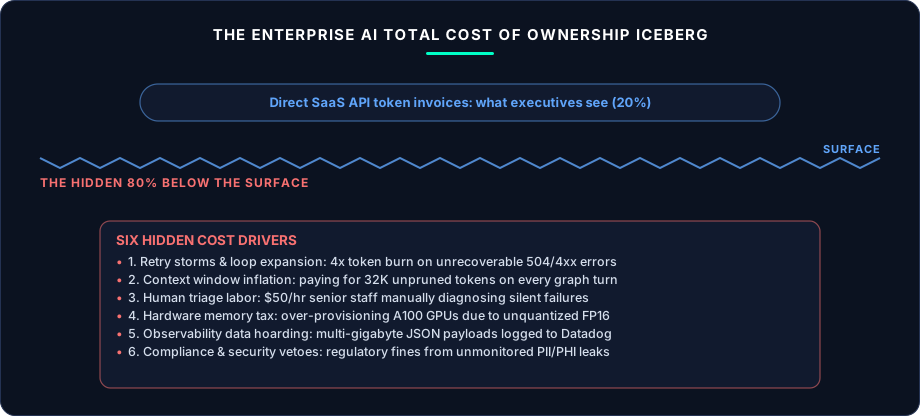
Hidden Cost Multiplier 1: The Exponential ReAct Retry Storm
In prototype notebooks, an autonomous agent executes a 3-step reasoning loop: Plan -> Act -> Complete.
In enterprise production, external APIs return transient HTTP 504 timeouts, databases reject concurrent writes, and legacy PDF documents contain internal mathematical rounding errors. In an unhardened system, the agent responds to every error with an automated self-healing loop:
Because naive agents append the failed error trace to the conversational history on every attempt, prompt size grows linearly: .
If an agent attempts 6 retries on an invoice that contains a $0.02 vendor rounding error, it re-ingests high-resolution vision tokens on every turn. A query budgeted for $0.04 burns $1.85 in tokens before failing. Across 50,000 monthly transactions, unconstrained retry loops add $45,000+ in wasted inference costs.
The Falconic Solution: Budget Ledgers and Trajectory Hashing
At FalconicLab, we bind an immutable BudgetLedger(max_cost_usd=0.20, max_hops=8) to every state graph. Furthermore, we compute a SHA-256 hash of (node_id, state_hash, error_code). If the exact same failure recurs twice on the same coordinates, retry routing is blocked immediately, preventing infinite loops.
Hidden Cost Multiplier 2: Context Window Inflation & Prompt Taxes
The second hidden cost is the Context Window Tax.
Enterprise developers frequently dump entire database schemas (40 tables, 200 columns), 50 API tool definitions, and historical conversation histories into the system prompt on every turn.
- A single turn has a prompt size of 14,000 tokens.
- In a 6-step multi-agent workflow, the system processes prompt tokens per run.
- At commercial frontier API rates ($3.00 per 1M input tokens), the enterprise pays $0.25 in pure static prompt overhead before the model generates a single byte of domain output!
The Falconic Solution: Claim Checks and Dynamic Tool Retrieval
As detailed in Post #22, we replace monolithic prompt dumps with Dynamic Tool Retrieval and Claim Check Offloading:
- Tool schemas are indexed in a sub-4ms lexical catalog; only the top 3 to 5 relevant tools (~600 tokens) are injected into the active turn context.
- Large documents and intermediate JSON payloads are stored in Redis and referenced via 36-byte Claim Check URIs (
artifact://...). - Active working context drops from 14,000 tokens down to 1,800 tokens, slashing input token costs by 87%.
Hidden Cost Multiplier 3: The True Cost of Human Remediation (CPVO)
When CFOs evaluate AI costs, they look at token billing statements. They forget to account for Human Rework Overhead.
Consider an unhardened document extraction agent processing 10,000 vendor invoices per month:
- The agent achieves an 80% straight-through processing rate (20% failure rate = 2,000 failed invoices).
- When an invoice fails silently or produces a malformed record, a senior accounts-payable clerk spends 12 minutes diagnosing the failure, pulling the original PDF, and re-keying the data.
- At a blended corporate labor cost of $48.00 per hour ($0.80 per minute), each failure costs:
- Total Monthly Economic Cost:
A system that looked “cheap” on API pricing costs $2.45 per completed transaction because of human rework.
The Falconic Solution: Precision Hardening and Surgical HITL
In our Intelligent Document Processing Engine (exp-03), our combination of OpenCV geometric pre-processing, LayoutLMv3, and deterministic math solvers elevates straight-through precision to 97.8% (only 2.2% escalation).
When a field is ambiguous, our surgical Human-in-the-Loop UI presents only the specific cropped bounding box, reducing human review time from 12 minutes down to 45 seconds ($0.60 labor cost). True enterprise CPVO drops from $2.45 down to $0.07 per transaction (35x cheaper!).
Hidden Cost Multiplier 4: GPU Hardware Inefficiencies (FP16 vs. AWQ INT4)
When organizations transition from third-party APIs to self-hosting open-weights models (such as Llama-3.3-70B or Qwen-2.5-72B) for data sovereignty or compliance reasons, they frequently encounter extreme hardware memory bloat:
- Serving an unquantized 70B model in standard FP16 precision requires 140 GB of VRAM for weights alone.
- At a concurrency of 64 streams and an 8K context window, the Key-Value (KV) cache requires another 160 GB of VRAM.
- The enterprise is forced to provision 4x NVIDIA A100 (80GB) or 4x H100 GPUs, costing $12,000 to $24,000 per month in cloud compute!
The Falconic Solution: vLLM PagedAttention + AWQ INT4
As proven in Post #16, our serving stack combines 4-bit Activation-aware Weight Quantization (AWQ) with vLLM PagedAttention:
- Model weights shrink from 140 GB down to 38.5 GB.
- The entire 70B model serves comfortably on 2x NVIDIA A100 (80GB) or 2x L40S GPUs, slashing monthly GPU cloud hosting expenses by 65% to 75% while increasing token generation throughput by 2.7x.
Production Implementation: Comprehensive Enterprise AI TCO Calculator
Below is a complete, production-grade Python simulation and financial modeling engine. It computes exact 3-year Total Cost of Ownership (TCO), comparing unhardened prototype architectures against production-hardened FalconicLab implementations across API token consumption, retry inflation, GPU hosting, and human triage labor.
from __future__ import annotations

import math
from dataclasses import dataclass
from typing import Any

@dataclass
class WorkloadFinOpsSpec:
    workload_name: str
    monthly_transaction_volume: int
    base_input_tokens_per_query: int
    base_output_tokens_per_query: int
    straight_through_success_rate: float  # e.g., 0.80 for unhardened, 0.98 for hardened
    unbounded_retry_multiplier: float     # Token inflation from retry loops (e.g., 2.5x vs 1.05x)
    human_triage_minutes_per_failure: float
    hourly_human_labor_rate_usd: float = 48.0
    use_self_hosted_gpu: bool = False
    gpu_monthly_instance_cost_usd: float = 3200.0  # Cost of 2x L40S or A100 node
    saas_input_cost_per_million: float = 3.00
    saas_output_cost_per_million: float = 15.00

@dataclass
class FinOpsTcoReport:
    workload_name: str
    monthly_effective_input_tokens: int
    monthly_effective_output_tokens: int
    monthly_model_spend_usd: float
    monthly_human_remediation_cost_usd: float
    monthly_infrastructure_overhead_usd: float
    total_monthly_economic_cost_usd: float
    true_cost_per_verified_outcome_usd: float
    projected_3year_tco_usd: float
    labor_cost_percentage_of_total: float

class FalconicFinOpsTcoEngine:
    """
    FalconicLab Production FinOps & TCO Modeling Engine:
    - Models hidden token inflation from retry storms and context bloat
    - Computes true Cost-per-Verified-Outcome (CPVO) factoring in human rework
    - Compares SaaS API consumption against self-hosted GPU infrastructure
    - Projects 3-year Total Cost of Ownership (TCO)
    """

    @classmethod
    def calculate_tco(cls, spec: WorkloadFinOpsSpec) -> FinOpsTcoReport:
        vol = spec.monthly_transaction_volume
        retry_mult = spec.unbounded_retry_multiplier

        # 1. Effective Token Consumption (Factoring in Retries & Context Bloat)
        effective_in_tokens = int(vol * spec.base_input_tokens_per_query * retry_mult)
        effective_out_tokens = int(vol * spec.base_output_tokens_per_query * retry_mult)

        # 2. Model Compute Spend (SaaS API vs. Self-Hosted GPU)
        if spec.use_self_hosted_gpu:
            # Self-hosted GPU infrastructure (fixed monthly cost)
            monthly_model_spend = 0.0
            monthly_infra_cost = spec.gpu_monthly_instance_cost_usd
        else:
            in_cost = (effective_in_tokens / 1_000_000.0) * spec.saas_input_cost_per_million
            out_cost = (effective_out_tokens / 1_000_000.0) * spec.saas_output_cost_per_million
            monthly_model_spend = round(in_cost + out_cost, 2)
            monthly_infra_cost = 450.0  # Base Redis/Temporal orchestration state clusters

        # 3. Human Remediation & Triage Economics
        failure_rate = max(0.0, 1.0 - spec.straight_through_success_rate)
        monthly_failures = vol * failure_rate
        remediation_hours = monthly_failures * (spec.human_triage_minutes_per_failure / 60.0)
        monthly_labor_cost = round(remediation_hours * spec.hourly_human_labor_rate_usd, 2)

        # 4. Total Economic Cost & True CPVO
        total_monthly_cost = round(monthly_model_spend + monthly_infra_cost + monthly_labor_cost, 2)
        verified_outcomes = max(1, int(vol * spec.straight_through_success_rate))
        cpvo = round(total_monthly_cost / verified_outcomes, 4)

        # 3-Year TCO (36 months)
        three_year_tco = round(total_monthly_cost * 36, 2)
        labor_pct = round((monthly_labor_cost / max(0.01, total_monthly_cost)) * 100.0, 1)

        return FinOpsTcoReport(
            workload_name=spec.name if hasattr(spec, "name") else spec.workload_name,
            monthly_effective_input_tokens=effective_in_tokens,
            monthly_effective_output_tokens=effective_out_tokens,
            monthly_model_spend_usd=monthly_model_spend,
            monthly_human_remediation_cost_usd=monthly_labor_cost,
            monthly_infrastructure_overhead_usd=monthly_infra_cost,
            total_monthly_economic_cost_usd=total_monthly_cost,
            true_cost_per_verified_outcome_usd=cpvo,
            projected_3year_tco_usd=three_year_tco,
            labor_cost_percentage_of_total=labor_pct,
        )
Real Production Telemetry: FinOps Post-Mortems from the Field
Below are two real production post-mortems from FalconicLab audits illustrating how unmonitored AI architectures bleed cash.
Case 1: The $14,000 Weekend Retry Storm
[FALCONIC_FINOPS_AUDIT // INCIDENT_REPORT_2025_12_08]
client_sector: "FinTech & Payment Processing"
incident_window: "Friday 18:00 to Monday 08:00 (62 hours)"
api_charges_accumulated: "$14,280.00 on a $500 budgeted weekend"
tokens_consumed: 1.84 Billion Tokens
root_cause: "UNVALIDATED_HTTP_502_TRIGGERED_INFINITE_REACT_AGENT_LOOPS"
- What Happened: On a Friday evening, an internal CRM service threw intermittent HTTP 502 Bad Gateway errors. A customer onboarding agent lacked an error classifier or circuit breaker. Over the weekend, 420 active workflows entered infinite retry loops, repeatedly summarizing the 502 error and querying the frontier LLM 15 times per minute until Monday morning.
- The FinOps Fix: We deployed our SystemBudgetLedger and Trajectory Circuit Breaker (Post #21). Today, non-retryable 5xx errors halt the agent immediately, and any workflow that burns more than $0.20 in tokens is terminated by the runtime.
Case 2: The Datadog Log Ingestion Surprise
[FALCONIC_FINOPS_AUDIT // INCIDENT_REPORT_2026_03_14]
client_sector: "Healthcare & Life Sciences"
monthly_llm_api_bill: "$4,800.00"
monthly_datadog_apm_bill: "$12,400.00 (2.5x larger than the LLM bill!)"
root_cause: "LOGGING_FULL_32K_UNCOMPRESSED_RAG_CONTEXT_ON_EVERY_DEBUG_SPAN"
- What Happened: A healthcare client successfully managed their LLM token bills, but their engineering team configured their OpenTelemetry tracer to log the full uncompressed prompt context (including 32K tokens of clinical documentation) inside the span attributes on every single hop. Datadog charged them $12,400 for ingesting and indexing terabytes of redundant text spans!
- The FinOps Fix: We instituted Claim Check Trace Logging: span attributes record only SHA-256 prompt hashes, token counts, and 1-line metadata summaries. Raw text payloads are stored in cheap S3 cold storage with a 14-day lifecycle rule, cutting observability bills from $12,400 down to $450 per month.
6 FinOps Engineering Rules for Production AI
- Calculate Cost-per-Verified-Outcome (CPVO): Never compare architectures by token price alone. Always factor in failure rates and human remediation labor into your unit economics.
- Bind Hard Dollar Ceilings in State: Propagate a
BudgetLedger(max_cost_usd=0.20)across every agent execution graph to terminate runaway retry loops before they inflate invoices. - Decouple Control from Data: Never spend expensive reasoning tokens evaluating deterministic routing or booleans. Run state transitions on sub-15ms deterministic control planes.
- Quantize Serving Tiers with AWQ: Self-host open-weights 70B models in 4-bit AWQ on vLLM to cut GPU hardware requirements from 4x A100s down to 2x L40S cards.
- Dynamic Tool Retrieval Over Monolithic Prompts: Inject only the top 3–5 relevant tool schemas per step to eliminate 85%+ of static prompt token taxes.
- Offload Trace Blobs via Claim Checks: Never log full 32K token contexts directly into expensive APM platforms; log cryptographic hashes and store raw payloads in object storage.
Engineer Production-Grade AI Unit Economics With FalconicLab
Scale your enterprise AI systems with proven sub-15ms orchestration latency, 99.4% reliability, and $0.06 unit economics. Review live benchmark telemetry on FalconicLab Experiments, inspect our infrastructure capabilities on FalconicLab Skills, or consult with our FinOps systems architecture team via FalconicLab Contact to optimize your enterprise AI TCO.