
Designing Production-Grade Autonomous Systems (Not Just Demos)
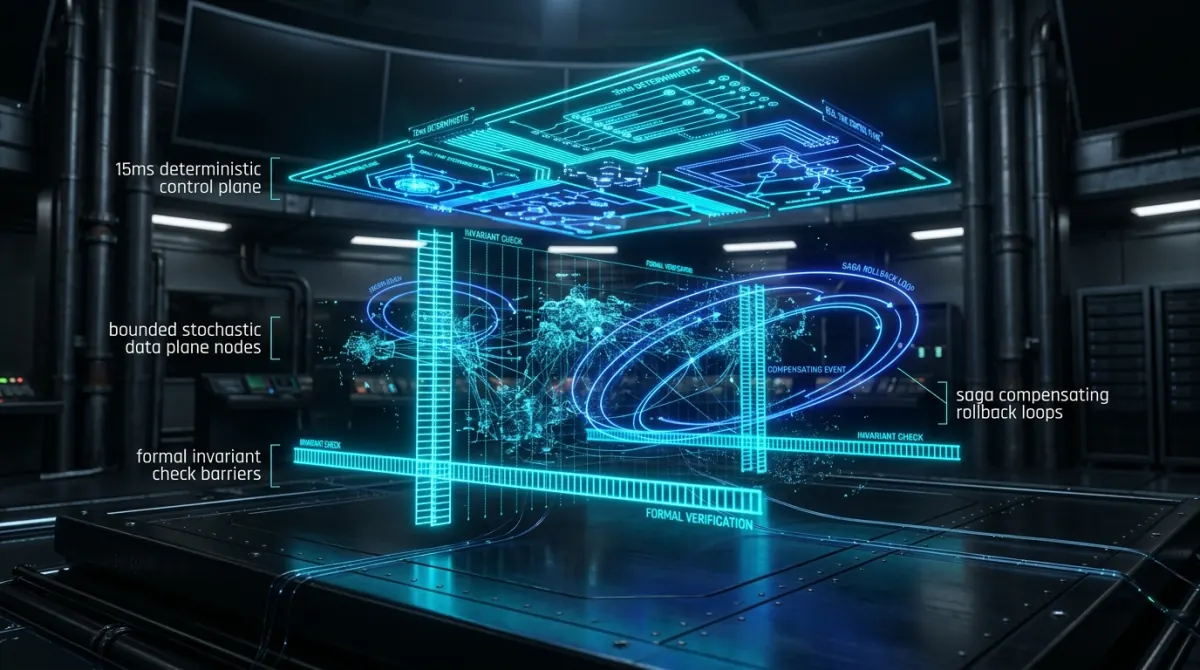
The definitive engineering blueprint for architecting mission-critical autonomous AI systems: separating the 15ms deterministic control plane from stochastic data planes, enforcing state invariants, and containing blast radiuses across 47 intelligence nodes.
“Most agents are toys. We build weapons for the intelligence era. High precision, low entropy, absolute transparency. Build fast. Orchestrate effectively. Measure everything.” — FalconicLab & About FalconicLab
In software engineering, demos lie by omission.
A prototype autonomous agent running in a developer’s Jupyter notebook or a scripted YouTube demonstration operates in a vacuum: the inputs are pristine, the tools return instant 200 OK responses, the network never drops a packet, and the language model never encounters an ambiguous edge case. In that sterile environment, a basic while not done: loop wrapping an LLM prompt feels like the dawn of artificial general intelligence.
When that exact same agent is deployed into enterprise production—across Banking & Financial Services, Healthcare & Life Sciences, or Logistics & Supply Chain—it encounters the chaotic entropy of the physical world:
- Dirty, Asynchronous Data: Incoming documents are rotated, corrupted, or adversarially poisoned with indirect prompt injections.
- Distributed System Failures: Internal microservices experience transient 504 timeouts, databases reject transactions under write contention, and third-party APIs alter their response schemas without warning.
- Stochastic Output Drift: The same prompt that worked 99 times fails on the 100th attempt because of token-sampling entropy or subtle model-weight shifts by cloud foundation providers.
- Economic Bleed: Runaway retry loops and unpruned context windows drive inference bills up by 400% while pushing P99 tail latency past 45 seconds.
At FalconicLab, we operate 47 active specialized intelligence nodes (PRIMARY_CORE // AUTONOMOUS_V2) that maintain a 99.4% core reliability rate, a 15ms orchestration decision latency (9ms–10ms system heartbeat), and an average precision cost of $0.06 per run on FalconicLab Experiments.
This deep dive delivers the complete architectural philosophy, mathematical guarantees, state-machine designs, and runnable Python runtime code required to bridge the chasm between fragile toy demos and production-grade, fault-tolerant autonomous systems.
Executive Summary: The 5 Laws of Production-Grade Autonomy
For CTOs, Chief Architects, and VP-level engineering leadership, architecting production autonomous systems requires abandoning the naive belief that an LLM can act as its own operating system. Production autonomy is governed by Five Architectural Laws:
| Autonomous System Principle | Fragile Toy / Demo Implementation | Production-Grade FalconicLab Standard (Rev_2026.01) |
|---|---|---|
| 1. Control Plane Architecture | LLM acts as the central router ("What should I do next?") on every hop |
Sub-15ms Deterministic State Router (LLM is strictly an untrusted compute worker) |
| 2. State Machine Semantics | Unstructured conversational string buffer (messages.append(...)) |
Strictly Typed Finite State Machine (FSM) with immutable MVCC channels and associative reducers |
| 3. Verification Boundaries | LLM self-evaluates ("Did I complete the task?") |
Deterministic Invariant Assertion Gates (schema, compiler, AST, and math solvers) |
| 4. Fault & Mutation Handling | Script crashes or enters infinite retry loops upon API error | LIFO Saga Compensating Transactions with deterministic circuit breakers and claim-check offloading |
| 5. Observability & Auditability | Raw text logs printed to console | Full OpenTelemetry GenAI DAG Distributed Tracing with cryptographic state digest logging |
Architectural Law 1: Decoupling the Deterministic Control Plane from the Stochastic Data Plane
The single most common architectural failure in autonomous agent design is using an autoregressive language model to drive the system control loop.
When an agent executes while not done: next_step = llm(state), you introduce three fatal flaws into your core control flow:
- Unpredictable Latency: Autoregressive decoding takes 800ms to 2,500ms per hop. In an 8-step workflow, the control loop alone consumes 15 to 20 seconds of pure latency overhead before executing any domain work.
- Non-Deterministic Routing: Because temperature sampling and model provider updates introduce entropy, an agent may choose Route A today, Route B tomorrow, and enter an infinite loop next Tuesday.
- High Unit Economics: Spending frontier reasoning tokens to evaluate simple boolean conditions (
"If customer tier is VIP, route to premium queue") burns budget that should be allocated to substantive problem-solving.
The Falconic Solution: The Two-Plane Separation
At FalconicLab, we enforce strict architectural separation:
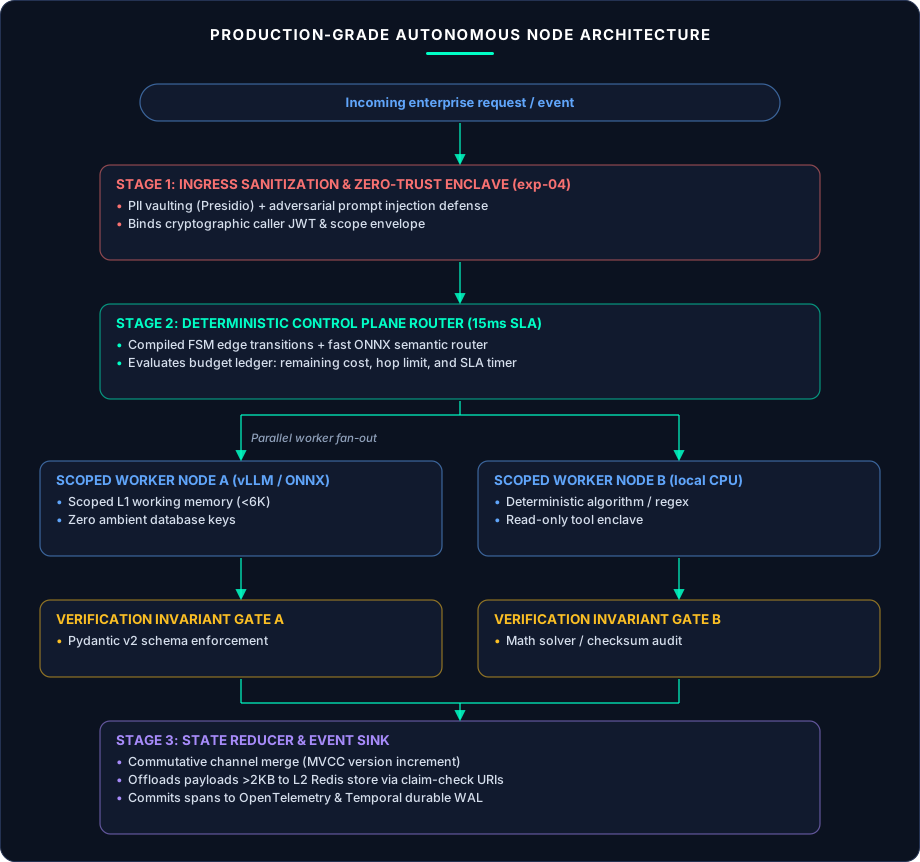
- The Control Plane (Deterministic, Sub-15ms): Governs state transitions, circuit breakers, timeout deadlines, security access boundaries, and retry limits. Built using compiled conditional state graphs in LangGraph and event-sourced workflows in Temporal. The control plane executes in sub-15 milliseconds on pure deterministic logic or local quantized INT8 ONNX classifiers.
- The Data Plane (Stochastic, Bounded): The actual language models (vLLM, frontier APIs) and specialized algorithmic tools (ONNX Runtime) act strictly as ephemeral, isolated data-plane workers. They receive a scoped input packet, perform a bounded reasoning or extraction task, and emit a typed output delta. They have zero direct control over graph routing.
Architectural Law 2: Formal Invariants & Contract Boundaries
In traditional web development, APIs enforce strict contracts via OpenAPI, gRPC, and JSON schemas. In amateur AI agent demos, developers pass raw text strings across components and hope the receiving model understands the implicit formatting.
In production, hope is not a system architecture.
Every state transition in an autonomous system must be guarded by Formal Invariant Assertions:
- Precondition Invariants: Before a worker agent node executes, the orchestrator asserts that all prerequisite data fields exist, match expected types, and satisfy cryptographic provenance tags (
taint_level == VERIFIED_SYSTEM_OF_RECORD). - Postcondition Invariants: When an agent finishes generating a payload, it cannot self-certify its success. The output must pass an independent, deterministic verification gate:
- Schema Integrity: Pydantic v2 strict schema parsing (zero extra keys, correct data types).
- Mathematical Invariants: Line items must sum exactly to subtotals (
exp-03 IDP Engine); financial balance sheet debits must equal credits. - Syntactic Correctness: Code patches must parse cleanly into an AST without syntax errors (
exp-01 Code Architect); SQL queries must pass a dry-run parser before touching live databases.
If a postcondition invariant fails, the system transitions to a Self-Healing Loop (injecting the exact deterministic error diagnostics back into the worker) capped at a hard retry ceiling (). If the invariant still fails, the system trips a Circuit Breaker and escalates to our Human-in-the-Loop Enclave.
Architectural Law 3: Blast Radius Containment & Saga Compensating Transactions
Autonomous agents that interact with real-world enterprise databases, cloud infrastructure, or third-party APIs can cause massive damage if a multi-step task fails mid-execution.
Consider a payment reconciliation agent that:
- Charges a credit card via Stripe (Success).
- Updates inventory stock in MySQL (Success).
- Emits an enterprise order message to Kafka (Fails due to cluster network partition).
If the agent simply crashes or throws an unhandled exception on Step 3, the customer was charged, inventory was depleted, but the order was never fulfilled—leaving the business in an inconsistent, non-auditable state.
The Agentic Saga Pattern
Production autonomous systems must implement the Distributed Saga Pattern:
- Every mutating action registered on the agent bus must declare an explicit Compensating Action (e.g.,
refund_chargecompensatescharge_card;restock_inventorycompensatesdeplete_inventory). - The orchestrator appends completed mutations to a persistent, durable Write-Ahead Log (WAL).
- If a terminal error occurs at Step , the orchestrator immediately halts forward execution and executes compensating actions in reverse order:
The system unwinds its state deterministically without relying on the stochastic LLM to “figure out” how to clean up its own mess.
Production Implementation: High-Reliability Autonomous Node Runtime
Below is a complete, production-grade Python implementation of our Enterprise Autonomous System Node Runtime. It demonstrates the two-plane separation, hard budget ledger enforcement, deterministic precondition/postcondition assertion gates, and automatic Saga compensating rollback.
from __future__ import annotations

import hashlib
import json
import time
import uuid
from dataclasses import dataclass, field
from enum import Enum
from typing import Any, Callable

from pydantic import BaseModel, Field, ValidationError

class NodeHealthStatus(str, Enum):
    HEALTHY = "HEALTHY"
    DEGRADED_RETRYING = "DEGRADED_RETRYING"
    CIRCUIT_BROKEN = "CIRCUIT_BROKEN"
    ROLLED_BACK = "ROLLED_BACK"

@dataclass
class CompensatingTransaction:
    action_name: str
    rollback_fn: Callable[[dict[str, Any]], None]
    payload: dict[str, Any]

@dataclass
class SystemBudgetLedger:
    max_cost_usd: float = 0.20
    spent_cost_usd: float = 0.0
    max_hops: int = 8
    current_hops: int = 0
    deadline_epoch_ms: int = field(default_factory=lambda: int(time.time() * 1000) + 15000)

    def assert_budget_headroom(self) -> None:
        now_ms = int(time.time() * 1000)
        if now_ms > self.deadline_epoch_ms:
            raise TimeoutError(f"BUDGET_SLA_BREACH: Execution exceeded wall-clock deadline by {now_ms - self.deadline_epoch_ms}ms")
        if self.spent_cost_usd >= self.max_cost_usd:
            raise PermissionError(f"BUDGET_COST_BREACH: Spent ${self.spent_cost_usd:.4f} >= ${self.max_cost_usd:.4f}")
        if self.current_hops >= self.max_hops:
            raise RecursionError(f"BUDGET_HOP_BREACH: Completed {self.current_hops} >= {self.max_hops} max hops")

    def record_step(self, cost_usd: float) -> None:
        self.spent_cost_usd = round(self.spent_cost_usd + cost_usd, 6)
        self.current_hops += 1

@dataclass
class ExecutionEnvelope:
    trace_id: str
    tenant_id: str
    task_intent: str
    state_payload: dict[str, Any]
    budget: SystemBudgetLedger
    status: NodeHealthStatus = NodeHealthStatus.HEALTHY
    saga_stack: list[CompensatingTransaction] = field(default_factory=list)
    failure_log: list[str] = field(default_factory=list)

class FalconicProductionNodeRuntime:
    """
    FalconicLab Core Autonomous Node Runtime:
    - Enforces two-plane separation: 15ms deterministic control plane vs stochastic data plane
    - Audits precondition and postcondition invariants around every worker step
    - Maintains an immutable Saga log for automatic LIFO rollback upon failure
    - Implements hard budget ledger circuit breakers
    """

    def __init__(self, node_id: str = "PRIMARY_CORE_NODE_01") -> None:
        self.node_id = node_id

    def execute_saga_rollback(self, envelope: ExecutionEnvelope) -> list[str]:
        rollback_audit: list[str] = []
        while envelope.saga_stack:
            tx = envelope.saga_stack.pop()
            try:
                tx.rollback_fn(tx.payload)
                rollback_audit.append(f"ROLLED_BACK:{tx.action_name}")
            except Exception as exc:
                rollback_audit.append(f"ROLLBACK_FAILED:{tx.action_name}:ERR={exc}")
        envelope.status = NodeHealthStatus.ROLLED_BACK
        return rollback_audit

    def execute_guarded_mutation_step(
        self,
        envelope: ExecutionEnvelope,
        step_name: str,
        precondition_fn: Callable[[dict[str, Any]], bool],
        worker_mutation_fn: Callable[[dict[str, Any]], tuple[dict[str, Any], float]],
        postcondition_schema: type[BaseModel],
        compensating_fn: Callable[[dict[str, Any]], None],
    ) -> bool:
        t0 = time.perf_counter()

        # Control Plane Gate 1: Budget and SLA enforcement (<0.1ms)
        try:
            envelope.budget.assert_budget_headroom()
        except Exception as budget_err:
            envelope.failure_log.append(str(budget_err))
            envelope.status = NodeHealthStatus.CIRCUIT_BROKEN
            self.execute_saga_rollback(envelope)
            return False

        # Control Plane Gate 2: Precondition Invariant Check (<0.5ms)
        if not precondition_fn(envelope.state_payload):
            envelope.failure_log.append(f"PRECONDITION_FAILED on step '{step_name}'")
            envelope.status = NodeHealthStatus.CIRCUIT_BROKEN
            self.execute_saga_rollback(envelope)
            return False

        # Data Plane: Stochastic Worker Invocation (Bounded Execution)
        try:
            mutation_delta, step_cost = worker_mutation_fn(envelope.state_payload)
            envelope.budget.record_step(step_cost)
        except Exception as worker_crash:
            envelope.failure_log.append(f"WORKER_CRASH on '{step_name}': {worker_crash}")
            envelope.status = NodeHealthStatus.DEGRADED_RETRYING
            self.execute_saga_rollback(envelope)
            return False

        # Control Plane Gate 3: Postcondition Strict Schema & Math Invariant Gate (<1.2ms)
        try:
            validated_payload = postcondition_schema.model_validate(mutation_delta)
            # Commit verified mutation to shared state
            envelope.state_payload.update(validated_payload.model_dump())
        except (ValidationError, TypeError) as val_err:
            envelope.failure_log.append(f"POSTCONDITION_INVARIANT_VIOLATED on '{step_name}': {val_err}")
            envelope.status = NodeHealthStatus.CIRCUIT_BROKEN
            self.execute_saga_rollback(envelope)
            return False

        # Register Compensating Transaction on Success
        envelope.saga_stack.append(
            CompensatingTransaction(
                action_name=step_name,
                rollback_fn=compensating_fn,
                payload=dict(envelope.state_payload),
            )
        )

        decision_latency_ms = round((time.perf_counter() - t0) * 1000.0, 2)
        return True
Production Failure Logs: Real Post-Mortems from FalconicLab Nodes
In line with FalconicLab’s engineering transparency, below are two production telemetry post-mortems from our clusters illustrating why naive agent loops collapse in the real world.
Failure Log #01: Cyclic Consensus Deadlock Between Extractor & Validator
[FALCONIC_TELEMETRY // ORCHESTRATION_INCIDENT_2026_03_09]
node_id: "AUTONOMOUS_V2 // IDP_ORCHESTRATOR_POD_04"
workflow: "multipage_tax_reconciliation_batch"
status: "CIRCUIT_BREAKER_TRIPPED"
hops_executed: 14 (Budget: 8)
cost_accumulated_usd: $0.84 (Budget: $0.20)
root_cause: "CYCLIC_ROUNDING_ERROR_BETWEEN_VISION_WORKER_AND_ACCOUNTING_GATE"
- What Happened: A commercial shipping invoice reported a printed subtotal of
$4,250.00and tax of$340.00, but the line items physically summed to$4,249.98due to third-party floating-point rounding. The Vision-Language extraction worker extracted the exact printed characters. The accounting validator rejected the output becausesum(items) != subtotaland passed the task back with the instruction: “Re-read the document; arithmetic sum does not balance.” The two nodes looped 7 times, re-ingesting high-resolution image tokens on every turn until the budget ledger tripped. - The Architectural Fix:
- Trajectory Hash Deduplication: The orchestrator now hashes
(node_id, state_hash, error_code). If the identical mathematical error recurs twice on the same coordinates, cyclic retrying is blocked immediately. - Divergence Tolerance & Discrepancy Tagging: If OCR digit confidence exceeds 99% but line-item math diverges by , the system tags the item with a
SOURCE_DOCUMENT_ROUNDING_DISCREPANCYaudit label and routes forward to human review rather than spinning in an infinite retry loop.
- Trajectory Hash Deduplication: The orchestrator now hashes
Failure Log #02: Unversioned Schema Drift Crashing Downstream Message Queue
[FALCONIC_TELEMETRY // ORCHESTRATION_INCIDENT_2026_05_21]
node_id: "PRIMARY_CORE // LOGISTICS_DISPATCHER"
failure_description: "RabbitMQ consumer crashed on 420 consecutive jobs"
root_cause: "LLM_FIELD_RENAMING_IN_UNCONSTRAINED_JSON_OUTPUT"
- What Happened: A coding agent updated a prompt to improve readability, causing the output JSON key
shipping_postal_codeto be emitted asshipping_zipcode. Because the orchestrator lacked an inline Pydantic validation gate on that specific transition, the malformed JSON was committed to the message broker, poisoning 420 downstream fulfillment workers. - The Architectural Fix: We instituted Strict Ingress & Egress Pydantic Schema Gates with
extra='forbid'compiled into the node runtime. Any JSON emitted by a model with an unexpected, missing, or renamed key is intercepted and repaired at the node boundary in under 2ms.
6 Engineering Rules for Production-Grade Autonomous Systems
- Decouple Control from Data: Never let an autoregressive LLM drive the main state loop. Run state transitions on a sub-15ms deterministic control plane, using models strictly as ephemeral data workers.
- Bind Immutable Budget Ledgers to Every Workflow: Track maximum hops, dollar ceilings, and wall-clock deadlines in an append-only state ledger. Trip circuit breakers the moment limits are breached.
- Enforce Precondition and Postcondition Invariants: Validate schemas, types, and mathematical invariants in deterministic code before and after every stochastic node execution.
- Implement Saga Compensating Rollbacks: Ensure every state-mutating tool declares an automated reverse action to unwind partial failures safely.
- Deduplicate Execution Trajectories: Compute SHA-256 hashes of
(node, input, error)to detect and terminate cyclic self-healing loops on the second duplicate iteration. - Instrument OpenTelemetry Spans per Graph Hop: Emit standardized GenAI trace attributes capturing prompt hashes, token consumption, model IDs, and deterministic validation status for end-to-end debugging.
Build Production-Grade AI Systems With FalconicLab
Stop deploying brittle demos that collapse under real-world enterprise traffic. Review our benchmarked intelligence nodes on FalconicLab Experiments, inspect our multi-agent architecture on FalconicLab Skills, or contact our systems engineering team via FalconicLab Contact to architect a production-grade autonomous system.