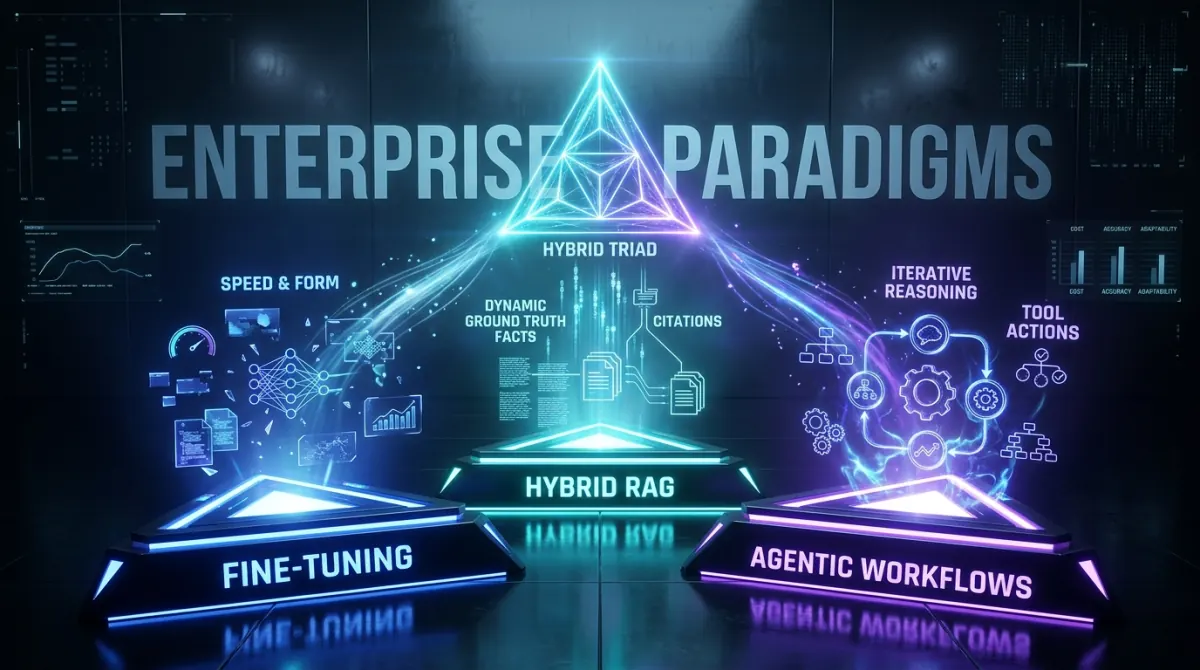

Choosing Between Fine-Tuning, RAG, and Agentic Workflows
A definitive executive and engineering decision framework for choosing between Fine-Tuning, Retrieval-Augmented Generation (RAG), and Agentic Workflows: comparing latency, unit economics, data volatility, and governance constraints.
“Every system must outperform on latency, precision, or unit cost. Otherwise, it is discarded.” — FalconicLab & About FalconicLab
In modern enterprise AI strategy, the most expensive mistake an engineering team can make is choosing the wrong architectural paradigm for the problem.
We see this architectural mismatch across enterprise pilots every quarter:
- A team spends four months and $120,000 in GPU cloud compute fine-tuning an open-weights model to “memorize” their company’s product catalog and API documentation. Two weeks after deployment, product prices change, new SDKs are released, and the fine-tuned model hallucinates outdated 2024 specifications with absolute confidence—because fine-tuning teaches style, syntax, and task format, not dynamic factual knowledge.
- Another team builds an elaborate 12-hop autonomous multi-agent graph with dynamic tool calling and self-healing reflection loops to answer routine customer FAQs. Users wait 18 seconds for answers that could have been retrieved in 80 milliseconds via a simple Hybrid Search RAG Pipeline, while the company pays $0.15 per query for unnecessary reasoning tokens.
- A third team deploys a standard RAG pipeline to generate complex multi-table accounting reconciliations or multi-file code refactors, only to discover that static semantic retrieval cannot execute iterative problem-solving or verify math invariants.
At FalconicLab, our 47 intelligence nodes (PRIMARY_CORE // AUTONOMOUS_V2) maintain an average precision cost of $0.06 per run and a 99.4% reliability rate on FalconicLab Experiments because we never treat Fine-Tuning, RAG, and Agentic Workflows as competing dogmas. They are complementary engineering primitives.
This guide provides technical executives (CTOs, Chief Data Officers, and VPs of Engineering) and systems architects with a rigorous, quantitative decision framework for selecting, sequencing, and combining Fine-Tuning, RAG, and Agentic Workflows across enterprise workloads.
Executive Summary: The Architectural Trade-Off Matrix
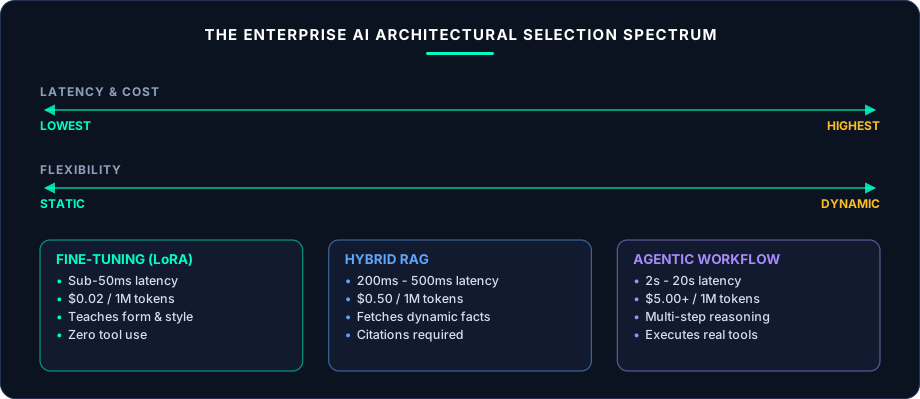
For decision-makers, evaluating these three paradigms requires analyzing the trade-offs between Information Volatility, System Latency, Reasoning Complexity, and Total Cost of Ownership (TCO):
| Architectural Metric | Fine-Tuning (LoRA / QLoRA / DPO) | Retrieval-Augmented Generation (RAG) | Autonomous Agentic Workflows |
|---|---|---|---|
| Primary Capability | Form, Syntax, Tone, & Fast Classification | Dynamic Factual Recall & Citation Grounding | Multi-Step Reasoning, Tool Use, & Mutation |
| P50 / P99 Latency SLA | Sub-40ms / Sub-90ms (running on local vLLM) | 120ms – 450ms (Vector search + single LLM call) | 1,800ms – 15,000ms+ (Multi-hop graph execution) |
| Information Volatility Handling | Poor (Requires retraining/fine-tuning pipeline) | Instant (Update vector/lexical index in real-time) | Instant (Queries live APIs & databases dynamically) |
| Deterministic Verifiability | Low (Internal parametric weights) | High (Direct verbatim quote & passage provenance) | Very High (Compiler, AST, math invariant assertion gates) |
| Upfront Capital Expenditure | High ($5K – $50K GPU training runs + curation) | Low to Medium (Index pipeline setup) | Medium (State graph & tool sandbox development) |
| Ongoing Per-Query Cost | Ultra-Low ($0.01 – $0.05 / 1M tokens) | Low to Medium ($0.20 – $1.50 / 1M tokens) | High ($2.00 – $15.00 / 1M tokens) |
| Best-Fit Enterprise Workloads | High-throughput classification, routing, JSON formatting | Enterprise knowledge search, policy Q&A, legal discovery | Complex document extraction (exp-03), code agents (exp-01) |
Paradigm 1: When to Fine-Tune (LoRA, QLoRA, DPO)
The core rule of fine-tuning is: Fine-tune to change the model’s behavior, format, or latency profile—never to teach it facts.
Ideal Fine-Tuning Use Cases
- High-Throughput Sub-50ms Routing & Classification: Training a distilled 8B model (such as Llama-3.1-8B or Qwen-2.5-7B) to classify query intent, extract named entities, or route incoming traffic across specialized nodes (Post #16) in under 15 milliseconds.
- Strict Domain-Specific JSON Schema Formatting: When a model must emit 100% compliant domain schemas (e.g., HL7 FHIR healthcare packets or SWIFT MT103 financial messages) without multi-thousand-token prompt instructions.
- Specialized Tone, Style, or Dialect Alignment: Emulating a specific corporate communication brand voice or legal drafting style across thousands of customer-facing touchpoints.
- Distillation for Massive FinOps Savings: Distilling the reasoning patterns of a 70B+ frontier model into an 8B quantized model that runs locally on commodity GPUs, slashing inference costs by 85%+.
When Fine-Tuning Fails
- Dynamic, Volatile Data: Using fine-tuning to update product inventories, tax code revisions, or customer CRM records. Models suffer from catastrophic forgetting and cannot reliably cite sources.
- Low-Sample Regimes: Fine-tuning with fewer than 500 high-quality, verified input-output pairs frequently degrades general reasoning capabilities.
Paradigm 2: When to Use Retrieval-Augmented Generation (RAG)
The core rule of RAG is: Use RAG when the model needs access to external, volatile, or permission-restricted facts and must provide verifiable citations.
Ideal RAG Use Cases
- Dynamic Enterprise Knowledge Bases: Corporate policies, HR guidelines, technical documentation, and product catalogs that update daily or weekly.
- High-Compliance Legal & Financial Search: ISDA master agreements, SEC/XBRL filings, and clinical trial records where every assertion must carry a clickable hyperlink to a verified document and page coordinates (Post #11 and Post #15).
- Role-Based Access Control (RBAC) Enforcement: When different employees or tenants are entitled to see different subsets of data. Vector databases (such as Qdrant or pgvector) enforce document-level ACLs before passages enter the prompt.
When RAG Fails
- Multi-Step Action Workflows: RAG answers questions; it cannot execute transactions, run tests, or modify database states.
- Complex Multi-Table Synthesis: Asking a standard RAG pipeline to calculate aggregate quarterly profit margins across 50 regional PDF schedules results in hallucinations because naive vector search retrieves disconnected chunks without table structure.
Paradigm 3: When to Deploy Autonomous Agentic Workflows
The core rule of Agentic Workflows is: Deploy agents when the task requires multi-step planning, tool interaction, environmental feedback, or deterministic verification.
Ideal Agentic Workflows Use Cases
- Iterative Problem-Solving & Self-Healing: Workflows where the first attempt may fail and requires diagnostic feedback—such as our Autonomous Code Architect Agent (exp-01, 98.4% precision), which writes code, runs unit tests in an ephemeral microVM, and repairs compiler errors autonomously.
- Complex Multi-Page Document Extraction: Processing unstructured documents with complex table geometry and cross-field math checks (Intelligent Document Processing Engine exp-03, 97.8% precision, $0.05/run).
- State-Mutating Enterprise Orchestration: Workflows that traverse multiple disparate systems (e.g., Salesforce SAP ERP Stripe Slack) using Saga compensating transactions (Post #21).
When Agentic Workflows Fail
- Simple Factual Lookups: Wrapping an FAQ bot in an autonomous agent loop introduces latency, cost, and cyclic failure modes without adding any user value.
- Latency-Critical Synchronous APIs: If a customer checkout endpoint has a hard 200ms deadline, a multi-hop agent loop (which requires 3 to 15 seconds) is fundamentally incompatible with the SLA.
The Production Pattern: The Hybrid Triad Architecture
In high-performance enterprise systems, the winning architecture is never pure Fine-Tuning, pure RAG, or pure Agents. It is the Hybrid Triad:
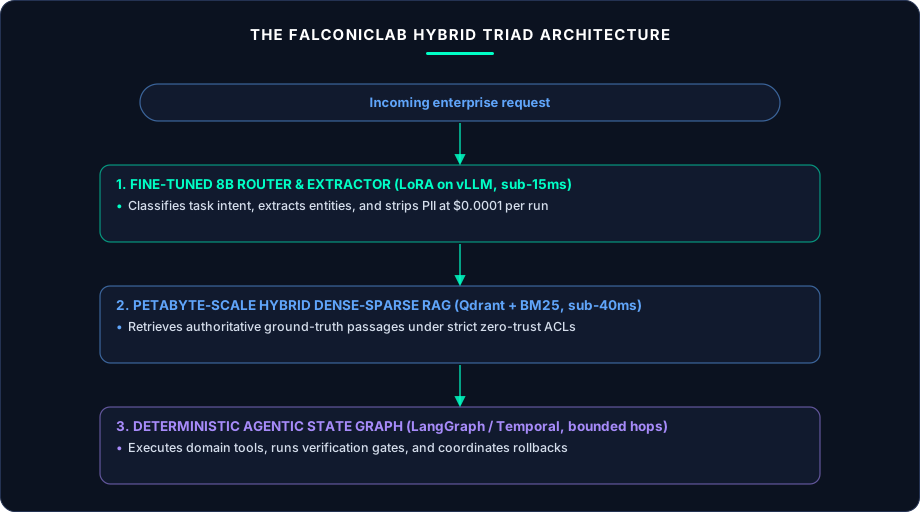
- A Fine-Tuned 8B Model handles ingress classification, entity extraction, and intent routing in under 15ms.
- A Hybrid Dense-Sparse RAG System injects verified, up-to-date domain passages and citations into the prompt context.
- An Agentic State Graph coordinates tool execution, verifies mathematical and schema invariants, and manages rollbacks.
Production Implementation: Enterprise Architecture Decision Matrix & Cost Estimator
Below is a complete, runnable Python implementation of our Enterprise Architecture Decision Matrix & TCO Estimator. Engineering leaders can input their workload parameters (monthly volume, required latency SLA, data volatility, need for tool actions, and compliance requirements) to receive a deterministic architectural recommendation and projected 3-year cost breakdown.
from __future__ import annotations

import math
from dataclasses import dataclass
from enum import Enum
from typing import Any

class ArchitecturalRoute(str, Enum):
    FINE_TUNED_SLM = "FINE_TUNED_SLM"
    HYBRID_RAG = "HYBRID_RAG"
    AUTONOMOUS_AGENT = "AUTONOMOUS_AGENT"
    HYBRID_TRIAD = "HYBRID_TRIAD"

@dataclass
class WorkloadProfile:
    monthly_query_volume: int
    latency_sla_ms: int
    data_volatility_days: float  # How often underlying facts change (0.1 = hourly, 90 = quarterly)
    requires_external_tools_or_mutations: bool
    requires_verifiable_citations: bool
    requires_multi_step_reasoning: bool
    input_tokens_avg: int = 800
    output_tokens_avg: int = 300

@dataclass
class ArchitecturalRecommendation:
    recommended_route: ArchitecturalRoute
    confidence_score: float
    decision_rationale: list[str]
    monthly_token_cost_usd: float
    monthly_infra_cost_usd: float
    projected_3year_tco_usd: float

class FalconicArchitectureEvaluator:
    """
    Evaluates enterprise AI workload requirements and computes the optimal
    architectural path (Fine-Tuning vs. RAG vs. Agent vs. Hybrid Triad)
    alongside a 3-year Total Cost of Ownership (TCO) model.
    """

    @classmethod
    def evaluate_workload(cls, profile: WorkloadProfile) -> ArchitecturalRecommendation:
        rationale: list[str] = []

        # 1. Hard Constraints Evaluation
        if profile.requires_external_tools_or_mutations and profile.requires_multi_step_reasoning:
            if profile.latency_sla_ms < 1500:
                rationale.append("Conflict: Multi-step agents require >1,500ms; latency SLA requires optimization.")
            route = ArchitecturalRoute.AUTONOMOUS_AGENT
            confidence = 0.95
            rationale.append("Workload requires external tool execution and iterative reasoning -> Autonomous Agent.")
        elif profile.data_volatility_days <= 7.0 and profile.requires_verifiable_citations:
            route = ArchitecturalRoute.HYBRID_RAG
            confidence = 0.92
            rationale.append("Data updates frequently with strict citation requirements -> Hybrid RAG.")
        elif profile.latency_sla_ms <= 80 and not profile.requires_external_tools_or_mutations:
            route = ArchitecturalRoute.FINE_TUNED_SLM
            confidence = 0.94
            rationale.append("Ultra-low latency (<80ms) and static domain formatting -> Fine-Tuned Small Language Model.")
        else:
            route = ArchitecturalRoute.HYBRID_TRIAD
            confidence = 0.88
            rationale.append("Complex multi-faceted workload -> Hybrid Triad (Fine-Tuned Router + RAG + Bounded Agent).")

        # 2. FinOps TCO Modeling
        vol = profile.monthly_query_volume
        in_tok = profile.input_tokens_avg
        out_tok = profile.output_tokens_avg

        if route == ArchitecturalRoute.FINE_TUNED_SLM:
            # Self-hosted 8B vLLM instance
            monthly_token_cost = 0.0
            monthly_infra = 650.0  # 1x NVIDIA L40S instance
            upfront_training = 6000.0
        elif route == ArchitecturalRoute.HYBRID_RAG:
            # Vector DB + Standard Model inference
            token_rate_in = 0.50 / 1_000_000.0
            token_rate_out = 1.50 / 1_000_000.0
            monthly_token_cost = vol * ((in_tok * token_rate_in) + (out_tok * token_rate_out))
            monthly_infra = 350.0  # Qdrant / pgvector cluster
            upfront_training = 1500.0
        elif route == ArchitecturalRoute.AUTONOMOUS_AGENT:
            # Multi-hop reasoning (avg 4 hops per task)
            hops = 4
            token_rate_in = 1.25 / 1_000_000.0
            token_rate_out = 5.00 / 1_000_000.0
            monthly_token_cost = vol * hops * ((in_tok * token_rate_in) + (out_tok * token_rate_out))
            monthly_infra = 850.0  # Temporal + Redis state clusters
            upfront_training = 3000.0
        else:  # HYBRID_TRIAD
            monthly_token_cost = vol * 1.5 * ((in_tok * (0.40 / 1e6)) + (out_tok * (1.80 / 1e6)))
            monthly_infra = 950.0
            upfront_training = 8000.0

        monthly_total = monthly_token_cost + monthly_infra
        three_year_tco = upfront_training + (monthly_total * 36)

        return ArchitecturalRecommendation(
            recommended_route=route,
            confidence_score=confidence,
            decision_rationale=rationale,
            monthly_token_cost_usd=round(monthly_token_cost, 2),
            monthly_infra_cost_usd=round(monthly_infra, 2),
            projected_3year_tco_usd=round(three_year_tco, 2),
        )
Real Production Failure Logs: Architectural Mismatch Post-Mortems
Below are two real production failure incidents from FalconicLab engagements illustrating the cost of choosing the wrong architecture.
Failure Log #01: Catastrophic Forgetting from Fine-Tuning on 10,000 API Specs
[FALCONIC_ARCHITECTURE_AUDIT // INCIDENT_LOG_2025_11_19]
client_sector: "FinTech & Payment Processing"
architecture_attempted: "LoRA Fine-Tuning Llama-3-70B on 10,000 Internal REST Endpoints"
training_compute_spent: "$48,200 in GPU cloud compute"
failure_observed: "HALLUCINATED_DEPRECATED_PARAMETERS_ON_42%_OF_INVOCATIONS"
root_cause: "FINE_TUNING_FAILED_TO_MAINTAIN_EXACT_API_SCHEMA_BOUNDARIES"
- What Happened: A client fine-tuned a 70B model to memorize all internal microservice API documentation. When internal APIs updated their parameters in a weekly release, the model continued emitting deprecated parameter names, causing runtime HTTP 400 Bad Request errors across production.
- The Architectural Remedy: We replaced the fine-tuned model weights with Hybrid Dense-Sparse RAG + Dynamic Tool Retrieval (Post #22). The underlying foundation model was left un-tuned, while live OpenAPI schemas were indexed into a sub-millisecond lexical vector catalog. When an API updated, only its documentation chunk was re-indexed, restoring accuracy to 99.2% in minutes.
Failure Log #02: Latency Collapse from Deploying a 10-Hop Agent for Routine Support
[FALCONIC_ARCHITECTURE_AUDIT // INCIDENT_LOG_2026_04_14]
client_sector: "Telecommunications & Customer Service"
architecture_attempted: "Full ReAct Multi-Agent Graph for Password Reset & FAQ Inquiries"
p95_latency_measured: "24,800ms (Customer Cart / Session Abandonment Spiked 38%)"
average_cost_per_query: "$0.44 per basic inquiry"
root_cause: "UNNECESSARY_AGENTIC_HOPS_ON_DETERMINISTIC_INFORMATION_RETRIEVAL"
- What Happened: A telecommunications provider routed simple password reset and billing FAQ queries through an autonomous multi-agent graph with dynamic tool calling and self-critique reflection loops. Each customer interaction took 25 seconds and cost $0.44 in reasoning tokens.
- The Architectural Remedy: We partitioned traffic with a sub-15ms Semantic Router (Post #16): 88% of routine informational queries were diverted to a fast Hybrid RAG endpoint ($0.01 per query, 380ms latency), while only complex account disputes were escalated to the autonomous agent graph.
6 Engineering Rules for Architectural Selection
- Never Fine-Tune to Teach Facts: Use fine-tuning to train form, output format, classification behavior, or tone. Use RAG for dynamic, retrievable facts.
- Never Deploy an Agent When RAG Suffices: If the task does not require environmental mutation, code execution, or iterative tool feedback, a single-pass RAG architecture is 10x faster and 80% cheaper.
- Respect Latency SLAs at Ingress: If the user SLA is sub-500ms, multi-hop agent graphs are mathematically ruled out. Use fine-tuned small models or indexed retrieval.
- Enforce Two-Tier Hybrid RAG for Citations: Whenever regulatory compliance requires auditable provenance (SEC, HIPAA, SOX), use hybrid dense-sparse RAG with quote-first synthesis.
- Combine Paradigms in the Hybrid Triad: Leverage fine-tuned 8B models for fast sub-15ms routing, RAG for fact retrieval, and agent graphs for execution and verification.
- Model 3-Year TCO Upfront: Factor in ongoing token inflation, GPU hosting overhead, and data re-indexing maintenance when making architectural commitments.
Architect Your Enterprise AI Stack With FalconicLab
Stop wasting compute on architectural misfits. Explore our benchmarked intelligence nodes on FalconicLab Experiments, review our production architectures on FalconicLab Skills, or consult with our principal systems architects via FalconicLab Contact to design the optimal AI architecture for your enterprise.