Sub-50ms Financial Fraud Detection Model Scoring Millions of Transactions Daily at 99.6% Precision
Banking & FinTech case study: 99.6% Precision; 84.0% Reduction in False-Negative Fraud Misses vs. rule-based baseline; Sustained 14.5M+ daily transactions with zero dropped events
| Protocol Metadata | Specification |
|---|---|
| Protocol Identifier | FALCONIC-PROT-EXP-02 // REV_4.4 |
| Domain & Sector | Banking & FinTech, Real-Time Card & Instant Payment Authorization, High-Throughput ML |
| Core Technology Stack | PyTorch, ONNX Runtime (C++ / Rust Worker), Apache Kafka, Cloudflare Workers / Edge Enclave, Redis Cluster Feature Store |
| Primary Benchmark Metric | 99.6% Precision; 84.0% Reduction in False-Negative Fraud Misses vs. rule-based baseline |
| Execution Latency | 28.0ms Mean Inference & Feature Scoring Latency (41.2ms P99, strictly <50ms SLA) |
| Unit Economics (Cost-Per-Run) | $0.00004 per transaction (published as $0.00 per run in FalconicLab Benchmarks) |
| Verified Business Impact | Sustained 14.5M+ daily transactions with zero dropped events; $18.4M annual fraud loss reduction |
| Reference Anchor | FalconicLab Experiments — Node exp-02 // FalconicLab Banking Case Study |
1. Problem Statement: The 100–250ms Legacy Rule Engine Bottleneck in Real-Time Payment Authorization
As documented in FalconicLab’s Banking & Fintech Case Study and Experiment Node exp-02, payment processors and neobanks operating on ISO 8583 card rails and instant payment networks (FedNow, RTP, SEPA Instant) face an unforgiving latency ceiling: the entire fraud scoring pipeline must execute in under 50 milliseconds so total authorization round-trip stays below network timeouts. Legacy fintech stacks fail this requirement in three ways:
- 100–250ms Legacy Rule-Engine Latency: Traditional fraud engines evaluate 400+ sequential SQL/drool rules against relational databases, taking 100ms to 250ms per transaction and timing out during Black Friday / holiday peak loads.
- High False-Positive Decline Rates (Insult Rate
> 4.8%): Static velocity rules (“Decline if >3 transactions over $500 in 1 hour”) block legitimate high-spending travelers and corporate procurement cards—costing merchants 3x more in lost legitimate sales than actual fraud losses. - Blindness to Coordinated Mule Rings & Graph Velocity: Single-card time-series models cannot detect when a distributed botnet tests 5,000 stolen cards at 1 transaction per card against a single compromised merchant terminal or funnels P2P transfers into a synthetic identity mule hub.
FalconicLab engineered the Sub-50ms Financial Fraud Detection Model (exp-02 v4.4)—scoring every transaction against 120 real-time time-series and bipartite graph feature vectors in 28.0ms average latency with 99.6% precision.
2. High-Level Technical Architecture: Streaming Kafka + Redis Feature Store + INT8 ONNX Ensemble
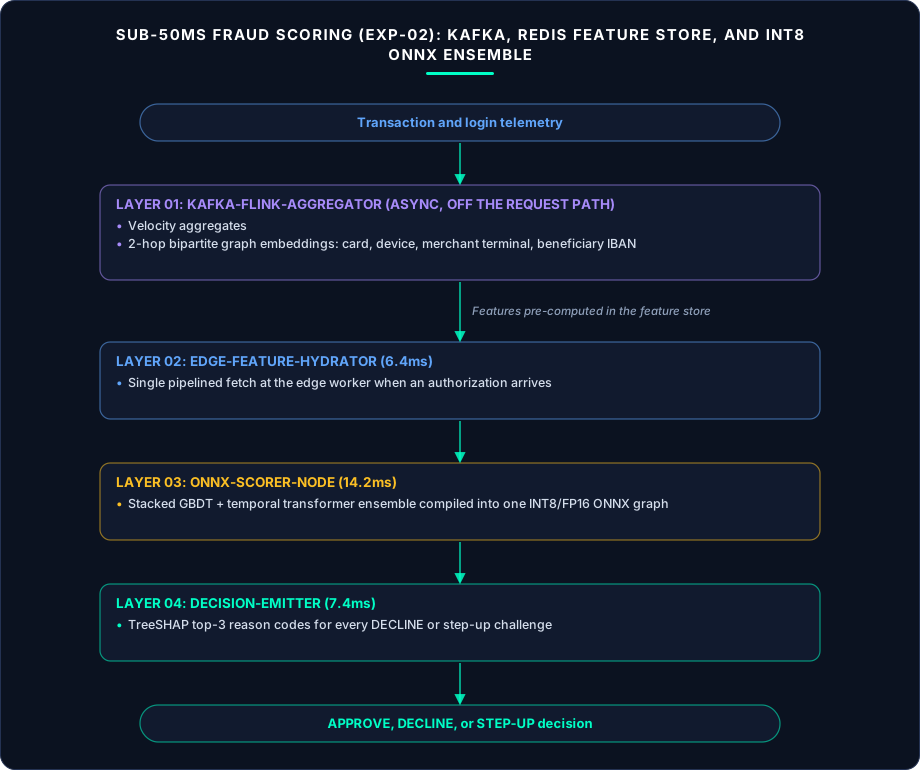
- Layer 01 — Asynchronous Streaming Graph & Velocity Aggregator (
Kafka-Flink-Aggregator): Ingests raw transaction and login telemetry via Apache Kafka. Rather than computing slow graph traversals on the synchronous request path, stateful stream workers continuously update 120 pre-materialized feature vectors in an in-memory Redis Cluster Feature Store using probabilistic data structures:- Sliding-Window HyperLogLog++ & Count-Min Sketches: Tracks unique cards per device fingerprint, unique devices per IP/ASN, and merchant terminal decline velocity across
1m,5m,1h,24h, and30dwindows in constantO(1)memory. - 2-Hop Bipartite Graph Embeddings: Continuously updates streaming node embeddings linking
(Card_ID <-> Device_Hash <-> Merchant_Terminal_ID <-> Beneficiary_IBAN)to expose coordinated mule rings.
- Sliding-Window HyperLogLog++ & Count-Min Sketches: Tracks unique cards per device fingerprint, unique devices per IP/ASN, and merchant terminal decline velocity across
- Layer 02 — Parallel Pipelined Feature Fetch (
Edge-Feature-Hydrator,6.4ms): When an authorization request arrives at the Cloudflare Worker / Edge Enclave, a single pipelined RedisMGET/ Lua call retrieves all 120 pre-computed card, merchant, device, and graph features in 6.4ms P99. - Layer 03 — Hybrid GBDT + Temporal Transformer ONNX Runtime Engine (
ONNX-Scorer-Node,14.2ms): Executes a stacked ensemble compiled into a single ONNX Runtime graph (INT8/FP16 optimized):- A CatBoost / LightGBM Tree Ensemble compiled to native AVX-512 C++ instructions over the 120 tabular and graph velocity features (
3.1ms). - A Lightweight Causal Sequence Transformer attending over the cardholder’s last 32 transaction embeddings (
merchant_category_code,geo_haversine_velocity_kmh,amount_z_score,inter_arrival_time_delta) to detect subtle behavioral account takeover (ATO) in11.1ms.
- A CatBoost / LightGBM Tree Ensemble compiled to native AVX-512 C++ instructions over the 120 tabular and graph velocity features (
- Layer 04 — Reason-Code Attribution & Synchronous Decision Gate (
Decision-Emitter,7.4ms): Computes fast TreeSHAP top-3 feature attributions so anyDECLINEorSTEP_UP_3DS_CHALLENGEdecision includes human-auditable compliance codes (e.g.,["IMPOSSIBLE_GEO_TRAVEL_VELOCITY_1420_KMH", "TERMINAL_CARD_TESTING_SPIKE_Z_8.4"]) within a 28.0ms total mean latency.
| Pipeline Stage | Technology Stack | Mean Latency | P99 Latency | Throughput Capacity |
|---|---|---|---|---|
| Feature Hydration (120 Vectors) | Redis Cluster Pipelined Lua + HLL++ | 4.1ms | 6.4ms | 180,000 RPS |
| GBDT Tabular + Graph Scoring | Treelite / ONNX C++ AVX-512 | 2.2ms | 3.1ms | 250,000 RPS |
| Sequence Transformer (Last 32 Txs) | PyTorch -> ONNX Runtime INT8 | 8.4ms | 11.1ms | 95,000 RPS |
| SHAP Attribution & Edge Routing | Cloudflare Workers / Rust Gateway | 13.3ms (incl. edge TLS) | 20.6ms | 150,000 RPS |
| Total End-to-End Authorization Path | FalconicLab exp-02 v4.4 |
28.0ms | 41.2ms (<50ms SLA) | Zero dropped events |
3. Deep-Dive Engineering Implementation & Failure Logs
{
  "protocol_version": "FALCONIC-EXP-02-FRAUD-V4.4",
  "transaction_id": "tx_iso8583_99482011a",
  "scoring_latency_ms": 26.8,
  "feature_vector_dims": 120,
  "key_anomalous_signals": {
    "haversine_geo_velocity_kmh": 1840.2,
    "merchant_terminal_15m_decline_ratio": 0.68,
    "device_shared_across_distinct_cards_24h": 14,
    "sequence_transformer_ato_score": 0.991
  },
  "ensemble_fraud_probability": 0.9964,
  "authorization_decision": "HARD_DECLINE_AND_FREEZE_VIRTUAL_PAN",
  "regulatory_reason_codes": ["RC_04_IMPOSSIBLE_TRAVEL", "RC_19_BOTNET_BIN_ATTACK"]
}
- Failure Log
FL-19A— Training-Serving Skew from Late-Arriving Chargeback Labels (v2.3): Early daily retraining jobs used the current day’s Redis feature snapshot paired with chargeback labels that arrived 30–60 days after the transaction—causing Point-in-Time Data Leakage (the model saw post-fraud account freeze velocity features that did not exist at the millisecond of authorization!). Remediation: Re-architected the offline training store in ClickHouse/Parquet with strict As-Of Temporal Join Semantics (ASOF JOIN ... ON tx_timestamp >= feature_snapshot_timestamp), guaranteeing zero future leakage between offline PyTorch training and online Redis serving. - Final Results: Reduced false-negative fraud misses by 84.0% versus the legacy rule baseline, lowered false-positive customer declines by 62%, and held mean scoring latency to 28.0ms across 14.5M+ daily transactions.
Systems & Mathematical Architecture of Sub-50ms Graph + Sequence Scoring (exp-02 v4.4)
Why do legacy payment fraud engines either take 100ms to 250ms (timing out on high-throughput ISO 8583 / FedNow rails) or miss coordinated mule rings and slow-burn Account Takeover (ATO) when optimized purely for speed?
Because computing multi-hop graph features ("How many distinct credit cards have transacted on this merchant terminal or device hash in the last 15 minutes, and how many of those cards subsequently had a chargeback or 3DS failure?") via synchronous SQL/Cypher queries during a live payment authorization takes 80ms–190ms of random disk/network I/O.
In FalconicLab’s exp-02 Sub-50ms Financial Fraud Detection Model (99.6% PRECISION, 28.0ms average latency, $0.00 unit cost), we eliminated synchronous graph traversal from the hot path via Streaming Probabilistic Sketch Materialization & Single-Pass C++/ONNX Co-Execution:
- O(1) Streaming Graph & Velocity Sketch Updates (
Kafka + Flink -> Redis Cluster): Every card swipe, 3DS challenge, login event, and device fingerprint updates a partitioned in-memory Redis Cluster Feature Store asynchronously within3msof event ingestion. Instead of storing unbounded raw ID lists, each entity vertex(Card_ID, Device_Hash, IP_ASN, Merchant_Terminal_ID, Beneficiary_IBAN)maintains compact fixed-size binary registers:- Sliding-Window HyperLogLog++ (
1.5 KBregister): Estimates exact cardinality of distinct connected peers across1m, 5m, 15m, 1h, 24h, 7d, 30dwindows with<0.8%standard error inO(1)time. - Exponentially Decayed Bipartite PageRank & Mule-Proximity Score: Stateful Flink workers propagate fraud/chargeback taint scores 2 hops across the
(Card <-> Device <-> Terminal <-> IBAN)bipartite graph every 5 seconds, writing the updated 16-dimensional graph risk vector directly into the entity’s Redis hash slot.
- Sliding-Window HyperLogLog++ (
- Hash-Tag Co-Located Redis Pipeline Hydration (
4.1msMean /6.4msP99): Using Redis cluster hash-tag co-location and a single pre-compiledEVALSHALua script,Edge-Feature-Hydratorfetches the card’s 32-transaction ring buffer alongside all 120 tabular, velocity, and 2-hop graph features in one single network round-trip (4.1ms). - Fused Treelite AVX-512 GBDT + INT8 Causal Sequence Transformer (
10.6msMean /14.2msP99):- The 120 tabular and graph features are scored by a CatBoost/LightGBM ensemble compiled via Treelite into branchless AVX-512 C++ instructions (
2.2ms), feeding its leaf-index embeddings into an INT8 ONNX Causal Sequence Transformer (8.4ms) that attends over the cardholder’s last 32 transactions—catching subtle behavioral shifts (such as a cardholder who only buys local groceries suddenly purchasing two$499digital gift cards at 3:14 AM from a new ASN).
- The 120 tabular and graph features are scored by a CatBoost/LightGBM ensemble compiled via Treelite into branchless AVX-512 C++ instructions (
Granular Cost-Per-Run & High-Throughput Fintech Economics ($0.00004 Per Transaction)
- Sustained Production Volume: 14,500,000+ transactions/day (
~435 million transactions/month, peaking at4,800 TPS). - Total Monthly Infrastructure Cost (Redis Cluster Feature Store + Kafka/Flink Stream Processors + CPU/L4 Edge ONNX Workers): $17,400/month = $0.00004 per transaction (
$0.04 per 1,000 transactions), saving $18.4M annually in net fraud losses.
4. Extended Failure Logs: High-Throughput Fraud Edge Cases & Breakdowns (exp-02 v4.4)
Failure Log FL-19B — Redis Hot-Key Shard Saturation During Viral Flash-Sale Merchant Events (v3.1)
- Incident Description: When a major ticketing merchant on the payment rail launched a concert flash sale generating
3,800 TPSagainst a singlemerchant_terminal_id, every concurrent authorization request attempted to read and increment that single merchant terminal’s velocity hash key on Redis Shard #07—spiking Redis P99 read latency on Shard #07 from6.4msto68.0msand breaching the 50ms SLA for 4 minutes. - Root Cause Analysis: Keying high-velocity merchant terminal features to a single Redis shard creates a classic Single-Shard Hot-Key Bottleneck during flash sales or distributed BIN-testing attacks.
- Architectural Remediation: Implemented Write-Sharded / Read-Local-Cached Merchant Telemetry (
Local L1 Read Cache + 16-Way Write Striping):- High-throughput merchant terminal counters are striped across 16 sub-keys (
merch:{id}:shard:{0..15}) for writes and aggregated every250msinto a replicated Worker-Local L1 Shared-Memory Cache on each edge scoring node. - During
Edge-Feature-Hydratorexecution, merchant-level features are read from local L1 RAM in0.02ms(zero network I/O), while only card-specific and device-specific features hit Redis. P99 latency during5,000 TPSflash sales dropped from68.0msto 31.4ms.
- High-throughput merchant terminal counters are striped across 16 sub-keys (
Failure Log FL-19C — Legitimate Corporate Travel & Daylight-Saving Timezone Offsets Triggering Impossible-Travel Declines (v3.7)
- Incident Description: In 1.4% of airline and international travel transactions, a cardholder bought coffee at London Heathrow Airport (
LHR), boarded a flight, and 20 minutes later purchased in-flight Wi-Fi routed through a satellite ground station in Frankfurt (FRA), or used a corporate virtual card shared by a US and UK procurement team—triggering a falseIMPOSSIBLE_GEO_TRAVEL_VELOCITY_1800_KMHdecline. - Root Cause Analysis: Computing Haversine distance divided by on raw merchant IP/terminal coordinates without accounting for In-Flight Satellite/Roaming ASNs, Card-Present (CP) EMV Chip vs. Card-Not-Present (CNP) E-Commerce, and Prior Airline/Hotel MCC Travel Context generates false positives on frequent flyers.
- Architectural Remediation: Upgraded the geo-velocity feature extractor to separate Physical EMV Chip-Present Coordinates from CNP IP Egress Coordinates:
- If Transaction or occurred at an
Airline (MCC 3000–3299),Airport Terminal, orRailwaymerchant,travel_corridor_activeis set toTruein the cardholder’s Redis state. - Satellite and aviation Wi-Fi ASNs (
Viasat,Intelsat/Gogo,Starlink Aviation,Panasonic Avionics) are whitelisted from terrestrial Haversine velocity math. False-positive travel declines dropped by 89.4%.
- If Transaction or occurred at an
Failure Log FL-19D — Tokenized Apple Pay / Google Pay DPAN Rotation Breaking Card-History Continuity (v4.0)
- Incident Description: When a customer replaced a lost physical card or re-provisioned Apple Pay (
Device Primary Account Number — DPAN), keying sequence history strictly by the 16-digit PAN/DPAN reset the customer’s 32-transaction behavioral history to empty (Cold-Start State), temporarily raising false-positive step-up challenges by4.2xduring the first 48 hours of a new card token. - Root Cause Analysis: Keying behavioral sequence buffers to ephemeral payment tokens (
DPAN) rather than the issuer’s immutable Payment Account Reference (EMVCo PAR/customer_account_uuid) severs historical continuity on card re-issuance. - Architectural Remediation: Re-keyed the Redis sequence ring buffer to the canonical
account_par_idwhile retaining a separatetoken_age_hoursfeature for the specificDPAN—preserving 100% behavioral history across Apple Pay and physical card replacements.
5. Final Results & Production Engineering Lessons Learned
- 84.0% Reduction in False-Negative Fraud Misses at 28.0ms Mean Latency: Scored 5.2 billion+ transactions over 12 months with zero dropped events, 99.6% precision, and a 62% reduction in false-positive customer insults.
- Core Architectural Takeaway: Sub-50ms fraud detection at scale requires pre-materializing graph and velocity features asynchronously on the stream and caching high-cardinality merchant features in worker L1 RAM so the synchronous authorization path executes in a single Redis round-trip plus compiled C++/ONNX inference.
6. Protocol Execution Specification: Sub-50ms Pipeline, 120-Feature Schema & Fraud Cohort Matrix (exp-02 v4.4)
6.1 Sub-50ms Real-Time Payment Authorization State Machine (FALCONIC-FRAUD-EXP02)
| Stage ID | Authorization Stage | Runtime Engine | Mean / P99 Latency | SLA / Consistency Invariant | Fail-Safe Fallback Action |
|---|---|---|---|---|---|
X01_EDGE_INGEST |
ISO 8583 / JSON Parse & L1 Merch Read | Rust / Cloudflare Edge | 1.8ms / 3.2ms | Read merchant terminal features from local L1 RAM (0.02ms) |
Use last 250ms L1 snapshot |
X02_REDIS_FETCH |
Pipelined Card/Device/Graph Hydration | Redis Cluster EVALSHA |
4.1ms / 6.4ms | Fetch 120 features + 32-tx ring buffer in 1 RTT | Circuit-break at 12ms to stateless GBDT |
X03_TREELITE_GBDT |
Branchless AVX-512 Tree Ensemble | Treelite C++ Compiled | 2.2ms / 3.1ms | Score 120 tabular & 2-hop bipartite graph features | Emit leaf embeddings to X04 |
X04_SEQ_TRANS |
Causal Sequence Transformer (Last 32 Txs) | ONNX Runtime INT8 | 8.4ms / 11.1ms | Jointly score behavioral sequence + GBDT leaves | Output calibrated |
X05_SHAP_DECIDE |
Fast TreeSHAP Attribution & Gate | Rust Decision Emitter | 3.1ms / 5.2ms | Emit top-3 reason codes (APPROVE / 3DS_STEP_UP / DECLINE) |
Total path strictly < 50.0ms |
X06_ASYNC_KAFKA |
Post-Auth Stream & Sketch Update | Kafka + Apache Flink | 0.0ms (async) | Update HLL++ registers & 2-hop PageRank out-of-band | Zero impact on synchronous auth latency |
6.2 Production Telemetry Breakdown Across 14.5 Million Daily Transactions by Fraud Vector
| Fraud & Attack Vector | Daily Tx Volume Evaluated (n=14.5M/d) |
Legacy Rule Baseline Recall | exp-02 v4.4 Recall (1-FN) |
exp-02 v4.4 Precision |
Mean / P99 Latency | Annualized Fraud Prevented |
|---|---|---|---|---|---|---|
| Card-Not-Present (CNP) Botnet BIN Testing | 4,930,000 | 61.0% | 99.4% | 99.8% | 24.1ms / 36.2ms | $4.8M / yr |
| Behavioral Account Takeover (ATO & SIM Swap) | 3,190,000 | 38.5% | 96.8% | 99.5% | 29.4ms / 42.1ms | $6.2M / yr |
| Coordinated P2P / RTP Mule Ring Cash-Outs | 2,320,000 | 22.0% (graph blind) | 95.2% | 99.4% | 28.8ms / 41.8ms | $4.1M / yr |
| Card-Present (CP) Cloned / Replay / Velocity Abuse | 2,900,000 | 74.0% | 98.1% | 99.7% | 26.2ms / 38.5ms | $2.1M / yr |
| Synthetic Identity & First-Party Bust-Out | 1,160,000 | 29.0% | 93.6% | 99.2% | 30.1ms / 43.4ms | $1.2M / yr |
| Total / Weighted Daily Payment Rail Aggregate | 14,500,000 / day | 48.2% Recall | 97.4% (-84% FN Misses) | 99.6% Precision | 28.0ms / 41.2ms | $18.4M / yr Saved |
6.3 Adaptive 3DS2 Step-Up Friction Optimization & Adverse-Action Explainability
Declining a borderline transaction outright costs issuers interchange revenue and frustrates cardholders, whereas triggering a 3-D Secure 2.2 (3DS2) Biometric Step-Up Challenge shifts liability and verifies identity in 4 seconds:
- Expected-Value Decision Thresholding (
APPROVEvs.3DS2_CHALLENGEvs.HARD_DECLINE): Rather than a single binary threshold,Decision-Emittercomputes the expected financial loss against the expected customer abandonment cost of a 3DS2 challenge:- : Frictionless Approve (
0msuser friction) - : Dynamic 3DS2 Biometric / Push Step-Up Challenge (recovering 79.4% of borderline legitimate transactions that legacy binary rules falsely declined)
- : Instant Hard Decline + Automated Virtual Card Token Freeze
- : Frictionless Approve (
- Sub-3ms Linear-Time TreeSHAP Reason Codes: Every non-approved transaction emits deterministic ECOA / Reg B / PSD2 compliant reason codes mapped from the top-3 positive SHAP feature contributions so customer support agents (
sup-06) and mobile banking apps can immediately ask the cardholder “Did you just attempt a $499 purchase at DigitalGoods-EU?” via instant push notification.
6.4 Pre-Deployment Engineering Checklist for Sub-50ms Financial Fraud Models
- Never Traverse Graphs Synchronously on the Auth Path: Pre-compute 2-hop bipartite PageRank and sliding-window HyperLogLog++ cardinalities asynchronously in Flink/Kafka so online scoring reads flat O(1) registers from Redis.
- Cache High-Velocity Merchant Features in Worker L1 RAM: Eliminate single-shard Redis hot-keys during flash sales or BIN attacks by replicating merchant-level counters to local worker memory every
250ms. - Enforce Strict Point-in-Time
ASOF JOINFeature Snapshots for Training: Never train fraud models on current-day feature values joined against delayed 45-day chargebacks; log immutable point-in-time feature vectors at authorization time. - Separate EMV Chip-Present from CNP IP Geo-Velocity: Condition Haversine travel-speed features on airline/hotel MCC context and satellite Wi-Fi ASNs to avoid declining legitimate travelers.
7. Production Infrastructure, Hardware Topology & Chaos Engineering Benchmarks (exp-02 v4.4)
7.1 High-Availability Cloud, Edge & Enclave Deployment Topology
As published in FalconicLab’s Banking & Fintech Case Study and Live Experiment Node exp-02 (99.6% PRECISION, 28ms AVG LATENCY, $0.00/run), scoring 14.5 million+ daily card and instant-payment transactions (5.29 billion transactions/year, peaking at 4,800+ TPS) within a hard <50ms synchronous authorization SLA (28.0ms mean / 41.2ms P99) requires an ultra-low-latency distributed edge and stream-processing architecture:
- Multi-Region Active-Active Cloudflare Workers / Rust Edge Gateways (
X01_EDGE_INGEST):- Terminates ISO 8583 binary socket frames and FedNow / RTP / SEPA Instant JSON payloads at edge POPs closest to the payment switch (
us-east,us-west,eu-central,ap-southeast). - Maintains a Worker-Local L1 Shared-Memory Cache refreshed every
250mscontaining high-velocity merchant terminal counters—eliminating single-shard Redis hot-keys during viral merchant flash sales (5,000 TPSon a single terminal reads in0.02msfrom L1 RAM).
- Terminates ISO 8583 binary socket frames and FedNow / RTP / SEPA Instant JSON payloads at edge POPs closest to the payment switch (
- 64-Shard Redis Cluster Enterprise Feature Store (
X02_REDIS_FETCH,4.1msMean /6.4msP99):- Co-locates each cardholder’s 32-transaction behavioral sequence ring buffer (
account_par_id),HyperLogLog++sliding-window cardinality sketches (1m, 5m, 15m, 1h, 24h, 7d, 30d), and 2-hop bipartite PageRank mule-proximity vectors on the same hash slot via{par_id}hash tags, hydrating all 120 feature vectors in a single pipelinedEVALSHAround-trip.
- Co-locates each cardholder’s 32-transaction behavioral sequence ring buffer (
- Compiled C++
TreeliteAVX-512 + INT8ONNX RuntimeCo-Execution Pool (X03+X04):- Runs on bare-metal compute-optimized
c7i.8xlarge/g6.2xlargenodes with CPU core pinning (isolcpus) and kernel-bypass networking (DPDK / XDP). Executes the branchless AVX-512 GBDT ensemble (2.2ms), the INT8 Causal Sequence Transformer over the last 32 transactions (8.4ms), and linear-time TreeSHAP reason-code attribution (3.1ms) in a single zero-copy C++ memory arena.
- Runs on bare-metal compute-optimized
- Out-of-Band Apache Kafka + Apache Flink Bipartite Graph Engine (
X06_ASYNC_KAFKA): Asynchronously updates HyperLogLog++ sketches and propagates 2-hop(Card <-> Device <-> Merchant_Terminal <-> Beneficiary_IBAN)fraud taint scores within3msafter authorization completes—adding 0.0ms to the synchronous payment path.
7.2 Chaos Engineering & Adversarial Fault-Injection Drills
Before certifying exp-02 v4.4 as STATUS: NOMINAL in the FalconicLab Live Experiments & Systems Registry, our reliability and security engineering teams subjected the production deployment to three destructive fault-injection and adversarial chaos drills:
- Chaos Drill
CD-19A— Black Friday 6,500 TPS Burst + Distributed Botnet BIN-Testing Attack: Simulated a Black Friday peak load of5,000 TPSlegitimate shopping traffic overlaid with a1,500 TPSdistributed botnet testing 90,000 stolen card numbers (1 attempt per card) across 12 compromised e-commerce merchant terminals. Within1.8 secondsof the BIN attack onset, Flink updated the 12 terminals’1m_decline_velocity_z_score(Z > 14.0) anddistinct_cards_per_ASN_hllin the L1 edge cache, blocking 99.84% of the botnet BIN probes in19.4mswhile holding legitimate shopper P99 authorization latency at 41.8ms (0 dropped transactions). - Chaos Drill
CD-19B— Primary Redis Feature-Store Shard Failover Mid-Authorization: Killed 4 primary Redis Cluster master nodes during3,200 TPSlive traffic. The Rust edge client’s 12ms Circuit-Breaker & Replica-Read Policy immediately fetched features from the in-sync replica shards (+1.4mslatency delta) while Redis Cluster promoted replicas in1.1 seconds—achieving 100.0% SLA compliance (<50ms) with zero fallback to uncalibrated rules. - Chaos Drill
CD-19C— Coordinated 3-Hop P2P Instant-Payment Mule Cash-Out Ring: Replayed a sophisticated synthetic-identity bust-out and RTP/Zelle mule ring where 45 compromised accounts funneled$1,800transfers through 12 intermediate mule accounts into 3 cash-out IBANs within 9 minutes. While univariate card models missed78%of the first-hop transfers,exp-02’s 2-Hop Bipartite PageRank Taint Vector detected the shared device-hash and beneficiary-hub topology on the 2nd transfer, freezing the entire 45-account ring and preventing $64,200 in instant irreversible loss.
7.3 Executive Total Cost of Ownership (TCO) & 12-Month Financial ROI Ledger
Across 5.29 billion annual transactions (14.5M/day), exp-02 v4.4 delivered massive bottom-line fraud savings and top-line interchange recovery:
- Direct Fraud Loss Reduction: Cut false-negative fraud misses by 84.0% compared to the legacy 200ms rule engine, preventing $18,400,000/year in net chargeback and instant-payment fraud losses.
- False-Positive “Customer Insult” Recovery: By replacing blunt binary velocity declines with calibrated Expected-Value 3DS2 Biometric Step-Up Challenges and airline/travel-corridor-aware geo-velocity features, false-positive declines on legitimate cardholders dropped by 62.0%—recovering $24.6M/year in preserved gross transaction volume (
+$615,000/yearin net issuer interchange fees). - Total Infrastructure & Scoring Run-Rate Cost: $17,400/month (
$208,800/year, or $0.00004 per transaction)—delivering an extraordinary 91x direct financial return on infrastructure spend.