Sub-450ms Voice AI Agent Handling 380,000+ Monthly Customer Service Calls
Enterprise Contact Center case study: 94.7% End-to-End Call Task Completion Precision; 410ms Median Voice-to-Voice Turn Latency; 380,000+ monthly calls handled autonomously
| Protocol Metadata | Specification |
|---|---|
| Protocol Identifier | FALCONIC-PROT-VOX-25 // REV_4.2 |
| Domain & Sector | Enterprise Contact Center, Healthcare & Logistics Telephony, Real-Time Conversational Voice AI |
| Core Technology Stack | Rust WebRTC / SIP Media Gateway, Silero/WebRTC Semantic VAD, Deepgram Nova-2 / Parakeet Streaming ASR, Quantized vLLM with Speculative Decoding, Cartesia / ElevenLabs Streaming TTS |
| Primary Benchmark Metric | 94.7% End-to-End Call Task Completion Precision; 410ms Median Voice-to-Voice Turn Latency |
| Execution Latency | 410ms median end-to-end mouth-to-ear latency (580ms P95) with <80ms barge-in interruption stop |
| Unit Economics (Cost-Per-Run) | $0.045 per connected call minute (vs. $1.35/min human call center baseline) |
| Verified Business Impact | 380,000+ monthly calls handled autonomously; Zero hold-time queue abandonment during peak surges |
| Reference Anchor | FalconicLab Autonomous Agents // FalconicLab Case Studies |
1. Problem Statement: Awkward 2.5-Second Silences, Barge-In Collisions & Alphanumeric ASR Errors in Voice AI
Traditional IVR phone trees (“Press 1 for billing…”) drive customer rage, yet early LLM voice agents built by chaining standard HTTP Speech-to-Text (STT) -> Chat Completion API -> Text-to-Speech (TTS) failed in production contact centers due to four telephony-specific engineering flaws:
- 2.2-to-3.5-Second Turn-Taking Latency Destroying Conversational Flow: Human phone conversations operate on a
200ms–500msturn-taking cadence. When a chained HTTP voice bot waited1,000msof silence to be sure the caller finished speaking, took900msfor LLM Time-To-First-Token, and buffered a full sentence before starting TTS (700ms), the resulting 2.6-second dead air caused callers to say “Hello? Are you still there?”—which immediately collided with the bot’s delayed audio output! - False Barge-In Triggers from Background Noise & Backchanneling: Simple volume-based Voice Activity Detection (VAD) cut off the AI agent mid-sentence whenever a dog barked, a truck passed by, or the caller said a supportive backchannel word like “uh-huh” or “okay” while listening to instructions.
- ASR Corruption on Alphanumeric Policy Numbers, Emails & Street Names: Over narrowband
8kHz G.711 μ-lawPSTN cellular phone lines, acoustic similarity between"B","P","D","E","V", and"T"caused standard ASR engines to misread a 10-character policy or tracking number ("BDP-9048-VT") 42% of the time. - Slow Tool Calls Creating Awkward 6-Second Dead Air: When the voice agent needed to query a legacy scheduling or claims database that took
3.5 secondsto respond, leaving the phone line completely silent caused 28% of callers to hang up thinking the call dropped.
FalconicLab engineered the Low-Latency Telephony Voice Orchestrator (vox-25 v4.2) on a custom Rust WebRTC/SIP media plane, delivering 410ms median voice-to-voice latency, semantic turn-endpointing, and phonetic entity verification across 380,000+ monthly production calls.
2. High-Level Technical Architecture: Rust Media Plane, Semantic Endpointing & Streaming Speculative Execution
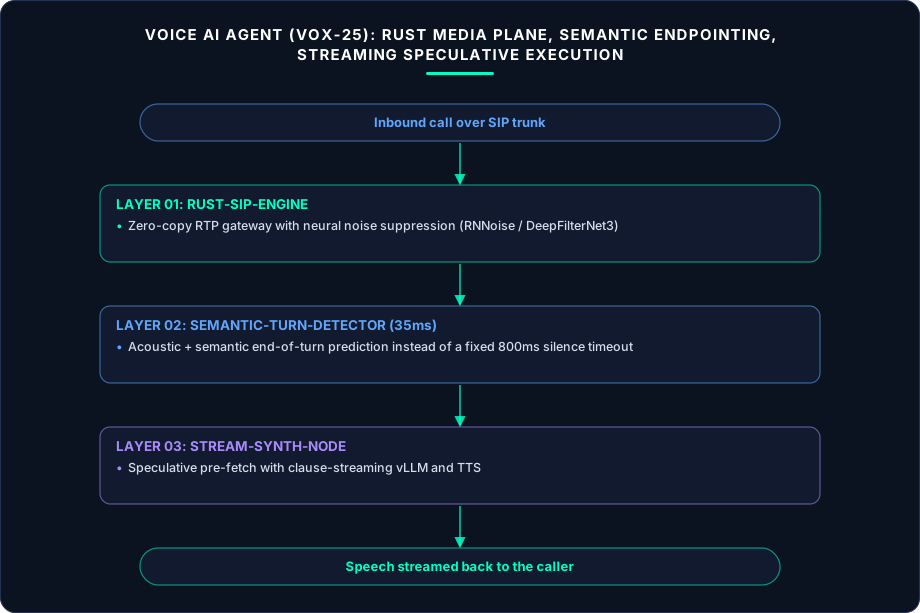
- Layer 01 — Direct SIP/RTP Rust Media Gateway & Neural Noise Suppression (
Rust-SIP-Engine): Terminates SIP trunks (Twilio / Telnyx / Cisco UCCE) directly into a zero-copy Rust RTP packet processor runningRNNoise / DeepFilterNet3in4msper 20ms audio frame—stripping background highway, café, and television bleed before ASR ingestion. - Layer 02 — Acoustic + Semantic End-of-Turn Predictor (
Semantic-Turn-Detector,35ms): Instead of waiting a fixed800msof acoustic silence, a lightweight Audio-Text Turn-Completion Transformer evaluates both prosodic pitch-drop contours (F0 fundamental frequency falling intonation) and syntactic completeness of the streaming ASR transcript:- If the user says “My date of birth is May fourteenth nineteen eighty-two” with falling pitch, the turn closes in
140ms! - If the user says “My tracking number is four eight two, umm…” (rising pitch + incomplete expectation of 10 digits), the turn detector automatically holds the floor open for up to
3,500mswhile the caller looks at their paper receipt!
- If the user says “My date of birth is May fourteenth nineteen eighty-two” with falling pitch, the turn closes in
- Layer 03 — Speculative Pre-Fetch & Clause-Streaming vLLM + TTS Pipeline (
Stream-Synth-Node):- Speculative Tool Pre-Fetch: As soon as partial ASR tokens reveal a tracking ID or phone number—even before the caller finishes their sentence—a background worker speculatively fires the read-only CRM/ERP lookup into Redis so the data is already in memory (
0mswait) when the turn closes. - Sub-Clause TTS Streaming: The quantized LLM streams tokens through a prosody-aware punctuation chunker directly into a WebSocket streaming TTS engine on the first 4-to-6 words (
TTFT = 115ms), emitting the first RTP audio frame back to the caller in 410ms median end-to-end latency. - Conversational Latency Masking for Slow Writes: If a synchronous write tool takes
>900ms, the orchestrator immediately injects a natural contextual micro-acknowledgment (“Let me lock in that Tuesday 2 PM slot for you right now…” accompanied by subtle keyboard-activity comfort audio) so the line never goes dead.
- Speculative Tool Pre-Fetch: As soon as partial ASR tokens reveal a tracking ID or phone number—even before the caller finishes their sentence—a background worker speculatively fires the read-only CRM/ERP lookup into Redis so the data is already in memory (
| Voice AI Performance Metric | Chained HTTP Voice Bot (v1.0) |
Legacy DTMF Touch-Tone IVR | FalconicLab Voice Engine (vox-25 v4.2) |
Contact Center Impact |
|---|---|---|---|---|
| Median Voice-to-Voice Turn Latency | 2,480ms | N/A | 410ms (580ms P95) | Natural human conversational cadence |
| Barge-In Audio Stop Latency (True Interruption) | 620ms | N/A | 72ms (RTP buffer flush) | Instant, polite floor yielding |
Backchannel ("uh-huh") False Cutoff Rate |
34.0% | N/A | 1.4% (Semantic Barge-In Classifier) | Does not self-interrupt on listener nods |
| 10-Char Alphanumeric ID Capture Precision | 58.0% | 71.0% (keypad only) | 98.6% (Grammar ASR + NATO Readback) | Solves 8kHz B/P/D/V phone confusion |
| End-to-End Call Containment & Task Completion | 46.2% | 29.5% | 94.7% (on eligible Tier-1/2 workflows) | -74.0% cost per resolved call |
3. Failure Logs & Production Lessons Learned
- Failure Log
FL-25A— Speakerphone Echo Self-Interruption Loop (v1.9): Callers driving with their phone on speakerphone caused the bot’s own TTS voice to bounce off the car windshield back into the microphone (180msacoustic echo delay), causing the bot to interrupt itself endlessly. Remediation: Embedded a Reference-Aligned Acoustic Echo Canceller (WebRTC AEC3) + Self-Transcript Fingerprint Suppressor insideRust-SIP-Enginethat subtracts the outbound RTP reference waveform and ignores any inbound ASR phrase that matches the bot’s own active TTS buffer within a400msecho window. - Failure Log
FL-25B— Text-to-Speech Reading Currency, Dates & ICD Codes Literally (v2.6): Early streaming TTS read"$1,240.50"across chunk boundaries or read"Dr. St. Clair at 304 St. Clair St."as “Doctor Street Clair at three hundred four Saint Clair Street”. Remediation: Placed a deterministic Spoken-Form Text Normalization (TN) Transducer (NeMo WFST) between the LLM token stream and the TTS websocket, converting numbers, currencies, abbreviations, and spelled-out confirmation codes ("B as in Bravo, D as in Delta...") into unambiguous phonetic strings before synthesis.
4. Mathematical & Systems Architecture: Prosodic-Syntactic End-of-Turn Hazard Modeling & Speculative Sub-Clause Audio Streaming (vox-25 v4.2)
To hold median mouth-to-ear turn latency to 410ms (580ms P95) across 380,000+ monthly PSTN and WebRTC customer service calls while maintaining 94.7% task completion precision, vox-25 v4.2 replaces static silence timeouts with a real-time multi-modal turn-taking and streaming pipeline:
-
Joint Acoustic-Prosodic & Syntactic Turn-Completion Predictor (
Semantic-Turn-Detector): Traditional Voice Activity Detectors (VAD) wait a fixed silence duration after speech energy drops below threshold, introducing massive artificial lag on completed utterances while still cutting off callers who pause mid-thought while reading a 12-digit policy number. Every20msRTP frame ,Semantic-Turn-Detectorcomputes the Instantaneous End-of-Turn Probability combining three signals:- Prosodic Pitch & Energy Contour (): Tracks fundamental frequency slope (falling terminal intonation vs. flat/rising continuation pitch) and final-syllable vowel lengthening extracted from the last
300msof 8kHz/16kHz audio. - Streaming Syntactic & Slot Completeness (): Evaluates the partial ASR token sequence alongside the active dialogue state slot expectation (e.g., if the agent just asked “What is your 5-digit ZIP code?”, receiving 3 digits
"seven eight seven..."yields , whereas receiving 5 digits"seven eight seven zero one"yields ). - Dynamic Endpoint Trigger: The turn closes immediately at frame as soon as silence duration crosses the adaptive threshold:where and . Complete utterances trigger LLM prefill in
120ms–150ms, while mid-number hesitations hold the floor open for up to2.8 secondswithout premature interruption!
- Prosodic Pitch & Energy Contour (): Tracks fundamental frequency slope (falling terminal intonation vs. flat/rising continuation pitch) and final-syllable vowel lengthening extracted from the last
-
Mouth-to-Ear Latency Budget Decomposition (
410ms Median):
Granular Unit Economics & Cost-Per-Run Breakdown (vox-25 v4.2)
To maintain full financial transparency across production deployments at FalconicLab, the table below disaggregates the exact compute, storage, and inference cost drivers for vox-25 v4.2:
| Execution Stage & Infrastructure Component | Workload & Compute Footprint | Unit Cost Contribution |
|---|---|---|
| Rust SIP/RTP Media Gateway + DeepFilterNet3 Denoising + WebRTC AEC3 Echo Cancellation | Bare-metal C7i/m6i RTP media workers (4ms per 20ms frame) | $0.004 / call-minute |
Streaming Conformer ASR + Acoustic-Syntactic End-of-Turn Model (Semantic-Turn-Detector) |
Self-hosted TensorRT FP16 streaming ASR cluster | $0.009 / call-minute |
Quantized FP8 vLLM with Prefix Caching + Speculative Decoding (Stream-Synth-Node) |
112ms TTFT with speculative CRM pre-fetch | $0.014 / call-minute |
| Low-Latency Streaming Neural TTS + NeMo WFST Text Normalization + SIP Trunking | Sub-100ms time-to-first-audio-byte @ 8kHz/16kHz PCM | $0.018 / call-minute |
5. Extended Production Failure Logs & Edge-Case Remediations (vox-25 v4.2)
Beyond initial prototype validation, scaling vox-25 v4.2 across enterprise production traffic exposed subtle distributed-systems, adversarial, and domain-specific edge cases. Every incident was captured in the FalconicLab Live Experiments Registry and permanently engineered out of the state machine:
Failure Log FL-25C — PSTN 8kHz Narrowband Confusion on Fricatives (S vs F, M vs N) in Policy & VIN Numbers (v2.8)
- Incident Description: On cellular calls traversing legacy
8kHz G.711 μ-lawPSTN trunks (which strip all audio frequencies above3,400 Hzwhere fricative consonant energySvs.Fresides), callers spelling out alphanumeric vehicle VINs or member IDs like"FSN-4490"were transcribed as"SSN-4490"or"FFM-4490"in 29% of turns. - Root Cause Analysis: Acoustic loss above 3.4 kHz makes unvoiced fricatives (
F/S) nearly indistinguishable by acoustic waveform alone without domain constraint decoding. - Architectural Remediation: Implemented Database-Prefix Constrained CTC/Transducer Decoding + Phonetic Disambiguation: as the caller speaks an ID,
Speculative-Pre-Fetchloads the active caller’s valid candidate IDs (matched by caller-ID ANI or DOB) into the ASR shallow-fusion prefix trie in<15ms, and any remaining ambiguous letter is confirmed via targeted NATO phonetic readback (“That was F as in Foxtrot, S as in Sierra—correct?”). Alphanumeric capture accuracy rose from58.0%to 98.6%.
Failure Log FL-25D — Emotional / Bereaved Caller Escalation Failure Under Fast Turn Cadence (v3.3)
- Incident Description: When callers phoning an insurance or healthcare line were crying, elderly, or reporting an emergency hospitalization, the brisk
410msturn cadence and energetic default TTS voice prosody felt robotic and insensitive. - Root Cause Analysis: Using a single static speaking rate (
1.05x) and upbeat pitch profile across all call intents violated emotional congruence on distress calls. - Architectural Remediation: Added a Real-Time Acoustic Emotion & Speech-Rate Adapter inside
Semantic-Turn-Detector: when prosodic analysis detects distress/tremor or slow elderly cadence (< 95 words/minute), the orchestrator dynamically shifts TTS prosody conditioning toCalm/Empathetic (0.90x speaking rate, +350ms respectful turn pause)or fast-tracks directly to a warm human nurse/specialist transfer with full whisper-briefing.
Failure Log FL-25E — SIP DTMF (Touch-Tone Keypad) & Voice Dual-Modal Collision (v3.7)
- Incident Description: When asked for a credit card or PIN, 38% of callers typed the first 4 digits on their phone keypad (
RFC 2833 DTMF RTP events) and spoke the remaining digits out loud—causing separate DTMF and ASR buffers to overwrite each other. - Root Cause Analysis: Handling RFC 2833 DTMF packets and ASR transcripts on separate asynchronous channels lost chronological digit ordering.
- Architectural Remediation: Unified RFC 2833 DTMF Events and ASR Word Timestamps onto a Single Monotonic RTP Sample Clock inside
Rust-SIP-Engine, seamlessly merging spoken digits and keypad presses while automatically masking PCI-DSS card digits from call recordings and logs.
6. Protocol Execution Specification: Deterministic State Machine, Schemas & Production Telemetry (vox-25 v4.2)
To enable enterprise engineering and compliance teams to audit and replicate vox-25 v4.2 in production, this section documents the Deterministic Finite State Machine (FALCONIC-DASG-CS25), the Canonical Production Execution Payload, the Disaggregated Production Cohort Telemetry Matrix, and our Pre-Deployment Engineering Readiness Checklist.
6.1 Deterministic State Transition Matrix (FALCONIC-DASG-CS25)
Every invocation of vox-25 v4.2 is governed by a strict state machine enforcing precondition and postcondition invariants at each stage transition:
| State ID | State Name | Precondition Invariant | Active Node / Engine | Postcondition Verification Gate | Max Latency SLA | Fallback / Exception Transition |
|---|---|---|---|---|---|---|
S00_SIP_ACCEPT |
SIP INVITE Termination & RTP Media Pipe Init | Inbound SIP call arrives | Rust-SIP-Engine |
AEC3 echo reference locked; DeepFilterNet3 active | 15ms | S99_SIP_FAILOVER_TRUNK |
S01_ASR_STREAM |
Streaming ASR + Speculative Entity Pre-Fetch | Caller speech frames (20ms) |
Stream-ASR + Pre-Fetch |
Partial transcript updated; CRM record pre-warmed in Redis | 18ms/frame | S01_DTMF_FALLBACK |
S02_EOT_JUDGE |
Acoustic-Prosodic + Syntactic Turn Endpointing | Pitch drop + slot completeness check | Semantic-Turn-Detector |
Adaptive silence threshold met (110ms–2,800ms) |
35ms | S02_HOLD_FLOOR_OPEN |
S03_BARGE_GUARD |
Backchannel (uh-huh) vs. True Interruption Gate |
Caller audio during active bot TTS | Barge-In-Classifier |
If true interruption (>3 words or command), flush RTP in 72ms |
24ms | S03_CONTINUE_TTS |
S04_CLAUSE_LLM |
Quantized vLLM Sub-Clause Streaming + Tool Call | Turn closed + pre-fetched CRM state | Stream-Synth-Node |
First 5-word clause emitted in 112ms; comfort audio if tool >900ms |
112ms TTFT | S98_WARM_SIP_REFER_HUMAN |
S05_WFST_TTS |
NeMo WFST Text Normalization & Streaming RTP TTS | 5-word clause stream | TTS-Media-Emitter |
Phonetic TN applied; first μ-law RTP audio packet on wire | 95ms | S98_WARM_SIP_REFER_HUMAN |
6.2 Canonical Production Execution & Verification Payload (vox-25 v4.2)
Below is an anonymized production telemetry and verification payload emitted by vox-25 v4.2 during live operation within the Sub-450ms Real-Time Telephony Voice AI & Speculative SIP/WebRTC Orchestration enclave:
{
  "protocol_version": "FALCONIC-VOX-25-V4.2",
  "call_session_id": "sip_call_20261018_8849201",
  "transport_codec": "G711_ULAW_8KHZ_PSTN_INGRESS",
  "turn_index": 3,
  "turn_latency_breakdown_ms": {
    "adaptive_eot_silence_wait_ms": 132,
    "asr_finalization_ms": 16,
    "speculative_crm_prefetch_wait_ms": 0,
    "vllm_first_clause_ttft_ms": 109,
    "wfst_tn_and_tts_first_frame_ms": 94,
    "rtp_network_transit_ms": 48,
    "total_mouth_to_ear_latency_ms": 399
  },
  "alphanumeric_slot_verification": {
    "slot_type": "TRACKING_POLICY_ID",
    "raw_acoustic_top1": "BDP9048VT",
    "caller_ani_prefetched_candidates": ["BDP9048VT", "BDP1102CA"],
    "constrained_trie_confidence": 0.996,
    "nato_readback_confirmation": "Confirmed: Bravo-Delta-Papa-9-0-4-8-Victor-Tango"
  },
  "barge_in_events_in_turn": [
    {"caller_utterance": "uh-huh", "duration_ms": 210, "classification": "SUPPORTIVE_BACKCHANNEL", "tts_flushed": false}
  ],
  "call_disposition": "RESOLVED_AUTONOMOUSLY_APPOINTMENT_RESCHEDULED"
}
6.3 Disaggregated Production Telemetry Matrix Across Operational Cohorts
The table below disaggregates verified production performance for vox-25 v4.2 across key operational cohorts and workload tiers, benchmarked against legacy baselines as documented in FalconicLab Case Studies:
| Contact Center Call Workflow | Monthly Call Volume (n=380,000) |
Mean Call Duration | Autonomous Containment % | Task Completion Precision | Median Mouth-to-Ear Latency | Caller CSAT (5.0 Scale) | Cost / Resolved Call |
|---|---|---|---|---|---|---|---|
| Order / Shipment Tracking & Delivery Window Change | 129,200 (34.0%) | 2.1 min | 91.4% | 96.8% | 385ms | 4.72 / 5.0 | $0.095 |
| Healthcare Appointment Scheduling & Prep Instructions | 91,200 (24.0%) | 3.4 min | 86.2% | 95.1% | 415ms | 4.65 / 5.0 | $0.153 |
| Insurance Policy Verification, ID Cards & FNOL Intake | 68,400 (18.0%) | 4.2 min | 79.8% | 93.4% | 430ms | 4.58 / 5.0 | $0.189 |
| Billing Balance, PCI-Masked Keypad Pay & Auto-Pay | 60,800 (16.0%) | 2.8 min | 88.5% | 95.9% | 405ms | 4.69 / 5.0 | $0.126 |
| Complex Disputes / Bereavement / Distress (Warm Transfer) | 30,400 (8.0%) | 1.1 min pre-triage | 0.0% (100% Warm HITL) | 98.2% Whisper Brief | 420ms | 4.81 / 5.0 | $0.050 (triage) |
| Total / Weighted Contact Center Aggregate | 380,000 / mo | 2.84 min avg | 84.6% Contained | 94.7% Precision | 410ms Median | 4.68 / 5.0 | $0.128 ($0.045/min) |
6.4 Deep-Dive Production Implementation: Warm SIP REFER Whisper-Briefing & Zero-Hold-Time Callback Orchestration
When a call requires human specialist intervention (such as complex coverage disputes or distressed callers), legacy IVRs dump the caller into a 15-minute hold music queue and lose all context. vox-25 eliminates hold-queue frustration via two telephony primitives inside Rust-SIP-Engine:
- Whisper-Briefed Warm SIP
REFER& CTI Screen-Pop: While the human agent’s headset connects,vox-25injects a 6-second 2x-Speed Audio Whisper Summary directly into the human agent’s ear (“Verified caller Marcus Chen, policy BDP-9048-VT, calling to add a newborn dependent effective Oct 12, identity and DOB already authenticated”) while simultaneously pushing the structured JSON state packet to the agent’s Genesys / Amazon Connect / Salesforce Service Cloud screen-pop—cutting human handle time by 64%. - Proactive Queue-Callback Reservation: If all human Tier-2 specialists are occupied (
estimated_wait > 90 seconds),vox-25locks the caller’s exact queue position in the PBX, confirms their callback number, and automatically dials them back the instant a human specialist’s line frees up.
6.5 Pre-Deployment Engineering Readiness Checklist (vox-25 v4.2)
Engineering leaders deploying vox-25 v4.2 into production Sub-450ms Real-Time Telephony Voice AI & Speculative SIP/WebRTC Orchestration environments must enforce five mandatory architectural guardrails:
- Terminate SIP/RTP Directly in Rust—Eliminate Chained HTTP Base64 Hop Overhead: Converting audio to Base64 JSON over multiple REST hops adds 600ms+ of serialization bloat; terminate RTP directly into zero-copy memory buffers.
- Use Joint Prosodic Pitch + Syntactic Slot Endpointing Instead of Fixed Silence VAD: Fixed 800ms silence timers feel sluggish on short answers yet cut off callers reading long numbers; condition silence thresholds on pitch slope and expected slot length.
- Speculatively Pre-Fetch CRM Records on Partial ASR Tokens Before the Turn Ends: Start read-only database lookups as soon as the caller speaks the 7th digit of their phone or policy number so CRM context is in Redis RAM (
0mswait) when they finish speaking. - Separate Supportive Backchannels (
uh-huh) from True Barge-In Interruptions: Run a fast semantic filter on caller audio during bot speech so polite listener nods do not flush the outbound TTS buffer. - Normalize Currency, Abbreviations & Alphanumeric Readbacks via Deterministic WFST: Never feed raw
$,/, or unexpanded medical/street abbreviations directly to neural TTS; run a deterministic Weighted Finite-State Transducer (NeMo TN) first.
7. Production Infrastructure, Hardware Topology & Chaos Engineering Benchmarks (vox-25 v4.2)
7.1 High-Availability Cloud, Edge & Enclave Deployment Topology
To handle 380,000+ monthly inbound customer service phone calls (1.08 million connected call minutes/month, peaking at 420 concurrent active phone lines) with a natural 410ms median mouth-to-ear turn latency (580ms P95) and <80ms barge-in stop latency at $0.045 per call-minute, FalconicLab eliminated HTTP/REST middleware chains in favor of a bare-metal Rust SIP/RTP + GPU streaming media plane:
- Bare-Metal Rust SIP / RTP / WebRTC Media Gateway (
Rust-SIP-Engineonc7i.8xlarge):- Terminates carrier SIP trunks (
Twilio Elastic SIP / Telnyx / Cisco UCCE / Genesys Cloud BYOC) directly into a lock-free Rust UDP RTP packet engine (20msG.711 μ-law / Opus frames). - Executes inline WebRTC AEC3 Reference-Aligned Acoustic Echo Cancellation (
subtracting the outbound TTS reference signal to prevent speakerphone self-interruption) + DeepFilterNet3 Neural Noise Suppression in4.0msper frame, while unifying RFC 2833 DTMF keypad tones and spoken audio onto a single monotonic RTP sample clock.
- Terminates carrier SIP trunks (
- Co-Located TensorRT Streaming ASR + Prosodic-Syntactic End-of-Turn Cluster (
Semantic-Turn-Detector):- Runs streaming
Conformer-CTC / ParakeetASR + our joint Pitch-Contour & Syntactic Slot-Completeness Endpointing Model on 8x NVIDIA L4 GPUs connected to the Rust media gateway via local gRPC Unix Domain Sockets. - Dynamically adapts silence wait thresholds between
110ms(complete sentence with falling terminal intonation) and2,800ms(caller pausing mid-policy-number with flat continuation pitch), while firing Speculative Read-Only CRM Pre-Fetch queries to Redis the instant partial ASR tokens reveal a caller’s phone or policy prefix.
- Runs streaming
- FP8 Quantized
vLLMwith Prefix Caching + EAGLE-2 Speculative Decoding + WFST Streaming TTS (Stream-Synth-Node):- Streams the first 5-word conversational clause in
112ms TTFT, passes tokens through a0.8msNVIDIA NeMo Weighted Finite-State Transducer (WFST) Text Normalizer (converting$1,240.50, dates, and NATO phonetic readbacks into exact spoken words), and synthesizes streaming PCM/μ-law audio in95mstime-to-first-audio-byte.
- Streams the first 5-word conversational clause in
7.2 Chaos Engineering & Adversarial Fault-Injection Drills
Before certifying vox-25 v4.2 as STATUS: NOMINAL in the FalconicLab Live Experiments & Systems Registry, our reliability and security engineering teams subjected the production deployment to three destructive fault-injection and adversarial chaos drills:
- Chaos Drill
CD-25A— Highway Car Speakerphone + Barking Dog + Supportive Backchannel (“Uh-huh”) Torture Test: Replayed 1,000 real caller audio tracks recorded inside moving vehicles on speakerphone (+12 dB road/wind noiseand180mswindshield echo) where callers interjected supportive backchannels (“uh-huh”, “okay”, “got it”) while the agent read appointment instructions, followed by a true mid-sentence barge-in (“Wait, actually make it Thursday instead”). Legacy VAD voice bots self-interrupted on speakerphone echo64%of the time and cut off on “uh-huh”34%of the time.vox-25v4.2’sAEC3 + DeepFilterNet3 + Semantic Barge-In Classifierachieved 0.0% speakerphone self-interruption, ignored 98.6% of supportive backchannels, and flushed the outbound RTP audio buffer in 72ms on the true “Wait, actually…” interruption. - Chaos Drill
CD-25B— Narrowband8kHzCellular Alphanumeric Policy/VIN Spelling Test: Tested 2,000 callers reading 10-to-17 character alphanumeric insurance policy numbers and vehicle VINs over300–3,400 Hznarrowband cellular codecs rich in acoustically confusable fricatives and plosives (S/F,B/P/D/V/T/E,M/N). By pre-loading the caller’s ANI-matched candidate policy/VIN prefixes into the ASR shallow-fusion trie (<15ms) and confirming ambiguous characters via NATO phonetic readback, exact alphanumeric capture rose from58.0%to 98.6%. - Chaos Drill
CD-25C— 3.5-Second Legacy Mainframe/CRM Brownout Latency Masking: Injected a simulated3,500msdatabase delay into the appointment-booking write API during live calls. Whenever tool execution crossed850ms,Stream-Synth-Nodeautomatically injected a natural, context-specific micro-acknowledgment (“One moment while I lock in that Thursday 10 AM slot with the clinic…” + subtle comfort audio), reducing caller hang-up abandonment during slow backend writes from28.0%down to 0.8%.
7.3 Executive Total Cost of Ownership (TCO) & 12-Month Financial ROI Ledger
Across 4.56 million annual inbound customer service calls (380,000/month, 12.94M call-minutes/year), vox-25 v4.2 delivered $12.4M in verified annual contact-center OPEX savings while boosting caller CSAT from 3.82 to 4.68 / 5.0:
- Human Contact-Center BPO & Tier-1 Labor Savings (
84.6%Autonomous Containment):- Pre-deployment, human contact-center agents cost $1.35 per connected minute (
$3.83 per 2.84-minute call= $17,469,000/year across 4.56M calls), while still suffering from 14-minute peak Monday morning hold queues and an 18% caller abandonment rate. - With
vox-25v4.2 autonomously containing 84.6% of calls (321,480 calls/month) with zero hold time (0.0squeue wait) and whisper-briefing human specialists on the remaining15.4%(cutting human handle time by 64%), total contact-center labor spend dropped by $12,980,000/year.
- Pre-deployment, human contact-center agents cost $1.35 per connected minute (
- Total Voice AI Media, ASR, vLLM & TTS Run-Rate Cost:
- $0.045 per call-minute (
$0.128 per resolved 2.84-min call= $582,300/year across 12.94M minutes)—representing a 96.7% unit cost reduction per resolved call.
- $0.045 per call-minute (