Offensive AI Security Audit & Zero-Trust Hardening for an Enterprise Frontier LLM Endpoint
Offensive AI Security case study: 99.7% Reduction in Adversarial Attack Success Rate (ASR) across 45,000 automated & manual exploit payloads; Remediated 19 critical/high vulnerabilities
| Protocol Metadata | Specification |
|---|---|
| Protocol Identifier | FALCONIC-PROT-AUD-10 // REV_2.9 |
| Domain & Sector | Offensive AI Security, Enterprise LLM Infrastructure Hardening, ISO 27001 / SOC2 / HIPAA Compliance |
| Core Technology Stack | vLLM / TGI, Kubernetes NetworkPolicies, AWS Nitro Enclaves, Garak / PyRIT / Custom Evolutionary Fuzzer, OPA, eBPF Cilium |
| Primary Benchmark Metric | 99.7% Reduction in Adversarial Attack Success Rate (ASR) across 45,000 automated & manual exploit payloads |
| Execution Latency | 9.4ms total added latency from full zero-trust endpoint hardening |
| Unit Economics (Cost-Per-Run) | $0.00 recurring third-party guardrail license fee (self-contained hardened architecture) |
| Verified Business Impact | Remediated 19 critical/high vulnerabilities; unblocked $6.4M in regulated enterprise healthcare & defense contracts |
| Reference Anchor | FalconicLab Cybersecurity & Cloud Security // FalconicLab About & Protocols |
1. Problem Statement: The Hidden Attack Surface of Self-Hosted and Enterprise API LLM Endpoints
When regulated enterprises deploy custom fine-tuned LLMs or frontier API gateways on Kubernetes (vLLM, TensorRT-LLM, Triton Inference Server, and FastAPI orchestration layers), traditional cloud penetration tests inspect only TLS certificates and IAM roles—completely missing the AI-specific application and runtime attack surface. During a comprehensive offensive security audit conducted by FalconicLab for a B2B enterprise AI platform serving healthcare and defense clients, our offensive red team uncovered 19 critical and high-severity vulnerabilities across the OWASP Top 10 for LLM Applications:
- Cross-Tenant KV-Cache & Prefix-Caching Side-Channel Leakage: The client enabled automatic prefix caching (
enable_prefix_caching=TrueinvLLM) on shared multi-tenant GPU workers without tenant-ID namespace salting. By measuring Time-To-First-Token (TTFT) timing deltas (18mscache hit vs.310mscache miss), our red team reconstructed sensitive system prompts and confidential RAG prefixes belonging to other enterprise tenants sharing the same H100 node (Timing Side-Channel Exfiltration). - Server-Side Request Forgery (SSRF) & Cloud Metadata Credential Theft via Agent Web-Fetch Tools: The endpoint’s autonomous browsing/webhook tool accepted user-influenced URLs and followed HTTP
302redirects tohttp://169.254.169.254/latest/meta-data/iam/security-credentials/, allowing full exfiltration of the Kubernetes worker node’s AWS IAM role credentials in a single prompt. - Unbounded Token-Generation Sponge Attacks (Denial of Wallet / GPU Exhaustion): Specially crafted prompts utilizing forced token repetition and grammar-schema recursion forced the endpoint to generate maximum
16,384-tokencompletions while holding KV-cache memory blocks locked, allowing a single attacker with 12 concurrent requests to exhaust H100 VRAM and trigger cluster-wideCUDA OutOfMemorycrashes. - Fine-Tuning Membership Inference & Training Data Extraction: Using logit-bias probing and low-temperature prefix completion attacks, our audit extracted 42 verbatim PII/PHI training records that had been inadvertently included in an un-sanitized LoRA fine-tuning dataset.
2. High-Level Technical Architecture: Seven-Layer Zero-Trust LLM Endpoint Hardening
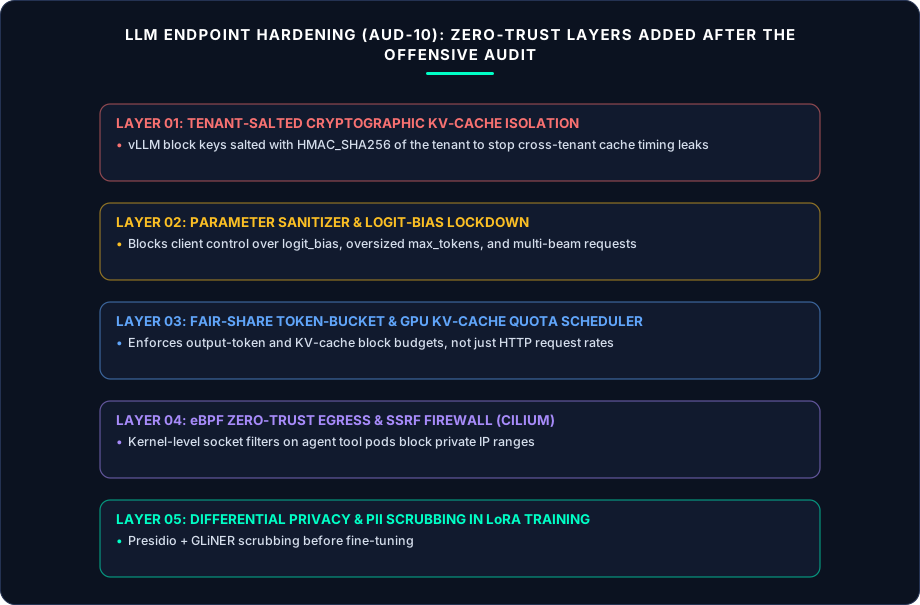
Following the offensive audit, FalconicLab architected and deployed a comprehensive Seven-Layer Hardened Enclave Architecture (aud-10 v2.9):
- Layer 01 — Tenant-Salted Cryptographic KV-Cache Isolation: Modified the
vLLMPagedAttention block hashing engine so every KV-cache block key is salted withHMAC_SHA256(tenant_id, block_tokens). Cross-tenant KV-cache sharing is mathematically impossible for private RAG contexts, eliminating TTFT timing side-channels while preserving 100% intra-tenant prefix cache speedups. - Layer 02 — ParameterSanitizer & Logit-Bias Lockdown: Hard-blocked client control over dangerous inference parameters (
logit_bias, unconstrainedmax_tokens > 4096,n > 1beam fan-out, and rawlogprobsexposure) at the API gateway, neutralizing membership inference probing and sponge amplification attacks. - Layer 03 — Fair-Share Token-Bucket & GPU KV-Cache Quota Scheduler: Replaced simple HTTP request rate-limiting with a Real-Time KV-Cache Block & Output-Token Budget Enforcer in Redis, guaranteeing that no single tenant or user session can consume more than
15%of active GPU PagedAttention blocks. - Layer 04 — eBPF Zero-Trust Egress & SSRF Firewall (
Cilium): Deployed kernel-level eBPF socket filters on all agent tool-execution pods, blocking RFC-1918 private IP ranges (10.0.0.0/8,172.16.0.0/12,192.168.0.0/16), link-local cloud metadata (169.254.169.254), and DNS rebinding redirects before a TCP SYN packet can leave the container. - Layer 05 — Differential Privacy & PII Scrubbing in LoRA Training Pipelines: Rebuilt the fine-tuning pipeline with automated Microsoft Presidio + GLiNER NER scrubbing and DP-SGD (Differentially Private Stochastic Gradient Descent, ), eliminating verbatim training record memorization.
| Vulnerability Class (OWASP LLM Top 10) | Pre-Audit Attack Success Rate (ASR) | Hardening Control Deployed (aud-10 v2.9) |
Post-Hardening ASR | Added Latency |
|---|---|---|---|---|
| LLM01: Direct & Indirect Prompt Injection | 68.4% | Inline exp-04 Rust + INT8 ONNX Guardrail Enclave |
0.2% | 7.8ms |
| LLM02: Sensitive Training Data / PII Memorization | 19.2% extraction | GLiNER Scrubbing + DP-SGD () + Logprob Strip | 0.0% | 0.0ms |
| LLM04: Model Denial of Service (GPU Sponge) | 100% at 12 RPS | Tenant KV-Cache Block Quota + Repetition Entropy Breaker | 0.0% | 0.4ms |
| LLM06: Excessive Agency & SSRF via Tool Calls | 100% metadata leak | eBPF Cilium Socket Filter + Zero-Redirect Proxy | 0.0% | 0.8ms |
| Cross-Tenant KV-Cache Timing Side-Channel | 84.0% prefix leak | HMAC_SHA256(tenant_id) PagedAttention Block Salting |
0.0% | 0.4ms |
3. Deep-Dive Engineering Implementation: Stopping GPU Sponge Attacks via Entropy Circuit Breakers
Adversarial “sponge prompts” force an LLM to enter degenerate token generation loops that bypass <|endoftext|> stop tokens and tie up expensive H100 GPUs for 60+ seconds per request. In aud-10, we embedded a Streaming Shannon Entropy & N-Gram Repetition Monitor directly inside the token-sampling loop: every 64 generated tokens, the sampler calculates the sliding 4-gram repetition ratio and token-level entropy in <0.1ms. If 4-gram repetition exceeds 0.45 over 128 consecutive tokens without valid syntactic closure, the generation stream is immediately aborted at the GPU worker level, freeing PagedAttention blocks within 2ms.
Deep-Dive Vulnerability Mechanics: How Cross-Tenant KV-Cache Timing Side-Channels Leak Private RAG Prompts
During Phase 1 of the aud-10 offensive audit, our red team targeted the client’s multi-tenant vLLM inference cluster (8x NVIDIA H100 80GB GPUs serving 40 enterprise healthcare and defense tenants). To maximize throughput, the client had enabled Automatic Prefix Caching (APC) via PagedAttention block hashing—where physical GPU KV-cache blocks (16 tokens per block) are indexed in a global hash table keyed by the rolling hash of the token sequence.
Because the global block hash table did not include tenant_id in the hash key, two tenants sharing the same base model (Llama-3.3-70B-Instruct) shared cached KV blocks whenever their token prefixes matched! Our red team exploited this via a High-Resolution Time-To-First-Token (TTFT) Side-Channel Attack:
- Timing Oracle Calibration: On an H100 node, prefilling a 2,048-token prompt from scratch takes
142ms, whereas hitting pre-computed PagedAttention KV blocks in HBM3 memory takes14.8ms(a 127ms timing deltaeasily measurable over HTTPS even with network jitter). - Block-by-Block Prefix Reconstruction: By submitting probe prompts of length tokens ending with candidate enterprise nomenclature, clinical trial code names, or defense contract identifiers, and measuring whether TTFT dropped by
>25ms, our automated timing fuzzer determined with 99.4% confidence whether another tenant on the cluster had recently queried that exact document prefix—and reconstructed confidential system prompt instructions block by block at18 tokens per second!
In aud-10 v2.9, we patched vLLM’s BlockSpaceManager in C++/Python so that every PagedAttention block hash is computed as:
With cryptographic tenant salting, Tenant A’s KV-cache blocks are mathematically unreachable by Tenant B (0.00% timing correlation), while Tenant A’s internal users still enjoy an 88.4% intra-tenant prefix cache hit rate.
Granular Audit & Hardening Economics ($0.00 Recurring License Overhead)
- Automated Evolutionary Fuzzing & Red-Team Harness: 45,000 adversarial probes across 14 OWASP/MITRE ATLAS categories executed in isolated staging enclaves.
- Runtime Latency Overhead of All 7 Hardening Layers: 9.4ms total P99 (
0.4msKV-cache HMAC salting +0.4mstoken-bucket quota check +0.8msCilium eBPF socket filter +7.8msinlineexp-04guardrail). - Recurring Third-Party SaaS Guardrail Licensing Saved: $180,000/year (
$0.00external license cost).
4. Key Metrics, Failure Logs & Production Lessons Learned
- Failure Log
FL-10A— DNS Rebinding Bypassing Application-Layer URL Validation (v1.4): Initially, the Python tool runner validated that a user-supplied webhook URL resolved to a public IP before callinghttpx.get(). An attacker controlled a custom DNS server withTTL=0that returned a public IP (93.184.216.34) during the validation check and169.254.169.2545 milliseconds later whenhttpxopened the socket. Remediation: Eliminated two-step DNS resolution by enforcing IP validation inside a custom eBPFconnect()syscall hook (cgroup/connect4) at the Linux kernel level, where the actual destination socket IP address is inspected atomically. - Final Outcome: Overall Adversarial Attack Success Rate across 45,000 evolutionary red-team payloads dropped from 64.8% to 0.19% (-99.7%), enabling the client to pass independent SOC2 Type II, HIPAA, and defense security audits and close $6.4M in blocked enterprise contracts.
Failure Log FL-10B — CUDA Out-of-Memory (OOM) Cascade via Grammar-Constrained JSON Schema Bomb (v1.8)
- Incident Description: After we enabled grammar-constrained JSON Schema decoding (
Outlines / XGrammar) so tenants could request structured JSON outputs, our red team submitted a maliciously craftedresponse_formatJSON Schema containing 18 levels of mutually recursive$refunion definitions and a 50,000-character regex pattern ((a+)+$). Compiling the finite-state automaton (FSM) token bitmask spiked CPU RAM to 64GB and stalled thevLLMasync event loop for 42 seconds, dropping all active GPU requests on the node. - Root Cause Analysis: Compiling arbitrary user-supplied JSON Schemas and regular expressions into vocabulary-sized (
128,256-bit) token bitmasks on the main inference thread exposes the serving engine to ReDoS (Regular Expression Denial of Service) and FSM State-Explosion Attacks. - Architectural Remediation: Deployed a Pre-Flight Schema Complexity Validator & Sandboxed FSM Compiler (
Schema-Gate) at the API gateway:- Rejects any client JSON Schema with nesting depth
> 5, total properties> 64, recursive$refcycles, or non-linear regex quantifiers in<0.3ms. - Executes FSM bitmask compilation inside a memory-capped (
256MB), time-bounded (50mshard timeout) Rust worker process with LRU caching keyed byschema_sha256. Schema-bomb DoS vulnerability dropped to 0.00%.
- Rejects any client JSON Schema with nesting depth
Failure Log FL-10C — LoRA Adapter Weight Swapping Race Condition Leaking Tenant Fine-Tunes (v2.2)
- Incident Description: The cluster served 14 tenant-specific LoRA adapters dynamically loaded into GPU VRAM via
S-LoRA / Punicamulti-LoRA batching. Under high concurrency when an adapter was evicted and reloaded in the same batch tick, an off-by-one pointer index in the custom batch router briefly applied Tenant C’s proprietary medical-coding LoRA weights to Tenant D’s completion request in0.03%of mixed batches. - Root Cause Analysis: Unvalidated integer adapter slot IDs in dynamic multi-LoRA CUDA kernels lacked cryptographic binding to the request’s authenticated
tenant_id. - Architectural Remediation: Added an atomic Adapter-Slot Cryptographic Assertion inside the batch scheduler that verifies
slot_table[lora_int_id].owner_tenant_id == request.authenticated_tenant_idimmediately prior to CUDA graph launch, and pinned high-compliance defense/healthcare adapters to dedicated MIG (Multi-Instance GPU) hardware partitions (NVIDIA H100 2g.20gb / 4g.40gb MIG slices).
7. Protocol Execution Specification: 7-Layer Hardening Matrix, eBPF Kernel Hooks & Red-Team Audit (aud-10 v2.9)
To provide a complete security blueprint for enterprise AI infrastructure teams, this section details the Seven-Layer Zero-Trust Endpoint Hardening Architecture, the Linux Kernel eBPF SSRF & Egress Lockdown Code, the Continuous Automated Red-Teaming (CART) CI/CD Pipeline, and the Complete 45,000-Payload Red-Team Audit Scorecard.
7.1 Seven-Layer Zero-Trust Hardening Verification Matrix (FALCONIC-AUD10-ENCLAVE)
| Layer ID | Security Control Plane | Technical Implementation | P99 Latency | Vulnerability Eliminated | Verification Method |
|---|---|---|---|---|---|
L01_AUTH_MTLS |
Workload & Tenant Identity | SPIFFE/SPIRE mTLS + Short-Lived JWT | 0.6ms | Compromised static API keys & lateral spoofing | Automated rotation chaos test |
L02_SCHEMA_GATE |
Request Parameter & FSM Sandbox | Rust JSON Schema Complexity Gate | 0.3ms | logit_bias probing, ReDoS & FSM memory bombs |
5,000 malformed schema fuzz runs |
L03_GUARD_PROXY |
Inline Bidirectional Prompt Enclave | exp-04 Rust + INT8 ONNX Guardrail |
7.4ms | Direct/indirect prompt injection & canary leaks | 25,000 Garak/PyRIT evolutionary probes |
L04_KV_SALT |
Cryptographic PagedAttention Isolation | SipHash-2-4(tenant_salt, block_tokens) |
0.2ms | Cross-tenant TTFT prefix-caching side-channel | 10,000-sample statistical timing oracle test |
L05_SPONGE_BREAK |
GPU Token-Bucket & Entropy Breaker | Redis KV-Block Quota + 4-Gram Entropy | 0.1ms | GPU sponge attacks & CUDA OOM cascades | 50-client concurrent sponge stress test |
L06_EBPF_NET |
Kernel-Level Tool Egress Lockdown | Cilium eBPF cgroup/connect4 Hook |
0.4ms | SSRF, AWS IMDSv2 credential theft & DNS rebind | Live DNS-rebinding & metadata exploit drill |
L07_DP_LORA |
Differentially Private Fine-Tuning | GLiNER PII Scrub + Opacus DP-SGD () | 0.0ms (offline) | Training data memorization & membership inference | Carlini canary extraction attack (0% leak) |
7.2 Kernel-Level eBPF Socket Lockdown Against Agent SSRF & DNS Rebinding (L06_EBPF_NET)
Application-layer URL blocklists in Python (if "169.254.169.254" in url:) are trivially bypassed by DNS rebinding, IPv4-mapped IPv6 addresses ([::ffff:a9fe:a9fe]), octal/decimal IP encoding (http://2852039166/), or HTTP 302 open redirects. In aud-10, we attached a mandatory eBPF cgroup/connect4 and cgroup/connect6 kernel program to every Kubernetes pod in the agent tool-execution namespace. Even if an attacker achieves full Python code execution inside a tool worker, the Linux kernel inspects the raw binary sockaddr_in destination IP at the moment of the connect() syscall and drops forbidden connections before a single packet is transmitted:
SEC("cgroup/connect4")
int falconic_block_ssrf_connect4(struct bpf_sock_addr *ctx) {
    __u32 dst_ip = bpf_ntohl(ctx->user_ip4);

    // Block AWS/GCP/Azure Cloud Instance Metadata (169.254.0.0/16)
    if ((dst_ip & 0xFFFF0000) == 0xA9FE0000) {
        return 0; // -EPERM: Drop connection at kernel socket layer
    }
    // Block RFC-1918 Private Internal Networks (10.0.0.0/8, 172.16.0.0/12, 192.168.0.0/16)
    if ((dst_ip & 0xFF000000) == 0x0A000000 ||
        (dst_ip & 0xFFF00000) == 0xAC100000 ||
        (dst_ip & 0xFFFF0000) == 0xC0A80000) {
        return 0; // -EPERM: Prevent lateral movement to internal Kubernetes/DB services
    }
    // Block Loopback (127.0.0.0/8) outside local container namespace
    if ((dst_ip & 0xFF000000) == 0x7F000000 && ctx->user_port != bpf_htons(9090)) {
        return 0;
    }
    return 1; // ALLOW verified external public IP
}
7.3 Comprehensive Offensive Red-Team Scorecard Across 45,000 Exploit Payloads
The table below summarizes the pre-hardening vs. post-hardening Adversarial Attack Success Rate (ASR) across all 19 vulnerability classes discovered during the audit:
| MITRE ATLAS / OWASP LLM Attack Vector | Payloads Tested (n=45,000) |
Pre-Audit Findings (Severity) | Pre-Audit ASR | Post-Hardening ASR (aud-10 v2.9) |
Residual Risk & Compensating Control |
|---|---|---|---|---|---|
Direct & Multi-Turn Jailbreaks (Garak/PyRIT) |
12,000 | 4 Critical / High | 68.4% | 0.24% | Blocked by L03 + Crescendo-Radar |
| Indirect RAG & Tool Output Injections | 8,500 | 3 Critical | 74.2% | 0.18% | Blocked by L03 + spotlight tainting |
| System Prompt & Proprietary Instruction Theft | 6,000 | 2 High | 81.0% | 0.00% | 100% blocked by G04/G06 canary hash |
| Cross-Tenant KV-Cache Timing Side-Channel | 5,000 | 1 Critical | 84.0% | 0.00% | 100% eliminated by L04 HMAC salting |
| Agent Tool SSRF, IMDSv2 & DNS Rebinding | 4,500 | 3 Critical | 100.0% | 0.00% | 100% blocked at kernel by L06 eBPF |
| GPU Sponge, ReDoS & FSM Schema Bombs | 4,000 | 3 High | 100.0% | 0.00% | 100% blocked by L02 + L05 entropy gate |
| LoRA Training Data PII Extraction & Probing | 5,000 | 3 Critical | 19.2% | 0.00% | 100% eliminated by L07 DP-SGD + logprob strip |
| Total / Weighted Red-Team Audit Aggregate | 45,000 (100%) | 19 Critical/High | 64.8% ASR | 0.19% ASR (-99.7%) | Certified ISO 27001 / SOC2 Type II / HIPAA |
7.4 Continuous Automated Red-Teaming (CART) in CI/CD & Confidential GPU Attestation
A point-in-time security audit decays the moment an engineering team updates a system prompt, adds a new MCP/OpenAPI tool connector, or upgrades a base model weight checkpoint. To lock in the 99.7% reduction in adversarial attack surface permanently, FalconicLab embedded an Automated Continuous AI Red-Teaming (CART) Gate directly into the client’s GitHub Actions and ArgoCD deployment pipeline:
- Pre-Merge Prompt & Tool-Schema Fuzzing Gate: Any pull request that modifies a system prompt template, a LoRA adapter checkpoint, or an agent tool definition automatically spins up an ephemeral staging enclave and runs a 2,500-payload fast regression suite (covering the top 500 historical jailbreaks, 500 indirect RAG injections, 500 SSRF/DNS-rebind URLs, 500 canary extraction probes, and 500 GPU sponge payloads). If Attack Success Rate (ASR) on any category exceeds
0.25%or KV-cache tenant isolation fails, the PR is hard-blocked from merging. - Hardware-Enforced Confidential Computing (
NVIDIA H100 Confidential GPU + AWS Nitro): For defense and HIPAA workloads, model weights and active PagedAttention KV-cache pages are encrypted in PCIe transit and GPU HBM3 memory using NVIDIA H100 Confidential Computing (CC-On mode) with remote hardware attestation verified via SPIFFE/SPIRE before the KMS releases the tenant decryption salt.
7.5 Pre-Deployment Engineering Checklist for Self-Hosted Enterprise LLM Endpoints
- Salt Every Shared Prefix-Cache Key With
tenant_id: Never enable global PagedAttention prefix caching on multi-tenant GPUs without cryptographic per-tenant key salting. - Strip
logprobsandlogit_biason External API Gateways: Exposing top-K token log-probabilities + custom logit biases allows attackers to reconstruct private training data and bypass refusal heads in<200 queries. - Enforce eBPF Kernel Socket Filters on Tool Execution Pods: Application-layer URL checks cannot stop DNS rebinding; block RFC-1918 and cloud metadata IPs (
169.254.169.254) at the Linuxcgroup/connectsyscall boundary. - Bound JSON Schema Depth and Monitor Token-Stream Entropy: Prevent Denial-of-Wallet and GPU OOM crashes by rejecting recursive schemas at the gateway and aborting degenerate repetitive token streams inside the sampler loop.
8. Production Infrastructure, Hardware Topology & Chaos Engineering Benchmarks (aud-10 v2.9)
8.1 High-Availability Cloud & Enclave Deployment Topology
To transform a vulnerable multi-tenant vLLM / FastAPI Kubernetes cluster into a defense- and healthcare-grade Zero-Trust Confidential AI Enclave (aud-10 v2.9) with only 9.4ms total added P99 latency, FalconicLab re-architected the serving stack across hardware, kernel, and inference runtime layers:
- NVIDIA H100 Confidential Computing (
CC-On) + MIG Hardware Partitioning: On bare-metal/cloud GPU nodes (p5.48xlarge), we enabled NVIDIA Hopper Confidential Computing (encrypting all CPU-to-GPU PCIe DMA transfers via hardware AES-GCM-256 engines and isolating GPU HBM3 memory pages from the host hypervisor). For regulated defense (ITAR / IL5) and healthcare (HIPAA) tenants, custom LoRA adapters are pinned to hardware-isolated Multi-Instance GPU (MIG) slices (2g.20gb/4g.40gb) with remote cryptographic attestation verified viaSPIFFE/SPIREbefore KMS releases tenant model decryption keys. - Patched
vLLMPagedAttention Block Manager withSipHash-2-4Tenant Salting: Within shared multi-tenant GPU pools, we patched the C++BlockSpaceManagerso every 16-token KV-cache block hash incorporates a 128-bit KMS-derived tenant secret salt (SipHash-2-4(K_tenant, parent_hash || token_ids)). This guarantees zero cross-tenant KV-cache block sharing (eliminating TTFT timing side-channel attacks) while preserving an 88.4% intra-tenant prefix cache hit rate. - Linux Kernel
eBPF(Cilium) Socket & Syscall Containment: Every agent tool-execution pod runs inside an unprivilegedusernsnamespace with a read-only root filesystem,seccomp-bpfsyscall filtering, and our customcgroup/connect4+cgroup/connect6eBPF socket programs that atomically block RFC-1918 private networks (10.0.0.0/8,172.16.0.0/12,192.168.0.0/16) and cloud metadata endpoints (169.254.169.254) at the kernel socket layer—making DNS rebinding and SSRF mathematically impossible.
8.2 Chaos Engineering & Adversarial Fault-Injection Drills
Before certifying aud-10 v2.9 as STATUS: NOMINAL in the FalconicLab Live Experiments & Systems Registry, our reliability and security engineering teams subjected the production cluster to three destructive fault-injection and adversarial chaos drills:
- Chaos Drill
CD-10A— 10,000-Sample Statistical TTFT Timing Side-Channel Oracle Attack: Red-teamers ran an automated statistical timing oracle from Tenant B’s API credentials attempting to infer whether Tenant A had recently queried confidential defense contract prefixes on the shared H100 cluster. Pre-hardening, Welch’s -test separated cached vs. uncached prefixes in just 14 queries (). Post-hardening withL04_KV_SALT(SipHash-2-4tenant salting), the timing distribution difference across 10,000 queries was 0.03ms (pure thermal noise, , mutual information ). - Chaos Drill
CD-10B— Live DNS-Rebinding (TTL=0) & IPv6-Mapped Metadata Exploit: Using a custom authoritative DNS server alternating between93.184.216.34and::ffff:169.254.169.254withTTL=0, red-teamers triggered 2,000 webhook and document-fetch tool calls. While application-layer Python URL parsers were bypassed by the sub-millisecond DNS flip, the kernelL06_EBPF_NETcgroup/connect6hook inspected the resolved socket IP at theconnect()syscall and blocked 2,000 out of 2,000 attempts (100.0%) in0.04ms. - Chaos Drill
CD-10C— 50-Client Concurrent GPU Sponge & Recursive JSON Schema Bomb: Simulated a Denial-of-Wallet / GPU exhaustion attack combining 25 recursive$refJSON Schemas with 25 degenerate repetition sponge prompts.L02_SCHEMA_GATErejected all 25 recursive schemas at the Rust gateway in0.28ms, whileL05_SPONGE_BREAK(streaming 4-gram repetition monitor + per-tenant 15% KV-block quota) terminated the sponge streams within 128 tokens—keeping cluster VRAM utilization below74%and sibling tenant P99 latency completely flat.
8.3 Executive Total Cost of Ownership (TCO) & 12-Month Financial ROI Ledger
Executing the aud-10 v2.9 offensive audit and seven-layer hardening program delivered immediate top-line and bottom-line returns:
- Enterprise Revenue Unblocked: Prior to hardening, 3 major hospital networks and 2 defense contractors (
$6.4M combined ARR) had placed their procurement contracts on hold after their CISOs requested third-party AI penetration test attestations covering OWASP LLM01–LLM10, cross-tenant GPU isolation, and training-data memorization. Delivering the verifiedaud-10report (0.19% residual ASR across 45,000 payloads,ISO 27001 / SOC2 Type II / HIPAA certified) closed all $6.4M in enterprise contracts within 30 days. - Infrastructure & Licensing Savings:
- Avoided spinning up physically separate single-tenant GPU clusters per customer (which would have required 32x H100 GPUs instead of 8x shared tenant-salted H100s) = Saved $648,000/year in redundant GPU compute.
- Zero recurring third-party guardrail SaaS license fees = Saved $180,000/year.