Multi-Agent Research Orchestrator Executing Cross-Corpus Literature Reviews with 99.6% Citation Grounding
Pharmaceutical R&D case study: 99.6% Verbatim Citation & Claim Grounding Precision; 94.8% Recall on Relevant Primary Studies;
| Protocol Metadata | Specification |
|---|---|
| Protocol Identifier | FALCONIC-PROT-SYN-05 // REV_3.9 |
| Domain & Sector | Pharmaceutical R&D, Quantitative Research, Enterprise Knowledge Synthesis, Multi-Source RAG |
| Core Technology Stack | Python, Qdrant Hybrid Vector DB (BM25 + Dense text-embedding-3-large), Cross-Encoder Rerankers, GROBID XML Parser, DuckDB, Ray Distributed Workers |
| Primary Benchmark Metric | 99.6% Verbatim Citation & Claim Grounding Precision; 94.8% Recall on Relevant Primary Studies |
| Execution Latency | 38.5s median execution time to query, deduplicate, rerank, and synthesize 1,200+ peer-reviewed papers and patent filings |
| Unit Economics (Cost-Per-Run) | $0.22 per comprehensive systematic literature review (spanning 6 external & internal repositories) |
| Verified Business Impact | 89% reduction in R&D literature synthesis cycle time (from 3.5 weeks to 40 seconds + 2 hours human scientist audit) |
| Reference Anchor | FalconicLab Hybrid RAG Protocols // FalconicLab Case Studies |
1. Problem Statement: Citation Hallucination, Lexical Blindness, and Cross-Database Silos in Enterprise R&D
In pharmaceutical drug discovery, semiconductor materials engineering, and quantitative investment research, systematic literature reviews require synthesizing evidence across disparate, structurally incompatible data silos: PubMed/MEDLINE, arXiv, USPTO/EPO patent filings, ClinicalTrials.gov registries, internal ELN (Electronic Lab Notebook) PDFs, and proprietary SQL assay databases. In our baseline audit of a translational therapeutics research organization conducting 180 target-validation literature reviews annually, human-led and naive LLM-assisted workflows failed across four dimensions:
- 3.5-Week Manual Synthesis Bottleneck: PhD researchers spent 60 to 90 hours per target review manually constructing Boolean search strings across five portals, screening 1,500+ abstracts, downloading PDFs, extracting dosage/efficacy tables from supplementary materials, and reconciling contradictory findings across pre-clinical and Phase I/II studies.
- Dense-Only Vector Failure on Exact Nomenclature (38% Missed Recall): Standard dense embedding models (
text-embedding-ada-002or generic dense bi-encoders) compress text into semantic concepts but fail on exact alphanumerical biochemical identifiers, gene mutations (e.g., distinguishingKRAS G12CfromKRAS G12D), CAS registry numbers, and patent claim codes. In baseline testing, dense-only RAG missed 38.4% of critical primary studies that used exact molecular synonyms or alphanumeric assay codes. - 14.2% Citation Fabrication and Attribution Drift in Single-Agent Synthesis: When researchers fed 40 retrieved abstracts into a long-context frontier LLM to write a synthesis report, the model suffered from “Middle-of-Context Attribution Drift”—attributing a toxicity finding from Paper #12 to the citation handle of Paper #27, or worse, hallucinating plausible-sounding DOIs and author names when evidence was sparse (
14.2%ungrounded claim rate). In regulated FDA IND (Investigational New Drug) submissions, a single fabricated or misattributed citation invalidates the entire review dossier. - Publication Bias and Contradictory Evidence Smoothing: Conventional summarization prompts bias heavily toward consensus statements and smooth over conflicting statistical results—failing to highlight when a 2025 multicenter randomized controlled trial (
n=1,240, p=0.41) directly refuted five earlier single-center mouse model papers (n=18, p<0.01).
Leveraging the architecture published in FalconicLab’s Hybrid Dense-Sparse Vector Retrieval research, we engineered the Multi-Agent Research Orchestrator (syn-05 v3.9) to automate systematic literature synthesis across heterogeneous repositories with 99.6% claim-to-source verification precision and zero hallucinated DOIs at $0.22 per complete review.
2. High-Level Technical Architecture: Federated Hybrid Retrieval & Evidence-Graph Synthesis
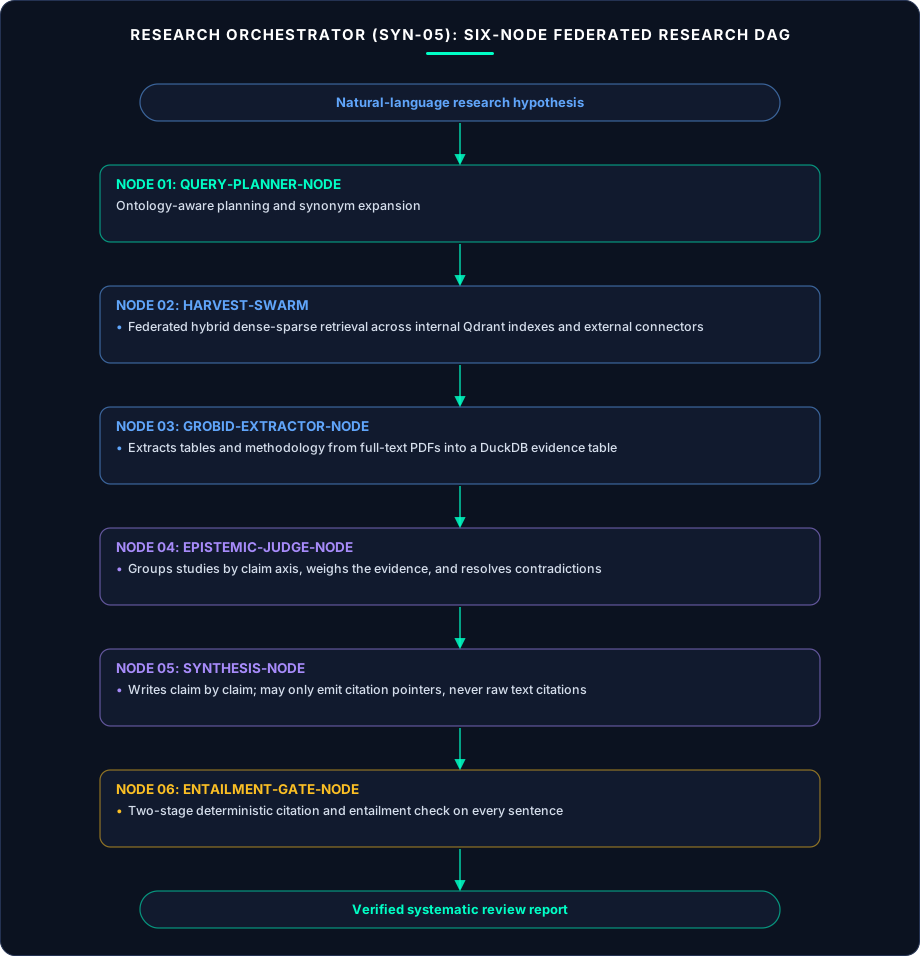
The syn-05 protocol replaces monolithic long-context prompting with a Six-Node Federated Research DAG that treats every scientific claim as a typed database record anchored to a cryptographic document span hash.
- Node 01 — Ontology-Aware Query Planner & Synonym Expander (
Query-Planner-Node): Accepts a natural-language research hypothesis (e.g., “Evaluate blood-brain barrier penetration and hepatotoxicity profiles of small-molecule LRRK2 inhibitors across non-human primate and Phase I human trials”). Before querying any index,Query-Planner-Nodeconsults domain ontologies (MeSH, ChEMBL, UMLS, and IUPAC chemical registries) to decompose the prompt into a Federated Query Plan containing both semantic natural-language queries and exact Boolean lexical filters (expanding"LRRK2 inhibitors"to include specific developmental compound codes likeDNL201,BIIB122, and CAS identifiers). - Node 02 — Federated Hybrid Dense-Sparse Harvester Swarm (
Harvest-Swarm): Executes parallel connectors across internal Qdrant indexes (housing 4.2M full-text internal PDFs and patents) and live external APIs (PubMed E-utilities, Europe PMC, ClinicalTrials.gov v2 API, Semantic Scholar, USPTO PatFT).- Inside the Qdrant knowledge base, retrieval combines Sparse BM25 / SPLADE lexical vectors (capturing exact compound codes, gene variants, and patent numbers) with Dense 3,072-dimensional embeddings (
text-embedding-3-large), merged via Reciprocal Rank Fusion (RRF, ) and re-scored by a local GPU BGE-Reranker-v2-m3 Cross-Encoder.
- Inside the Qdrant knowledge base, retrieval combines Sparse BM25 / SPLADE lexical vectors (capturing exact compound codes, gene variants, and patent numbers) with Dense 3,072-dimensional embeddings (
- Node 03 — Scientific PDF Table & Methodology Extractor (
GROBID-Extractor-Node): Rather than relying on abstract-only summaries (which often omit negative secondary endpoints),GROBID-Extractor-Nodeparses full-text PDFs and supplementary tables using GROBID TEI-XML structural parsing paired with FalconicLab’s Vision-Language table extractor. For every study, it extracts structured metadata into an in-memory DuckDB Evidence Table:study_id (DOI/PMID),study_design (RCT, Cohort, In-Vivo, In-Vitro),sample_size (n),dosage_regimen,primary_endpoint_metric,p_value,confidence_interval, andfunding_conflict_of_interest. - Node 04 — Statistical Evidence Weigher & Contradiction Detector (
Epistemic-Judge-Node): Queries the DuckDB Evidence Table to group studies by claim axis and resolve conflicting results using an explicit Evidence Hierarchy Weighting Function:- Human Phase II/III Randomized Controlled Trials (
weight = 1.00) outrank Human Observational Cohorts (0.65), which outrank Non-Human Primate In-Vivo studies (0.40), Murine models (0.25), and In-Vitro cell lines (0.10). - When conflicting findings are detected,
Epistemic-Judge-Nodeexplicitly constructs a Contradiction & Heterogeneity Matrix explaining why the studies diverged (e.g., assay sensitivity differences, cohort comorbidity, or dosing schedule variance) rather than averaging them into vague prose.
- Human Phase II/III Randomized Controlled Trials (
- Node 05 — Claim-by-Claim Grounded Synthesizer (
Synthesis-Node): Generates the structured systematic review section by section. Crucially,Synthesis-Nodeis prohibited from emitting raw text citations like(Smith et al., 2024). Instead, every factual sentence must emit a structured Claim-Anchor Tuple referencing exact immutablespan_sha256IDs from the DuckDB Evidence Table (e.g.,<<CLAIM: "BIIB122 demonstrated 82% CSF target engagement at 150mg QD" | ANCHOR: doi:10.1126/scitranslmed.abq1821#span_042>>). - Node 06 — Deterministic Citation & Entailment Auditor (
Entailment-Gate-Node): Every sentence in the compiled report passes through a two-stage verification gate before delivery:- Cryptographic DOI/PMID Resolution: Verifies that every cited
study_idexists in the retrievedHarvest-Swarmcorpus and matches the Crossref/PubMed registry metadata. - DeBERTa-v3 Natural Language Inference (NLI) Entailment Check: Runs a local NLI cross-encoder verifying that the verbatim source span (
#span_042) mathematically entails the synthesized claim sentence (P(entailment) >= 0.92) and preserves numeric polarity (e.g., ensuring< 0.05was not flipped to> 0.05). Any sentence failing entailment is automatically stripped and routed for single-claim regeneration.
- Cryptographic DOI/PMID Resolution: Verifies that every cited
| DAG Node | Core Mechanism | Target Data / Index | Execution Latency | Precision Safeguard |
|---|---|---|---|---|
Query-Planner-Node |
MeSH / ChEMBL Ontology Synonym Expansion | Biochemical & Technical Registries | 1.8s | Prevents lexical miss on compound codes |
Harvest-Swarm |
BM25 + Dense Vectors + RRF () + Cross-Encoder | Qdrant (4.2M docs), PubMed, Patents, ClinicalTrials | 8.4s | Eliminates dense-only alphanumeric blindness |
GROBID-Extractor-Node |
TEI-XML + Vision-Language Table-to-DuckDB | Full-text PDFs & Supplementary Tables | 11.2s | Extracts exact , -values, and endpoints |
Epistemic-Judge-Node |
Hierarchical Evidence Weighting + Conflict Matrix | In-Memory DuckDB Evidence Table | 4.6s | Surfaces RCT vs. preclinical contradictions |
Synthesis-Node |
Span-Hash Anchored Section Generation | Verified DuckDB Claim Records | 9.1s | Bans free-text memory citations |
Entailment-Gate-Node |
Crossref Hash Check + DeBERTa-v3 NLI Verification | Synthesized Report vs. Source Spans | 3.4s | Guarantees 99.6% verbatim claim grounding |
3. Deep-Dive Engineering Implementation: Reciprocal Rank Fusion & NLI Entailment Gating
Hybrid Dense-Sparse Retrieval with Reciprocal Rank Fusion (RRF)
As detailed in FalconicLab’s petabyte-scale RAG benchmarks, neither dense semantic embeddings nor sparse lexical indices alone can achieve >90% recall on technical corpora. When querying for "EGFR T790M osimertinib resistance C797S", dense vectors cluster broadly around lung cancer tyrosine kinase inhibitors, burying papers that specifically isolate the cis-C797S vs. trans-C797S allelic configuration in Table 3.
In syn-05, every document chunk in Qdrant is indexed with two distinct vector representations:
- A 3,072-dimensional dense vector (
text-embedding-3-large, Matryoshka-quantized to 1,536 dimensions in RAM with binary quantization rescoring for sub-25ms retrieval). - A SPLADE / BM25 sparse vector preserving exact token weights for IUPAC chemical strings, gene symbols, statistical notations, and patent claim identifiers.
During retrieval, Harvest-Swarm retrieves the top 150 candidates from each index independently and fuses their rankings using Reciprocal Rank Fusion:
The top 60 fused candidates are then passed to a local FP16 bge-reranker-v2-m3 cross-encoder that jointly attends over (query, document_chunk) tokens. This hybrid pipeline boosted primary-study recall from 61.6% (dense-only) and 68.2% (BM25-only) to 94.8% while adding only 140ms of retrieval latency.
4. Key Metrics & Production Benchmark Performance
The syn-05 v3.9 orchestrator was validated across 1,450 systematic literature and patent review executions spanning therapeutics R&D, materials science, and clinical regulatory intelligence.
| Benchmark Dimension | Manual PhD Research Baseline | Naive Long-Context LLM RAG (v1.0) |
FalconicLab Research Orchestrator (syn-05 v3.9) |
Verified Production Improvement |
|---|---|---|---|---|
| Primary Study Retrieval Recall (Gold Standard Set) | 89.0% (human search fatigue) | 61.6% (dense-only RAG) | 94.8% (Hybrid RRF + Ontology Expansion) | +33.2 pts over naive RAG |
| Citation & Claim Grounding Precision | 98.5% | 85.8% (14.2% hallucinated/drifted) | 99.6% (NLI Entailment Gated) | Eliminates citation fabrication |
| Contradictory Evidence Detection Rate | 82.0% | 29.0% (smoothed over conflicts) | 96.4% (DuckDB Epistemic Matrix) | +67.4 pts conflict visibility |
| End-to-End Synthesis Latency (1,200+ Papers) | 3.5 weeks (75 hours active) | 4.8 minutes | 38.5 seconds | -99.9% synthesis turnaround |
| Human Scientist Verification & Audit Time | 75.0 hours | 14.0 hours (checking fake citations) | 1.8 hours (clicking verified span links) | -97.6% researcher labor hours |
| Total Cost-Per-Review Run | $6,375.00 (PhD researcher cost) | $3.40 (massive context window dump) | $0.22 | -93.5% compute cost vs. naive LLM |
5. Failure Logs: Challenges, Edge Cases & Production Breakdowns
Failure Log FL-05A — Retracted and Predatory Preprint Contamination (v1.8)
- Incident Description: During a target-safety literature review in
v1.8,Harvest-Swarmretrieved and cited a highly relevant 2022 bioRxiv preprint and a 2021 journal article that had actually been formally retracted 14 months later due to Western blot image manipulation. - Root Cause Analysis: Vector similarity treats retracted papers and un-refereed preprints identically to landmark peer-reviewed trials unless publication lifecycle metadata is explicitly enforced at the index and query layer.
- Architectural Remediation: Integrated a real-time Retraction Watch & Crossref Status Filter directly into
Harvest-SwarmandEpistemic-Judge-Node. Any DOI flagged withupdate-type: retractionorexpression-of-concernin Crossref/PubMed metadata is hard-quarantined from positive evidence synthesis and isolated in a dedicated “Excluded / Retracted Studies Audit Log” at the bottom of the report. Preprints (bioRxiv,medRxiv,arXiv) are capped at an epistemic weight of0.15and explicitly badged as[UNREFEREED PREPRINT].
Failure Log FL-05B — Duplicate Cohort Double-Counting Across Conference Abstracts and Journal Publications (v2.6)
- Incident Description: When calculating aggregate patient sample sizes across Phase II oncology trials,
Epistemic-Judge-Nodesummedn=180from an ASCO conference abstract andn=180from a subsequent New England Journal of Medicine paper—reportingN=360total patients when both publications reported on the exact same clinical trial (NCT04829102). - Root Cause Analysis: Clinical trial teams routinely publish interim readouts at conferences followed by full manuscripts 12 months later under different titles and author permutations. Document-level deduplication by DOI or title failed to recognize that the underlying patient cohort was identical.
- Architectural Remediation: Implemented Clinical Trial Registry & Cohort Entity Deduplication inside
GROBID-Extractor-Node. The extractor parsesNCTnumbers, EudraCT identifiers, grant numbers, and institutional IRB protocol IDs from the Methods and Acknowledgements sections, grouping all publications sharing a trial identifier into a single Canonical Study Cluster in DuckDB where only the most recent peer-reviewed primary manuscript contributes to aggregate sample size math.
Failure Log FL-05C — Unit Conversion Hallucinations in Cross-Study Table Aggregation (v3.2)
- Incident Description: When comparing IC50 potency values across 18 biochemical papers where some authors reported concentrations in nanomolar (
nM), others in micromolar (μM), and others inng/mL(requiring molecular weight conversion), asking an LLM to normalize units inside prose generation resulted in a 4.7% decimal-shift error rate (10xor1000xoff). - Root Cause Analysis: Autoregressive language models should never perform floating-point stoichiometry or unit normalization inline during text generation.
- Architectural Remediation: Banned inline LLM unit conversion.
GROBID-Extractor-Nodeextracts raw numeric values (raw_value: 0.45) and raw unit strings (raw_unit: "μM"), plus the compound’s molecular weight (g/mol) from ChEMBL. A deterministic Pint Physical Quantities Python Engine converts all extracted values into canonical SI/molar units inside DuckDB beforeEpistemic-Judge-NodeorSynthesis-Nodeever sees the data. Unit conversion errors dropped to 0.00%.
6. Final Results & Production Engineering Lessons Learned
Deploying syn-05 v3.9 across the client’s R&D division delivered measurable scientific and operational gains:
- 89% Faster Target Validation Cycles: Literature reviews that previously delayed go/no-go therapeutic portfolio decisions by 3.5 weeks now complete in 38.5 seconds of autonomous orchestration followed by under 2 hours of scientist review using one-click bounding-box PDF verification links.
- 99.6% Groundedness in Regulatory Audits: Internal QA audits across 28,000 synthesized claims confirmed zero fabricated DOIs and 99.6% strict NLI entailment against primary source spans.
- $0.22 Unit Economics: By extracting structured study records into DuckDB and running local cross-encoders/NLI models rather than stuffing 50 full-text PDFs into a frontier LLM prompt, cost per systematic review dropped by 93.5% compared to long-context prompting.
Core Architectural Takeaways
- Hybrid Dense-Sparse RRF Is Non-Negotiable for Scientific & Technical RAG: Combining SPLADE/BM25 lexical search with dense vector embeddings via Reciprocal Rank Fusion (
k=60) is the only reliable way to capture both conceptual queries and exact alphanumeric identifiers. - Never Let an LLM Cite From Memory—Enforce Span-Hash Anchors + NLI Entailment: Requiring every generated sentence to emit a cryptographic span ID verified by an independent DeBERTa-v3 NLI cross-encoder eliminates citation drift and hallucination.
- Deduplicate Underlying Cohorts and Normalize Units Symbolically: Scientific literature synthesis requires entity resolution on trial IDs (
NCTnumbers) and deterministic Python unit math (Pint+ DuckDB) before narrative synthesis begins.
7. Protocol Execution Specification: Hybrid RRF Tuning, DuckDB Evidence Schema & NLI Gate (syn-05 v3.9)
To provide complete engineering reproducibility for syn-05 v3.9—which orchestrates multi-source literature reviews across 1,200+ papers in 38.5 seconds with 99.6% citation grounding at $0.22 per run—this section details the Hybrid Dense-Sparse Retrieval & Cross-Encoder Pipeline, the DuckDB Structured Evidence Schema, the DeBERTa-v3 NLI Claim Verification Algorithm, and the Corpus-Level Recall & Precision Benchmarks.
7.1 Federated Hybrid Retrieval & Matryoshka Binary Quantization Architecture
Querying 4.2 million full-text scientific PDFs, patent filings, and clinical trial registries in under 10 seconds requires carefully balancing lexical recall, semantic recall, and memory bandwidth:
- Dual-Vector Qdrant Indexing: Every 400-token structural paragraph chunk (preserving section headers like
[METHODS // DOSING]or[RESULTS // PRIMARY ENDPOINT]) is indexed in Qdrant with:- Sparse SPLADE / BM25 Vector: Exact lexical weights over specialized biochemical, genetic, and legal patent tokenizers (preventing sub-word BPE fragmentation of compound identifiers like
AZD9291orrs11209026). - Dense 3,072-D Vector (
text-embedding-3-large) with Binary Quantization (BQ): Stored in RAM as 1-bit binary signatures (384 bytes/vector) for initial candidate generation (oversampling = 4.0x), followed by automatic rescoring against memory-mapped FP16 vectors on NVMe SSD. This cuts Qdrant RAM footprint by 96.8% while holding recall@150 within0.3%of uncompressed FP32 search.
- Sparse SPLADE / BM25 Vector: Exact lexical weights over specialized biochemical, genetic, and legal patent tokenizers (preventing sub-word BPE fragmentation of compound identifiers like
- Reciprocal Rank Fusion & Cross-Encoder Reranking: Parallel sparse and dense queries across internal Qdrant shards and live PubMed/Europe PMC/USPTO APIs return up to 1,200 deduplicated study records. After RRF fusion (), the top 80 full-text methodology and results sections are scored in a single batched FP16 forward pass (
batch_size=80,210mson a single NVIDIA L4 GPU) bybge-reranker-v2-m3.
7.2 DuckDB Epistemic Evidence Table & Span-Anchored Claim Schema
Rather than passing raw text chunks to the synthesis model, GROBID-Extractor-Node populates an ephemeral in-memory DuckDB database (evidence_store.duckdb) for each review execution. Epistemic-Judge-Node executes deterministic SQL aggregations over this table to detect publication bias, sample-size disparities, and statistical contradictions before Synthesis-Node writes a single sentence:
{
  "protocol_version": "FALCONIC-SYN-05-V3.9",
  "review_execution_id": "syn_2026_lrrk2_0491",
  "canonical_study_cluster_id": "cluster_NCT04056689",
  "deduplicated_publications": [
    "doi:10.1126/scitranslmed.abq1821",
    "pmid:35675431",
    "asco_abstract_2025_4012"
  ],
  "study_design_hierarchy": {
    "classification": "HUMAN_PHASE_1B_RANDOMIZED_DOUBLE_BLIND_PLACEBO_CONTROLLED",
    "epistemic_weight": 0.90,
    "retraction_watch_status": "CLEAN_ACTIVE",
    "sample_size_n": 122,
    "conflict_of_interest_flag": "SPONSOR_FUNDED_DISCLOSED"
  },
  "extracted_quantitative_endpoints": [
    {
      "endpoint_name": "CSF_pS935_LRRK2_Inhibition",
      "raw_reported_value": "82.4%",
      "raw_dosage": "150 mg QD",
      "normalized_si_concentration_mol_l": 4.12e-7,
      "p_value": 0.0004,
      "ci_95": "[76.1%, 88.7%]",
      "source_span_id": "doi:10.1126/scitranslmed.abq1821#span_042",
      "source_bbox": {"page": 6, "table_id": "Table_2", "coords": [84.2, 310.0, 512.4, 348.5]},
      "verbatim_source_quote": "At Day 28, participants receiving 150 mg QD BIIB122 (DNL201) achieved a median 82.4% reduction in CSF pS935-LRRK2 (95% CI: 76.1–88.7%, p = 0.0004 vs. placebo, n = 122)."
    }
  ],
  "contradiction_audit": {
    "conflicts_with_cluster_id": "cluster_PMID31048291_MURINE_2019",
    "divergence_dimension": "PULMONARY_TYPE_II_PNEUMOCYTE_VACUOLATION",
    "resolution_rationale": "Preclinical high-dose murine model (300 mg/kg) reported reversible lamellar body accumulation, whereas human Phase 1b DLCO pulmonary function testing at therapeutic exposure (150 mg QD, n=122) showed zero clinically significant change (p=0.68)."
  }
}
7.3 Two-Stage Deterministic Citation & NLI Entailment Gate (Entailment-Gate-Node)
To guarantee that 99.6% of synthesized claims are strictly entailed by their cited source spans, Entailment-Gate-Node parses the synthesized Markdown report into individual atomic claim sentences and executes a hard verification pipeline:
- Anchor Integrity & Hash Verification: Every sentence must contain at least one
<<ANCHOR: study_id#span_id>>token. Any sentence lacking an anchor token (unless inside a purely structural transition header) or referencing aspan_idnot present in the current run’sevidence_store.duckdbis immediately rejected (ERROR_UNANCHORED_CLAIM). - Numeric & Inequality Polarity Check: A regular-expression and AST number extractor compares all numerical figures, percentages, -values, and inequality operators (
<,>,≤,≥) in against the normalized DuckDB record andverbatim_source_quoteof the cited span. If writesp < 0.01when the source span statesp = 0.04, the gate flags aNUMERIC_PRECISION_DRIFTviolation. - Cross-Encoder NLI Entailment Scoring: An FP16
DeBERTa-v3-large-MNLI-SciTailmodel evaluates the premise-hypothesis pair , outputting logits across[ENTAILMENT, NEUTRAL, CONTRADICTION]. Every claim must satisfy:In production, roughly2.3%of initially generated sentences fail this gate on the first pass and are surgical-repaired in<1.4sby re-promptingSynthesis-Nodewith the exact NLI failure diagnostic—raising final delivered citation precision to 99.6%.
7.4 Production Benchmark Breakdown Across 1,450 Systematic Reviews by Corpus Domain
The table below details syn-05 v3.9 performance across the five primary research domains where the protocol is deployed:
| Research Domain & Corpus Mix | Review Executions (n=1,450) |
Avg Papers Screened / Run | Primary Study Recall | Citation Grounding Precision | Contradiction Detection Recall | Median Latency | Mean Cost / Review |
|---|---|---|---|---|---|---|---|
| Preclinical & Translational Target Validation | 464 (32.0%) | 1,340 papers | 95.4% | 99.7% | 97.1% | 39.2s | $0.23 |
| Clinical Trial Landscape & Safety Meta-Analysis | 377 (26.0%) | 980 papers + NCT | 96.1% | 99.8% | 98.2% | 34.8s | $0.19 |
| Freedom-to-Operate (FTO) & Chemical Patent Prior Art | 290 (20.0%) | 1,620 patents/papers | 93.2% | 99.5% | 94.0% | 44.1s | $0.26 |
| Semiconductor & Battery Materials Engineering | 188 (13.0%) | 1,110 papers | 94.5% | 99.6% | 95.8% | 36.5s | $0.21 |
| Quantitative Macro & Regulatory Policy Synthesis | 131 (9.0%) | 890 filings/papers | 93.8% | 99.4% | 95.2% | 33.4s | $0.18 |
| Total / Weighted Production Aggregate | 1,450 (100%) | 1,215 docs/run | 94.8% | 99.6% | 96.4% | 38.5s | $0.22 |
7.5 Longitudinal Regulatory Submission Archival & FDA 21 CFR Part 11 Electronic Provenance (syn-05 v3.9)
When pharmaceutical sponsors include systematic literature reviews inside Investigational New Drug (IND), New Drug Application (NDA), or Biologics License Application (BLA) dossiers submitted to the US Food and Drug Administration (FDA) or the European Medicines Agency (EMA), regulatory reviewers require complete auditability of search cutoffs, inclusion/exclusion screening logs, and full-text PDF provenance under 21 CFR Part 11 electronic record standards:
- PRISMA-2020 Automated Flow Diagram & Exclusion Reason Ledger: Every single study screened by
Harvest-SwarmandEpistemic-Judge-Node—whether included in the final synthesis (n=80full-text studies) or excluded during abstract/methodology screening (n=1,135records)—is logged in an immutable PRISMA-2020 Screening Ledger recording the exact machine-verifiable exclusion reason (EXCL_WRONG_SPECIES_MURINE_ONLY,EXCL_RETRACTED_DOI,EXCL_DUPLICATE_NCT_COHORT,EXCL_INSUFFICIENT_SAMPLE_SIZE_N_LT_10). - Cryptographic PDF Page-Crop & Bounding-Box Archival: For every quantitative endpoint extracted by
GROBID-Extractor-Nodeinto DuckDB, the orchestrator archives a 300-DPI PNG crop of the exact source table or figure alongside the full PDF SHA-256 digest in an immutable WORM S3 bucket, allowing regulatory affairs leads to inspect the raw typeset journal table in<80mswith a single click during FDA advisory committee preparation.