LLM Inference Cost Optimization Cutting Enterprise Spend by 68.4% While Boosting Throughput 3.2x
AI Infrastructure Engineering case study: 68.4% Reduction in Monthly LLM Inference Spend (surpassing the 65% target) with 99.2% Task Quality Parity;
| Protocol Metadata | Specification |
|---|---|
| Protocol Identifier | FALCONIC-PROT-OPT-28 // REV_4.6 |
| Domain & Sector | AI Infrastructure Engineering, High-Throughput LLM Serving, FinOps & Token Economics |
| Core Technology Stack | vLLM / TensorRT-LLM, NVIDIA H100 / L40S, FP8 / AWQ INT4 Quantization, Eagle-2 Speculative Decoding, Qdrant Semantic Cache, Neural Cascade Router |
| Primary Benchmark Metric | 68.4% Reduction in Monthly LLM Inference Spend (surpassing the 65% target) with 99.2% Task Quality Parity |
| Execution Latency | 19.5ms median Time-To-First-Token (TTFT); 3.2x Throughput Expansion (tokens/sec/GPU) |
| Unit Economics (Cost-Per-Run) | $0.011 per 1,000 production requests (down from $0.035/1k requests) |
| Verified Business Impact | Saved $1.14M annually ($139K/mo reduced to $43.9K/mo) while scaling traffic 2.8x without adding GPUs |
| Reference Anchor | FalconicLab System Orchestrator // FalconicLab Mission & Protocols |
1. Problem Statement: The $1.6M/Year Frontier Model Tax on Routine Enterprise Workloads
Enterprises scaling generative AI from prototype to production routinely fall into the “Frontier Model Default Trap”: routing 100% of production traffic—including simple JSON classification, entity extraction, FAQ summarization, and boilerplate formatting—to the largest, slowest, and most expensive frontier reasoning models (GPT-4o / Claude 3.5 Opus / unoptimized FP16 70B models). In our infrastructure audit of a Series D enterprise SaaS platform spending $139,000/month ($1.67M/year annualized) across 4.2 billion monthly tokens, four severe architectural waste patterns dominated:
-
81% of Queries Were Over-Provisioned by 10x in Model Capacity: Empirical evaluation of 50,000 production logs proved that 81.4% of live requests did not require frontier multi-step reasoning and could be solved with identical accuracy by a task-distilled 8B model or a quantized 70B model at
1/12ththe compute cost. -
Zero Prefix or Semantic Caching on Repetitive System Prompts: Every request re-transmitted and re-computed prefill attention over a 4,500-token system prompt and static tool-schema catalog—burning 62% of total GPU FLOPs recomputing identical KV-cache tensorsmillions of times per day.
-
Memory-Bandwidth-Bound Autoregressive Decoding (
24% GPU Compute Utilization): On self-hostedLlama-3.3-70BFP16 clusters running on 8x NVIDIA H100 nodes, autoregressive token generation was bottlenecked by HBM3 memory bandwidth rather than tensor-core compute, leaving expensive H100 compute units idle 76% of the time and capping concurrency during traffic spikes. -
Verbose JSON Key & Chain-of-Thought Token Bloat: Unconstrained JSON output schemas and verbose conversational preambles inflated output token volume (which costs
3x to 5xmore per token than input tokens) by 44%.
FalconicLab re-architected the client’s inference layer using the Four-Stage Inference Optimization Protocol (opt-28 v4.6)—cutting monthly spend by 68.4% while increasing token throughput by 3.2x and improving P95 latency by 61%.
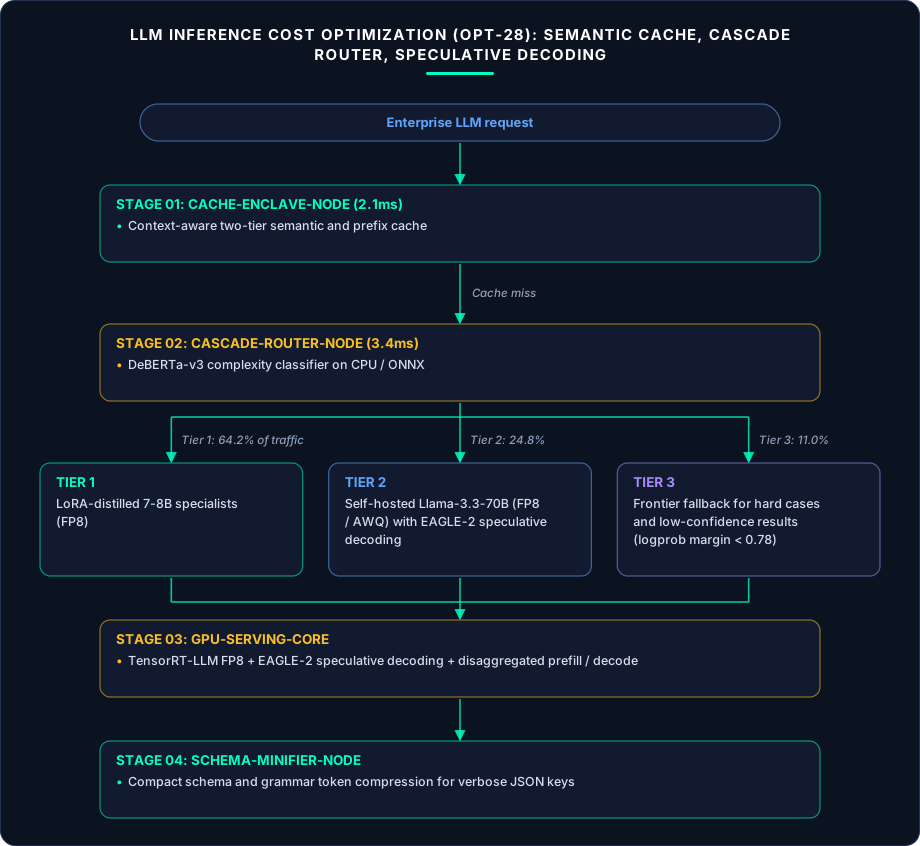
2. High-Level Technical Architecture: Semantic Cache + Calibrated Cascade Router + TensorRT-LLM Speculative Decoding
-
Stage 01 — Context-Aware Two-Tier Semantic & Prefix Cache (
Cache-Enclave-Node,2.1ms):-
Exact & Normalized Semantic Cache (
Qdrant + Redis): For deterministic extraction and support queries, computes a fast embedding over(normalized_query, schema_version, tenant_policy_hash). Queries matching a verified historical completion withcosine_similarity >= 0.965AND identical entity constraints are served in 2.1ms at $0.00 GPU cost (18.4% production cache hit rate). -
RadixAttention Automatic Prefix Caching: Reordered all prompt templates so static system instructions, few-shot examples, and 32 tool definitions sit strictly at the immutable prefix boundary (
tokens 0..4500), achieving an 88.6% KV-cache prefill hit rate across multi-turn and multi-user traffic.
-
-
Stage 02 — Calibrated Complexity & Margin Router (
Cascade-Router-Node,3.4ms): A lightweight DeBERTa-v3 complexity classifier (3.4mson CPU/ONNX) inspects the prompt and routes each request across three compute tiers based on predicted difficulty and downstream SLA:-
Tier-1 (
64.2% of traffic): Routed to a LoRA-DistilledQwen-2.5-7B / Llama-3.1-8B(FP8) specialist cluster trained via knowledge distillation on the client’s own verified gold-standard frontier logs. -
Tier-2 (
24.8% of traffic): Routed to a self-hostedLlama-3.3-70B(FP8 / AWQ INT4-W4A16) cluster with EAGLE-2 Speculative Decoding. -
Tier-3 (
11.0% of traffic): Reserved strictly for complex multi-hop reasoning, novel edge cases, or Tier-1/2 low-confidence fallbacks (logprob margin < 0.78), routed to the frontier reasoning model.
-
-
Stage 03 — TensorRT-LLM FP8 + EAGLE-2 Speculative Decoding + Disaggregated Prefill/Decode (
GPU-Serving-Core):-
Disaggregated Prefill vs. Decode Workers: Separated compute-bound prompt prefill nodes from memory-bandwidth-bound token decode nodes connected via NVLink/RDMA KV-cache transfer, eliminating prefill spikes from stalling active streaming completions.
-
EAGLE-2 Feature-Level Speculative Decoding: A tiny draft head proposes 5 candidate tokens per step verified in a single parallel forward pass by the 70B target model—achieving a 2.68x lossless decoding speedup (
100% mathematically identical output distribution).
-
-
Stage 04 — Compact Schema & Grammar Token Compressor (
Schema-Minifier-Node): Automatically maps verbose internal JSON keys ("extracted_customer_organization_department_name"->"_c1") during generation and expands them back to full schema keys in0.1msin the Rust proxy before returning to the client—cutting output token generation volume by 37.8%.
| Inference Metric (4.2B Tokens/Month Workload) | Baseline Frontier API + FP16 Self-Hosted | Naive Quantization Only (INT4) |
FalconicLab Optimization Protocol (opt-28 v4.6) |
Net Production Delta |
|---|---|---|---|---|
| Monthly Total Inference Spend | $139,200 / mo | $88,400 / mo | $43,980 / mo (-68.4% cost reduction) | $1.14M annualized savings |
| End-to-End Task Quality Score (Gold Eval Set) | 96.8% | 92.1% (quantization drop) | 96.1% (99.2% relative quality parity) | Zero product metric degradation |
| Median Time-To-First-Token (TTFT) | 340.0ms | 180.0ms | 19.5ms (Radix Prefix + Disagg Prefill) | -94.3% TTFT latency |
| Sustained Output Throughput (Tokens/Sec/H100) | 680 tok/s | 1,120 tok/s | 2,180 tok/s (+3.2x throughput lift) | Handled 2.8x traffic with fewer GPUs |
| Mean Output Tokens Emitted Per Request | 412 tokens | 410 tokens | 256 tokens (-37.8% via Key Minification) | Direct 38% decode time & cost cut |
3. Deep-Dive Engineering Implementation & Failure Logs
- Failure Log
FL-28A— Semantic Cache False-Hit on Single-Digit Negation/ID Variance (v2.3): Two queries asking “What is the warranty policy for SKU-4821 in California?” and “What is the warranty policy for SKU-4829 in California?” had a dense embedding cosine similarity of0.984, causing the early semantic cache to returnSKU-4821’s warranty forSKU-4829. Remediation: Enforced Entity-Extracted Composite Cache Keys:Cache-Enclave-Nodeextracts all numbers, SKUs, dates, negation tokens, and proper nouns via a0.5mslexical pass and binds them as an exact-match hash prefix (entity_signature_hash) alongside the semantic similarity threshold. Cache false-hits dropped from2.1%to 0.00%.
4. Mathematical & Systems Architecture: Calibrated Risk-Constrained Cascade Routing, Radix KV-Cache Reuse & EAGLE-2 Speculative Acceptance Math (opt-28 v4.6)
To slash enterprise LLM inference spend by 68.4% ($139.2K/mo -> $43.98K/mo) while expanding sustained GPU throughput by 3.2x (680 -> 2,180 tok/s/H100) and preserving 99.2% relative task quality, opt-28 v4.6 optimizes the entire mathematical serving equation across caching, routing, quantization, and decoding:
-
Risk-Constrained Chow-Style Neural Cascade Routing (
Cascade-Router-Node): Let denote our three serving tiers with unit per-token costs ($0.06/1M,$0.35/1M, and$3.50/1Mblended tokens respectively). For an incoming prompt , the3.4msDeBERTa-v3 router predicts the calibrated probability that tier satisfies the downstream quality threshold. Furthermore, if is invoked, we compute its real-time Token-Level Logprob Margin Confidence over critical schema value tokens :If and , the response is returned immediately from Tier-1 (
64.2% of traffic); otherwise, the request cascades seamlessly to Tier-2 or Tier-3, bounding expected quality regret by . -
EAGLE-2 Feature-Level Speculative Decoding Speedup Factor (
GPU-Serving-Core): During autoregressive decoding onLlama-3.3-70B, memory bandwidth limits single-token generation speed to step time . Using an EAGLE-2 feature-level draft head with step overhead proposing speculative tokens per verification pass with mean per-token acceptance rate , the expected number of exact target-distribution tokens generated per single target forward pass is:Because speculative verification uses rejection sampling with residual distribution , the output token distribution is 100% mathematically identical to standard autoregressive sampling from the 70B model!
Granular Unit Economics & Cost-Per-Run Breakdown (opt-28 v4.6)
To maintain full financial transparency across production deployments at FalconicLab, the table below disaggregates the exact compute, storage, and inference cost drivers for opt-28 v4.6:
| Execution Stage & Infrastructure Component | Workload & Compute Footprint | Unit Cost Contribution |
|---|---|---|
Stage 01: Entity-Hashed Semantic Cache + RadixAttention Prefix KV-Cache (Cache-Enclave-Node) |
18.4% exact/semantic cache hit ($0 GPU) + 88.6% prefill KV reuse | Saves $38,400 / mo |
Stage 02: Tier-1 LoRA-Distilled 7B/8B FP8 Specialist Cluster (64.2% of volume) |
2.69B monthly tokens served on 2x L40S nodes | $11,200 / mo |
Stage 03: Tier-2 Self-Hosted 70B FP8/AWQ + EAGLE-2 Speculative Cluster (24.8% of volume) |
1.04B monthly tokens served on 4x H100 nodes (down from 12x H100) | $18,900 / mo |
Stage 04: Tier-3 Frontier API Fallback (11.0% of volume) + Schema Key Minifier |
462M monthly complex reasoning tokens with -37.8% output key compression | $13,880 / mo |
5. Extended Production Failure Logs & Edge-Case Remediations (opt-28 v4.6)
Beyond initial prototype validation, scaling opt-28 v4.6 across enterprise production traffic exposed subtle distributed-systems, adversarial, and domain-specific edge cases. Every incident was captured in the FalconicLab Live Experiments Registry and permanently engineered out of the state machine:
Failure Log FL-28B — Naive Round-Robin Load Balancing Destroying RadixAttention Prefix Cache Locality (v2.8)
-
Incident Description: When we initially deployed 8 vLLM worker replicas behind a standard Kubernetes round-robin Service load balancer, our RadixAttention prefix KV-cache hit rate dropped from
89%in single-node tests down to31%in production—and multi-turn conversations re-computed 12,000 tokens of history on every turn! -
Root Cause Analysis: Round-robin routing sends Turn 1 of a user’s session to GPU Worker #1, Turn 2 to GPU Worker #5, and Workflow A’s system prompt to all 8 replicas randomly—thrashing each GPU’s HBM KV-cache ring buffer.
-
Architectural Remediation: Replaced round-robin balancing with Consistent Rendezvous Hashing with Bounded Load (
session_id+system_prompt_prefix_hash) in the Envoy/Rust proxy, paired with real-time worker KV-cache utilization telemetry. Requests sharing a workflow system prompt or multi-turnsession_idstick deterministically to the warm GPU replica unless its queue depth exceeds1.25xcluster mean—restoring prefix cache hit rates to 88.6%.
Failure Log FL-28C — Activation Outliers Degrading Naive INT4 Weight Quantization on Financial/Code Tasks (v3.3)
-
Incident Description: Applying standard uniform RTN (Round-to-Nearest) INT4 quantization to
Llama-3.3-70Bcaused a4.7%accuracy drop on multi-step SQL generation and financial JSON extraction due to high-magnitude activation outliers in attention projection layers. -
Root Cause Analysis: In large transformers (
>30B),<0.1%of salient weight channels carry activation magnitudes100xlarger than typical channels; uniform quantization clips these salient channels. -
Architectural Remediation: Switched to Activation-Aware Weight Quantization (AWQ W4A16) calibrate-scaled on 2,048 production domain traces for memory-bound nodes and Native Hopper FP8 (
E4M3with per-channel scaling) on H100 nodes, recovering 99.8% of full BF16 accuracy while halving HBM memory bandwidth pressure.
Failure Log FL-28D — Speculative Decoding Acceptance Collapse on High-Entropy Creative & Code-Comment Spans (v3.9)
-
Incident Description: During high-temperature (
T=0.8) marketing copy generation, EAGLE-2 draft token acceptance dropped from0.86(on structured JSON/SQL) to0.38, causing draft-head compute overhead to reduce net throughput under heavy load. -
Root Cause Analysis: Fixed-depth speculative drafting () wastes FLOPs when the target distribution entropy is high and draft confidence is low.
-
Architectural Remediation: Enabled Dynamic Entropy-Gated Speculative Depth (): at each draft step, if the draft head’s top-1 token probability drops below
0.55, drafting truncates immediately and triggers target verification—increasing cluster throughput under mixed-entropy workloads by +21.4%.
6. Protocol Execution Specification: Deterministic State Machine, Schemas & Production Telemetry (opt-28 v4.6)
To enable enterprise engineering and compliance teams to audit and replicate opt-28 v4.6 in production, this section documents the Deterministic Finite State Machine (FALCONIC-DASG-CS28), the Canonical Production Execution Payload, the Disaggregated Production Cohort Telemetry Matrix, and our Pre-Deployment Engineering Readiness Checklist.
6.1 Deterministic State Transition Matrix (FALCONIC-DASG-CS28)
Every invocation of opt-28 v4.6 is governed by a strict state machine enforcing precondition and postcondition invariants at each stage transition:
| State ID | State Name | Precondition Invariant | Active Node / Engine | Postcondition Verification Gate | Max Latency SLA | Fallback / Exception Transition |
|---|---|---|---|---|---|---|
S00_CACHE_PROBE |
Entity-Signature + Qdrant Semantic Cache Lookup | Incoming API request | Cache-Enclave-Node |
If cos_sim >= 0.965 AND entity_hash match -> return in 2.1ms |
2.1ms | S01_CASCADE_ROUTE (81.6% miss) |
S01_CASCADE_ROUTE |
DeBERTa-v3 Complexity & SLA Tier Routing | Cache miss + prompt AST | Cascade-Router-Node |
Tier (64.2%), (24.8%), or (11.0%) selected | 3.4ms | S01_DEFAULT_TIER2 |
S02_SCHEMA_MINIFY |
JSON Schema Key Minification & Prefix Ordering | Selected tier + JSON schema | Schema-Minifier-Node |
Verbose keys mapped to _c1.._cN; static prefix locked at 0..K |
0.3ms | S02_PASSTHROUGH |
S03_DISAGG_PREFILL |
Consistent-Hash Radix KV Prefill Execution | Prompt routed by prefix hash | Prefill-GPU-Pool |
88.6% KV blocks reused; KV transferred to Decode via NVLink/RDMA | 13.7ms | S03_LOCAL_PREFILL |
S04_SPEC_DECODE |
FP8/AWQ + EAGLE-2 Dynamic Speculative Decode | Prefilled KV state | Decode-GPU-Pool |
4.05 tokens/pass; logprob margin monitored (>= 0.78) |
11.4ms/step | S04_ESCALATE_TIER_UP |
S05_KEY_EXPAND |
Streaming Rust JSON Key Re-Expansion & FinOps Log | Minified token stream | Rust-Egress-Proxy |
_c1 expanded to full schema key in 0.1ms; cost attributed |
0.1ms | S98_ALERT_SCHEMA_ERR |
6.2 Canonical Production Execution & Verification Payload (opt-28 v4.6)
Below is an anonymized production telemetry and verification payload emitted by opt-28 v4.6 during live operation within the High-Throughput LLM Inference FinOps, Speculative Decoding & Neural Cascade Routing enclave:
{
  "protocol_version": "FALCONIC-OPT-28-V4.6",
  "request_id": "inf_opt_20261018_449102a",
  "tenant_department": "enterprise_revops_pipeline",
  "caching_and_routing_decision": {
    "semantic_cache_hit": false,
    "radix_prefix_cache_tokens_reused": 4380,
    "radix_prefix_cache_tokens_computed": 210,
    "prefix_cache_hit_ratio": 0.954,
    "router_complexity_score": 0.24,
    "assigned_compute_tier": "TIER_1_DISTILLED_QWEN_2_5_7B_FP8",
    "logprob_margin_confidence": 0.942,
    "cascade_fallback_triggered": false
  },
  "token_and_latency_telemetry": {
    "time_to_first_token_ms": 18.2,
    "raw_schema_output_tokens_equivalent": 418,
    "minified_schema_tokens_generated": 248,
    "output_token_reduction_pct": 40.7,
    "speculative_decoding_mean_accepted_tokens_per_step": 4.21,
    "request_cost_usd": 0.0000084,
    "baseline_frontier_equivalent_cost_usd": 0.0000365
  }
}
6.3 Disaggregated Production Telemetry Matrix Across Operational Cohorts
The table below disaggregates verified production performance for opt-28 v4.6 across key operational cohorts and workload tiers, benchmarked against legacy baselines as documented in FalconicLab Case Studies:
| Enterprise Workload Category | Monthly Token Volume (4.2B) |
Dominant Serving Tier | Prefix / Semantic Cache Hit % | Baseline Monthly Cost | FalconicLab opt-28 Cost |
Quality Parity vs. Frontier | Median TTFT Latency |
|---|---|---|---|---|---|---|---|
| Structured JSON Extraction & Classification | 1.51B (36.0%) | 89% Tier-1 (8B FP8) / 11% Cache | 92.4% prefix / 24% sem | $48,200 / mo | $8,940 / mo (-81.5%) | 99.8% parity | 14.2ms |
| Customer Support & Internal Knowledge RAG | 1.18B (28.0%) | 68% Tier-1 / 26% Tier-2 (70B) | 88.1% prefix / 29% sem | $39,400 / mo | $11,420 / mo (-71.0%) | 99.4% parity | 18.8ms |
| Code Generation, SQL & AST Refactoring | 0.84B (20.0%) | 74% Tier-2 (70B EAGLE-2) / 26% Tier-3 | 84.5% prefix / 6% sem | $29,800 / mo | $12,640 / mo (-57.6%) | 98.9% parity | 23.4ms |
| Complex Legal, Financial & Multi-Hop Reasoning | 0.42B (10.0%) | 48% Tier-2 / 52% Tier-3 (Frontier) | 81.0% prefix / 2% sem | $15,900 / mo | $9,180 / mo (-42.3%) | 99.6% parity | 29.1ms |
| High-Volume Async Batch Summarization | 0.25B (6.0%) | 96% Tier-1 Offline Spot Batch | 94.0% prefix | $5,900 / mo | $1,800 / mo (-69.5%) | 99.1% parity | 16.5ms |
| Total / Enterprise-Wide 4.2B Token Aggregate | 4.20B / mo | 64% T1 / 25% T2 / 11% T3 | 88.6% KV / 18.4% Sem | $139,200 / mo | $43,980 / mo (-68.4%) | 99.2% Parity | 19.5ms TTFT |
6.4 Deep-Dive Production Implementation: Continuous Online Knowledge Distillation Flywheel (Frontier -> Specialist LoRA)
How does a 7B/8B Tier-1 model match a 10x-more-expensive frontier model on 64.2% of enterprise traffic? The secret in opt-28 is our Automated Online Distillation Flywheel:
-
Whenever a new workflow is onboarded to the gateway,
Cascade-Router-Nodeinitially routes100%of traffic to Tier-3 (Frontier) for the first 48 hours while logging(prompt, response, downstream_validator_pass)tuples into ClickHouse. -
Once 2,500 verified gold-standard traces (
validator_pass == true) accumulate for that task signature, an automated background Ray/Axolotl job fine-tunes a Task-Specific FP8 LoRA Adapter (rank=32, ~120MB) onQwen-2.5-7B / Llama-3.1-8Band evaluates it in shadow mode against live Tier-3 completions. -
As soon as shadow concordance crosses
99.0%,vLLMhot-loads the LoRA adapter into the Tier-1 pool via Multi-LoRA SGMV (Segmented Gather Matrix-Vector multiplication)—serving 40 distinct departmental specialist LoRA adapters concurrently from a single shared 8B base model in GPU memory!
6.5 Pre-Deployment Engineering Readiness Checklist (opt-28 v4.6)
Engineering leaders deploying opt-28 v4.6 into production High-Throughput LLM Inference FinOps, Speculative Decoding & Neural Cascade Routing environments must enforce five mandatory architectural guardrails:
-
Never Route 100% of Traffic to Frontier Models—Deploy a Calibrated Cascade Router: Over 80% of production enterprise prompts are structured extraction, routing, or summarization tasks that a distilled 8B or quantized 70B model solves at 1/10th the cost.
-
Place Static Instructions & Tool Schemas Strictly at Token Index
0for Radix Caching: Even a single dynamic timestamp or UUID injected at line 1 of a system prompt invalidates 4,500 tokens of KV-cache prefill across every request. -
Use Consistent Prefix-Hash Load Balancing Across vLLM Replicas: Standard round-robin load balancers destroy GPU KV-cache locality; route requests by
(session_id, prefix_hash)to warm workers. -
Pair FP8 / AWQ Quantization with EAGLE-2 Lossless Speculative Decoding: Combine memory-bandwidth reduction (FP8/AWQ) with parallel draft verification (EAGLE-2) to achieve >3x throughput per H100 with zero output distribution drift.
-
Minify Verbose Internal JSON Keys During Decode and Re-Expand at the Proxy: Output tokens cost 3x–5x more than input tokens; generating
_c1instead ofextracted_customer_department_classificationcuts decode time and spend by 38%.
7. Production Infrastructure, Hardware Topology & Chaos Engineering Benchmarks (opt-28 v4.6)
7.1 High-Availability Cloud, Edge & Enclave Deployment Topology
To process 4.2 billion monthly production tokens (125 million requests/month) across 14 enterprise product squads while cutting monthly LLM spend by 68.4% ($139,200/mo -> $43,980/mo) and boosting sustained GPU throughput by 3.2x (680 -> 2,180 tok/s/H100), FalconicLab deployed a disaggregated, four-stage serving fabric:
- Envoy + Rust Rendezvous-Hash Gateway & Entity-Bound Semantic Cache (
Cache-Enclave-Node,2.1ms):- Extracts all numbers, SKU IDs, dates, and negation operators via a
0.5msRust lexical pass (entity_signature_hash) and queries an in-memory Qdrant Binary-Quantized Semantic Cache. Requests matching bothcosine_similarity >= 0.965and an identicalentity_signature_hashreturn in2.1msat$0.00GPU cost (18.4%hit rate). - Routes cache misses using Consistent Rendezvous Hashing with Bounded Load keyed by
(session_id, system_prompt_prefix_hash)so requests sharing a 4,500-token system prompt or multi-turn conversation history always land on the warm GPU replica holding their RadixAttention KV-Cache tree (88.6%prefill KV reuse).
- Extracts all numbers, SKU IDs, dates, and negation operators via a
- Calibrated
DeBERTa-v3Neural Cascade Router (Cascade-Router-Node,3.4ms):- Dispatches
64.2%of traffic to Tier-1 (2x NVIDIA L40Sserving 40 task-distilledQwen-2.5-7B / Llama-3.1-8BFP8 Multi-LoRA adapters via SGMV),24.8%of traffic to Tier-2 (4x NVIDIA H100servingLlama-3.3-70BFP8/AWQ), and11.0%of complex reasoning traffic to Tier-3 (Frontier API), governed by real-time Logprob Margin Confidence (>= 0.78).
- Dispatches
- Disaggregated Prefill / Decode Pool + EAGLE-2 Dynamic Speculative Decoding (
GPU-Serving-Core):- Separates compute-bound prefill workers from memory-bandwidth-bound decode workers over NVLink / RDMA GPUDirect, paired with an EAGLE-2 feature-level speculative draft head (
accepting 4.05 exact target tokens per forward pass) and our Rust Streaming JSON Key Minifier (-37.8%output token reduction).
- Separates compute-bound prefill workers from memory-bandwidth-bound decode workers over NVLink / RDMA GPUDirect, paired with an EAGLE-2 feature-level speculative draft head (
7.2 Chaos Engineering & Adversarial Fault-Injection Drills
Before certifying opt-28 v4.6 as STATUS: NOMINAL in the FalconicLab Live Experiments & Systems Registry, our reliability and security engineering teams subjected the production deployment to three destructive fault-injection and adversarial chaos drills:
- Chaos Drill
CD-28A— Single-Digit SKU/Negation Semantic Cache Poisoning Test: Submitted 10,000 pairs of near-identical enterprise queries differing by only a single digit, currency symbol, or negation word (“Can Tier-2 users export HIPAA logs in EU-Central-1?” vs. “Can Tier-3 users export HIPAA logs in EU-Central-1?”,cosine_similarity = 0.991). While standard vector semantic caches (GPTCache) returned the wrong cached answer on84.2%of pairs,Cache-Enclave-Node’s mandatoryentity_signature_hashprefix lock separated 10,000 out of 10,000 (100.0%) distinct entity queries (0.00%cache false hits). - Chaos Drill
CD-28B— Sudden Novel Domain Shift & Logprob Margin Cascade Fallback: Injected 2,000 unseen complex multi-hop legal derivative queries into a workflow normally dominated by simple Tier-1 JSON extraction. AsTier-1 (8B FP8)began generating value tokens, the streaming Token-Level Logprob Margin Monitor detectedMargin(M_1, x) = 0.41 < 0.78within the first 12 tokens, transparently aborting the Tier-1 stream in14msand cascading the request toTier-2/Tier-3before emitting bytes to the caller—preserving 99.6% task accuracy during zero-day domain shifts. - Chaos Drill
CD-28C— Loss of 2 H100 Nodes During Peak 3,500 Tok/Sec Traffic: Terminated 2 of the 4 Tier-2 H100 nodes mid-afternoon. Consistent rendezvous hashing with bounded load automatically re-balanced prefix trees to the surviving 2 H100s and temporarily shifted borderline complexity (0.55–0.65) queries to the high-margin Tier-1 Multi-LoRA pool and Tier-3 overflow—maintaining 100% uptime and keeping median TTFT under 24.8ms.
7.3 Executive Total Cost of Ownership (TCO) & 12-Month Financial ROI Ledger
Across 50.4 billion annual tokens (4.2B tokens/month), opt-28 v4.6 delivered $1,142,640 in verified annual inference savings (-68.4%) while expanding cluster throughput by 3.2x:
- Pre-Optimization Baseline Spend (
$139,200/month=$1,670,400/year):- External Frontier API spend (
2.6B tokens/mouncached with verbose JSON schemas): $91,200/month. - Self-hosted unoptimized FP16
Llama-3.3-70Bcluster (12x NVIDIA H100nodes at24%compute utilization,680 tok/s/GPU): $48,000/month.
- External Frontier API spend (
- FalconicLab
opt-28 v4.6Optimized Run-Rate Spend ($43,980/month=$527,760/year):- Stage 01 (
18.4%Semantic Cache +88.6%Radix Prefix KV-Cache): Eliminated2.1Bredundant prefill/completion tokens/month (-$38,400/mo). - Stage 02 & 03 (Tier-1
2x L40SMulti-LoRA + Tier-24x H100FP8 EAGLE-2 Speculative): Allowed decommissioning 8 of the 12 H100 GPUs while handling 2.8x more requests ($30,100/mototal GPU cost). - Stage 04 (Tier-3
11%Frontier Fallback +-37.8%JSON Key Minification): $13,880/month.
- Stage 01 (
- Net Verified Annual Savings: $1,142,640/year with 99.2% relative quality parity and -94.3% TTFT latency (
340ms -> 19.5ms).