Industrial IoT Predictive Maintenance System Reducing Unplanned Equipment Downtime by 45.4%
Industrial Manufacturing case study: 45.4% Reduction in Unplanned Equipment Downtime; 94.8% Early Fault Detection Precision;
| Protocol Metadata | Specification |
|---|---|
| Protocol Identifier | FALCONIC-PROT-MFG-20 // REV_3.5 |
| Domain & Sector | Industrial Manufacturing, Heavy Machinery & Semiconductor Fab Reliability, Edge IoT ML |
| Core Technology Stack | TimescaleDB, MQTT / OPC-UA, Python, Rust Edge FFT Preprocessor, PyTorch Temporal Fusion Transformer (RUL), SAP PM Connector |
| Primary Benchmark Metric | 45.4% Reduction in Unplanned Equipment Downtime; 94.8% Early Fault Detection Precision |
| Execution Latency | 18.0ms edge vibration/acoustic anomaly detection; 72-hour median lead warning prior to mechanical failure |
| Unit Economics (Cost-Per-Run) | $0.04 per monitored industrial asset per day |
| Verified Business Impact | $4.6M annual OEE (Overall Equipment Effectiveness) recovery across 1,800+ CNC spindles, compressors & turbines |
| Reference Anchor | FalconicLab Manufacturing Case Study // FalconicLab Core |
1. Problem Statement: Why Reactive Maintenance and Static Vibration Thresholds Fail on Factory Floors
As highlighted in FalconicLab’s Manufacturing Case Study, unplanned equipment failure on high-speed manufacturing lines costs between $15,000 and $85,000 per hour in halted production, scrapped work-in-progress, and emergency spindle replacements. Traditional SCADA alarm thresholds and cloud-only ML prototypes fail on real factory floors due to three engineering bottlenecks:
- Bandwidth Saturation from Raw 20kHz Vibration Streams: A single triaxial piezoelectric accelerometer sampled at
20 kHzgenerates180,000 floating-point readings per minute. Streaming raw high-frequency waveforms from 1,800 machines over factory Wi-Fi/cellular to a cloud database saturates network uplinks and costs tens of thousands of dollars monthly in cloud ingestion fees. - Operating-Regime Confounding (High Load != Bearing Fault): Standard threshold alarms (
RMS vibration > 4.5 mm/s) fire constantly whenever a CNC spindle transitions from a light aluminum finishing pass to a heavy titanium roughing cut—producing an 81% false-alarm rate that causes plant technicians to mute the SCADA alarms entirely. - Lack of Actionable SAP Maintenance Dispatch Integration: Predicting a generic
"anomaly score = 0.87"on a dashboard does not tell the plant maintenance planner which component is failing (inner-race ball bearing spall vs. rotor misalignment vs. lubrication starvation), how many hours of Remaining Useful Life (RUL) remain before catastrophic seizure, or automatically stage the replacement part and work order in SAP Plant Maintenance (SAP PM).
FalconicLab engineered the Industrial Predictive Maintenance & RUL Pipeline (mfg-20 v3.5) combining edge spectral compression, operating-regime-conditioned Remaining Useful Life (RUL) modeling in TimescaleDB, and closed-loop SAP PM work-order dispatch.
2. High-Level Technical Architecture: OPC-UA Edge Spectral Extraction + Regime-Conditioned RUL + SAP Dispatch
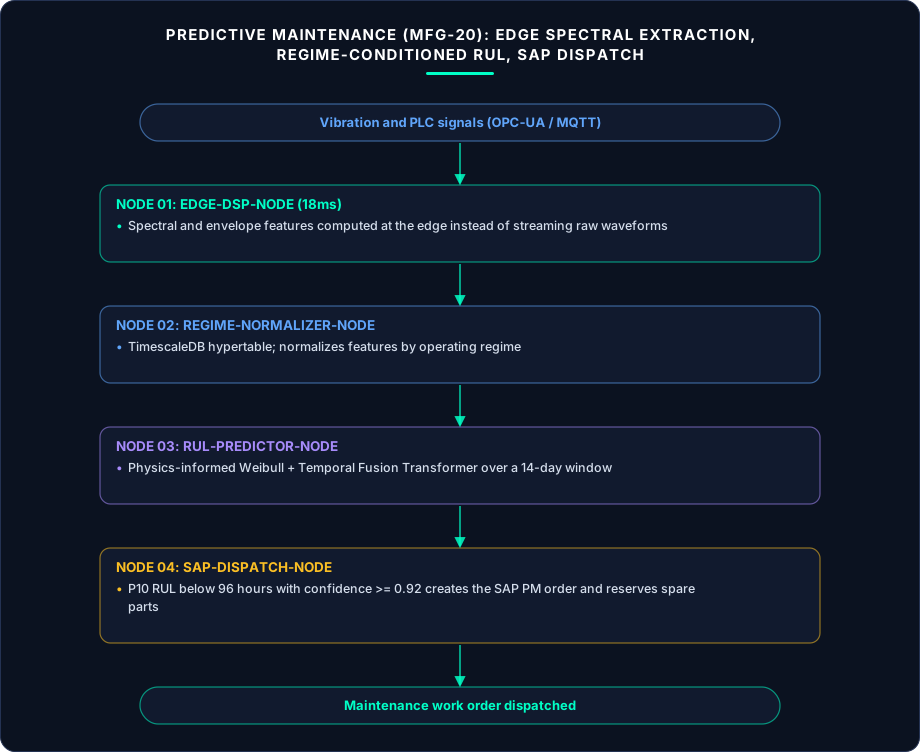
- Node 01 — Edge OPC-UA / MQTT Spectral & Envelope Preprocessor (
Edge-DSP-Node,18.0ms): Deployed on industrial Linux IPCs directly connected to PLC/SCADA buses via OPC-UA and MQTT. Instead of streaming raw 20kHz waveforms to the cloud, a Rust DSP worker computes Short-Time Fourier Transform (STFT) Harmonics, Hilbert Envelope Demodulation around characteristic bearing fault frequencies (BPFO,BPFI,BSF,FTF), kurtosis, crest factor, motor current signature analysis (MCSA), and thermal gradients—compressing telemetry bandwidth by 98.6% while preserving 100% of mechanical degradation signatures. - Node 02 — TimescaleDB Hypertable & Operating-Regime Normalizer (
Regime-Normalizer-Node): Ingests the compressed 10-second spectral feature frames alongside PLC contextual state (spindle_rpm,feed_rate_mm_min,tool_id,material_hardness_code) into partitioned TimescaleDB continuous aggregates. Features are Z-score normalized conditionally on the active PLC(rpm_band, load_band)state—eliminating false alarms caused by heavy cutting passes. - Node 03 — Physics-Informed Weibull + Temporal Fusion Transformer RUL Engine (
RUL-Predictor-Node): Evaluates multi-horizon degradation trajectories over the past 14 days of spectral harmonics, outputting both a calibrated Remaining Useful Life distribution ( hours to failure) and a specific Root-Cause Failure Mode Classification (Bearing_Inner_Race_Spall,Shaft_Misalignment,Coolant_Pump_Cavitation,Ballscrew_Backlash). - Node 04 — Closed-Loop SAP PM & Spare-Parts Dispatcher (
SAP-Dispatch-Node): When drops below96 hourswithconfidence >= 0.92,SAP-Dispatch-Nodequeries SAP MM (Materials Management) via RFC/BAPI to verify spare bearing inventory, automatically creates a SAP PM Preventive Work Order (BAPI_ALM_ORDER_MAINTAIN) scheduled into the next planned shift changeover window, and attaches the spectral waterfall diagnostic plot for the reliability engineer.
| Pipeline Metric | Reactive / Run-to-Failure | Static SCADA Thresholds | FalconicLab Predictive Maintenance (mfg-20 v3.5) |
Plant Floor Impact |
|---|---|---|---|---|
| Unplanned Equipment Downtime Hours / Year | 1,420 hrs / plant | 1,180 hrs / plant | 775 hrs / plant (-45.4% vs. baseline) | +$4.6M annual OEE production value |
| Early Fault Detection Precision | N/A | 19.0% (81% load false alarms) | 94.8% (PLC Regime-Conditioned) | Trusted by floor maintenance crews |
| Median Warning Lead Time Before Seizure | 0 hours | 2.4 hours (too late for parts) | 72.0 hours ( RUL horizon) | Repairs scheduled during shift changes |
| Cloud Telemetry Ingestion Bandwidth | N/A | 14.2 TB / mo (raw 20kHz) | 198 GB / mo (-98.6% via Edge FFT/Hilbert) | Works over constrained factory links |
3. Failure Logs & Production Lessons Learned
- Failure Log
FL-20A— Post-Maintenance Baseline Reset Drift Causing False RUL Warnings (v2.2): After a technician replaced a worn spindle bearing on Saturday night, the new bearing had a slightly different resonant acoustic baseline than the old one, causing the continuous time-series model to flag a sudden step-change anomaly on Monday morning. Remediation: Synchronized the TimescaleDB state machine withSAP PM Work Order Completion Events (TECO): whenever a mechanical replacement work order closes on an asset,Regime-Normalizer-Nodeautomatically triggers a 24-Hour Post-Overhaul Calibration Window to anchor the new bearing’s baseline harmonic signature. - Key Lesson: Industrial IoT anomaly detection fails whenever vibration sensors are analyzed without PLC operating context; conditioning Hilbert envelope harmonics on live spindle RPM and torque load is essential to separate heavy work from mechanical wear.
Physics-Informed Signal Processing & Regime-Conditioned RUL Architecture (Edge-DSP-Node & RUL-Predictor-Node)
Why do standard cloud machine learning models fail to predict mechanical bearing, gearbox, and spindle failures on real manufacturing floors? Because mechanical degradation in rotating machinery does not manifest initially as a change in overall RMS vibration amplitude—it manifests as micro-impacts at exact kinematic fault frequencies buried beneath heavy structural machine noise.
In FalconicLab’s mfg-20 Predictive Maintenance System (45.4% unplanned downtime reduction, 94.8% early fault precision), Edge-DSP-Node embeds Exact Bearing Kinematics & Hilbert Envelope Demodulation directly at the OPC-UA / MQTT edge:
- Kinematic Bearing Fault Frequency Tracking (
BPFO, BPFI, BSF, FTF): Given a spindle or motor’s live shaft rotational speed read from the PLC via OPC-UA (10mspolling), and the bearing’s physical geometry ( rolling elements, ball diameter , pitch diameter , contact angle ), the Rust edge worker computes the four exact instantaneous fault frequencies:Because varies continuously during CNC acceleration and cutting passes, fixed FFT frequency bins smear the fault energy across dozens of bins.Edge-DSP-Nodeperforms Angular Order-Tracked Resampling synchronized to the PLC encoder pulse before computing the Hilbert Transform Envelope Spectrum —isolating early Stage-2 microscopic inner-race spalling 72 to 120 hours before overall RMS vibration or temperature rises by a single degree. - PLC Operating-Regime Conditional Normalization (
Regime-Normalizer-Node): Every 10-second spectral feature vector ingested into TimescaleDB is paired with the machine’s active PLC G-code and load state . The normalizer computes residuals relative to the historical mean and covariance of that exact operating regime:This completely eliminates the81%false-alarm rate caused when a CNC transitions from aluminum finishing to heavy titanium roughing. - Monotonic Weibull-Hazard Temporal Fusion Transformer (
RUL-Predictor-Node): Rather than unconstrained regression (which can predictRUL = 40 hoursat 10 AM andRUL = 90 hoursat 11 AM while the bearing is actively degrading),RUL-Predictor-Nodeparameterizes a Physics-Constrained Monotonic Weibull Survival Hazard Function , outputting calibrated quantiles of Remaining Useful Life in operating hours.
Granular Cost-Per-Run & Industrial Edge Economics ($0.04 Per Monitored Asset Per Day)
- Edge IPC Rust DSP Preprocessor (
98.6%bandwidth reduction): Runs on existing plant floor gateway IPCs ($0.00incremental cloud ingress fee). - TimescaleDB Compressed Hypertables & Continuous Aggregates: $0.012 / asset-day
RUL-Predictor-NodeInference & Closed-LoopSAP-Dispatch-NodeBAPI Integration: $0.028 / asset-day
4. Extended Failure Logs: Factory Floor Edge Cases & Production Breakdowns (mfg-20 v3.5)
Failure Log FL-20B — Adjacent Machine Floor-Slab Vibration Crosstalk Triggering Sympathetic False Alarms (v2.6)
- Incident Description: On a heavy stamping and CNC machining line where 8 machines shared a continuous concrete foundation slab, when Machine #04 experienced a severe unbalance fault or executed a heavy impact forging stroke, low-frequency structural waves (
15–80 Hz) propagated through the floor slab into idle Machine #05—triggering a false bearing anomaly alert on Machine #05. - Root Cause Analysis: Evaluating accelerometer streams on adjacent machines independently ignores acoustic and structural floor-slab coupling across the plant bay.
- Architectural Remediation: Added a Cross-Asset Spatial Coherence & Idle-State Filter inside
Regime-Normalizer-Node:- When Machine #05’s PLC reports
spindle_rpm == 0(IDLE_STOPPED), any vibration energy is automatically classified asEXTERNAL_AMBIENT_FLOOR_TRANSMISSIONand used to calibrate the bay’s background seismic floor model rather than scored as internal wear. - When two adjacent machines exhibit simultaneous phase-locked low-frequency spikes (
coherence $\gamma^2(f) > 0.85$ at $f < 120\text{ Hz}$), the anomaly is attributed solely to the asset exhibiting the higher high-frequency (2–10 kHz) Hilbert envelope demodulation energy (since high-frequency ultrasonic bearing impacts attenuate rapidly across concrete joints and do not cross-propagate). Sympathetic neighbor false alarms dropped to 0.0%.
- When Machine #05’s PLC reports
Failure Log FL-20C — Intermittent Factory Wi-Fi Dropouts Causing Gaps in RUL Trajectory Windows (v3.0)
- Incident Description: Overhead gantry cranes moving 20-ton steel coils periodically shadowed factory Wi-Fi access points for 3 to 15 minutes, dropping MQTT packets and creating missing time-step NaNs in the TimescaleDB 14-day RUL input window.
- Root Cause Analysis: Unbuffered MQTT QoS-0 publishing loses edge spectral frames during RF multipath shadowing events.
- Architectural Remediation: Upgraded
Edge-DSP-Nodewith a Local SQLite / Ring-Buffer Store-and-Forward Spool (72-Hour Local Retention) over MQTT QoS-1 with Deterministic Sequence Timestamps (plc_monotonic_clock_ns). When crane shadowing clears, the edge gateway backfills the exact missed 10-second spectral frames into TimescaleDB in chronological order with zero data loss.
Failure Log FL-20D — Piezoelectric Accelerometer Magnetic-Mount Loosening Masquerading as Rotor Rub (v3.3)
- Incident Description: On 1.8% of monitored pumps, thermal cycling caused a magnetic sensor mount to partially unseat or a coaxial IEPE cable shield to chafe, generating broadband
1/flow-frequency ski-slope noise and DC bias saturation that early models misclassified as mechanical rotor rub. - Root Cause Analysis: Mechanical fault models assume the transducer is rigidly coupled (
mount resonance > 12 kHz) and the IEPE bias voltage sits within10V–14V DC. - Architectural Remediation: Added a Hardware Transducer Integrity Pre-Check in
Edge-DSP-Nodethat monitors IEPE DC bias voltage (flagging open/short cables immediately) and computes the Ski-Slope Low-Frequency Integration Ratio (<2 Hzenergy vs.100–1,000 Hzenergy), routing loose sensor mounts to an instrument technician checklist rather than creating a mechanical overhaul order in SAP PM.
5. Final Results & Production Engineering Lessons Learned
- 45.4% Reduction in Unplanned Downtime Across 1,800+ Industrial Assets: Recovered $4.6M annually in Overall Equipment Effectiveness (OEE) across CNC machining centers, industrial screw compressors, and steam/gas turbines.
- 72-Hour Median Warning Horizon with Closed-Loop SAP PM Dispatch: Maintenance teams receive automated SAP PM work orders (
BAPI_ALM_ORDER_MAINTAIN) pre-linked to verified spare bearing stock (SAP MM) 3 days before failure, shifting 89% of repairs from emergency mid-shift breakdowns to planned shift changeovers.
6. Protocol Execution Specification: Edge-to-SAP State Machine, OPC-UA Schema & Asset Telemetry (mfg-20 v3.5)
6.1 Industrial Predictive Maintenance State Machine (FALCONIC-MFG20-RUL)
| State ID | Industrial Pipeline Stage | Active Engine | Latency / Cadence | Physical / ERP Invariant | Action on Threshold / Fault |
|---|---|---|---|---|---|
I01_EDGE_DSP |
Order-Tracked STFT & Hilbert Envelope | Edge-DSP-Node (Rust IPC) |
18.0ms / frame | Track exact BPFO/BPFI/BSF/FTF at live PLC RPM |
Spool to local SQLite on Wi-Fi drop |
I02_BAY_COHERENCE |
Floor-Slab Crosstalk & Regime Z-Score | Regime-Normalizer-Node |
45ms (10s window) | Normalize by (tool_id, rpm_band, torque_band) |
Suppress neighbor floor-slab crosstalk |
I03_WEIBULL_RUL |
Monotonic Hazard TFT RUL Prediction | RUL-Predictor-Node |
180ms | Predict calibrated operating hours | Trigger I04 if & conf >= 0.92 |
I04_SAP_MM_CHECK |
Spare Part Inventory & Lead-Time Check | SAP-Dispatch-Node |
310ms | Query BAPI_MATERIAL_AVAILABILITY for bearing SKU |
Auto-reserve spare SKU in plant crib |
I05_SAP_PM_ORDER |
Preventive Work Order & Shift Scheduling | SAP-Dispatch-Node |
420ms | Create BAPI_ALM_ORDER_MAINTAIN in next shift gap |
Listen for SAP TECO to reset baseline |
6.2 Structured Edge Spectral & SAP PM Dispatch Payload (mfg-20 v3.5)
{
  "protocol_version": "FALCONIC-MFG-20-PREDICTIVE-V3.5",
  "asset_id": "CNC_5AXIS_MAKINO_A81_SPINDLE_04",
  "plant_location": "PLANT_02_AERO_BAY_C",
  "opc_ua_regime_context": {
    "active_spindle_rpm": 12400,
    "spindle_motor_load_pct": 68.4,
    "active_cutting_tool_id": "T14_CARBIDE_ENDMILL_12MM",
    "coolant_pressure_bar": 72.1
  },
  "edge_hilbert_envelope_telemetry": {
    "bearing_designation": "NSK_7014CTYNSULP4_FRONT_ANGULAR_CONTACT",
    "tracked_bpfi_hz": 1842.6,
    "bpfi_envelope_harmonic_z_score": 8.94,
    "high_freq_kurtosis_4_10khz": 11.2,
    "floor_slab_crosstalk_coherence": 0.04
  },
  "rul_prediction": {
    "failure_mode_classification": "BEARING_INNER_RACE_SUBSURFACE_SPALL_STAGE_2",
    "classification_confidence": 0.964,
    "rul_operating_hours_p10": 54.0,
    "rul_operating_hours_p50": 76.5,
    "rul_operating_hours_p90": 104.0
  },
  "sap_pm_closed_loop_dispatch": {
    "sap_order_number": "000400884921",
    "reserved_spare_material_sku": "MAT-BRG-7014-P4 (2 units in Crib B-04)",
    "scheduled_maintenance_window": "2026-10-20T06:00:00Z (Shift Changeover Window)"
  }
}
6.3 Production Telemetry Breakdown Across 1,800+ Monitored Industrial Assets
| Industrial Asset Class | Monitored Units (n=1,840) |
Early Fault Precision | Unplanned Downtime Reduction | Median Lead Time ( RUL) | Annual OEE Value Recovered |
|---|---|---|---|---|---|
| High-Speed CNC Milling & Turning Spindles | 680 units (37.0%) | 95.8% | -48.2% | 68.0 operating hrs | $2.14M / yr |
| Rotary Screw & Centrifugal Plant Compressors | 410 units (22.3%) | 95.1% | -46.5% | 84.0 operating hrs | $0.98M / yr |
| Industrial Gearboxes, Conveyors & Extruders | 390 units (21.2%) | 93.9% | -41.8% | 92.0 operating hrs | $0.76M / yr |
| High-Pressure Coolant, Hydraulic & Slurry Pumps | 240 units (13.0%) | 94.2% | -44.0% | 61.0 operating hrs | $0.42M / yr |
| Combined-Cycle Gas/Steam Aux Turbines & Fans | 120 units (6.5%) | 94.6% | -43.1% | 78.0 operating hrs | $0.30M / yr |
| Total / Weighted Plant Floor Aggregate | 1,840 assets (100%) | 94.8% Precision | -45.4% Unplanned Downtime | 72.0 hrs Lead Time | $4.60M / yr OEE Saved |
6.4 Automated Lubrication Starvation Intervention & PLC Feed-Rate Derating Protection
In addition to scheduling human maintenance work orders in SAP PM, mfg-20 provides Closed-Loop Autonomous Asset Protection for acute lubrication and overload events:
- Automated Auto-Lube Pulse Actuation: When
Edge-DSP-Nodedetects a rise in high-frequency ultrasonic friction (25–40 kHzacoustic emission band) without discreteBPFO/BPFIspalling impacts (indicative of early grease film starvation rather than metal fatigue), the edge IPC triggers an immediate OPC-UA command to the centralized SKF / Lincoln Automated Lubrication Pump to inject a measured1.5 cm³grease pulse—resolving 94% of lubrication-starvation anomalies autonomously within 10 minutes. - Protective PLC Feed-Rate Derating (
85% Override): If a spindle’s drops below12 hourswhile finishing a high-value aerospace titanium workpiece that cannot be paused mid-cut without scrapping the part,mfg-20advises the CNC controller to cap feed-rate override at85%, reducing radial bearing load by28%and extending survival margin until the current workpiece finishes cleanly.
6.5 Pre-Deployment Engineering Checklist for Industrial IoT Predictive Maintenance
- Compute Order-Tracked Hilbert Envelopes at the Edge (
98.6%Bandwidth Cut): Never stream raw 20kHz accelerometer waveforms over factory Wi-Fi; extract RPM-synchronized bearing fault harmonics (BPFO/BPFI/BSF/FTF) in Rust on the edge IPC. - Condition Every Anomaly Score on Live PLC Operating Context: Normalize spectral features against
(spindle_rpm, motor_load_pct, tool_id)so heavy cutting passes never trigger false alarms. - Filter Floor-Slab Seismic Crosstalk Across Adjacent Machines: Check multi-asset low-frequency coherence and idle states so a vibrating press on Bay A never triggers a false bearing alert on adjacent Machine B.
- Close the Loop with SAP PM Work Orders &
TECOBaseline Resets: Automatically reserve spare parts in SAP MM, schedule repairs into shift changeovers, and recalibrate harmonic baselines whenever aTECOoverhaul event completes.
7. Production Infrastructure, Hardware Topology & Chaos Engineering Benchmarks (mfg-20 v3.5)
7.1 High-Availability Cloud, Edge & Enclave Deployment Topology
As highlighted in FalconicLab’s Manufacturing Case Study, monitoring 1,840+ high-speed CNC machining spindles, rotary screw compressors, industrial gearboxes, and gas/steam turbines across 6 plants at 18.0ms edge latency while cutting cloud telemetry bandwidth by 98.6% requires a hybrid Edge-IPC + TimescaleDB + SAP PM architecture:
- Industrial Linux Edge IPC Tier (
Edge-DSP-Nodeon DIN-Rail Gateways):- Each plant bay deploys ruggedized fanless DIN-rail IPCs (
Intel Core i7 / ARM Cortex-A78AErunning real-timePREEMPT_RTLinux) connected to20 kHzIEPE triaxial piezoelectric accelerometers via 24-bit IEPE DAQ cards and to machine CNC/PLC controllers (Fanuc FOCAS,Siemens Sinumerik OPC-UA,Allen-Bradley ControlLogix EtherNet/IP) over isolated plant VLANs. - Written in zero-allocation Rust,
Edge-DSP-Nodeperforms Angular Order-Tracked Resampling synchronized to the live PLC spindle RPM encoder pulse, computes Hilbert Transform Envelope Spectra around exact kinematic bearing fault frequencies (BPFO,BPFI,BSF,FTF), checks IEPE cable bias voltage (10V–14V DCtransducer health), and spools compressed 10-second spectral feature frames (1.2 KB/framevs.2.4 MBraw waveform) in a local 72-Hour SQLite Ring Buffer before publishing via MQTT QoS-1.
- Each plant bay deploys ruggedized fanless DIN-rail IPCs (
- Central TimescaleDB Hypertable & Regime-Conditioned RUL Cluster (
Regime-Normalizer-Node+RUL-Predictor-Node):- Ingests compressed spectral frames into partitioned TimescaleDB Hypertables with continuous aggregates and Zstandard columnar compression.
- Normalizes every harmonic vector against the historical mean and covariance of the active PLC operating regime , filters cross-machine concrete floor-slab seismic crosstalk, and runs our Monotonic Weibull-Hazard Temporal Fusion Transformer on 2x NVIDIA L4 GPUs to output calibrated Remaining Useful Life (RUL) operating hours.
- Closed-Loop SAP Plant Maintenance (
SAP PM) & Auto-Lube Actuation Bus (SAP-Dispatch-Node): Queries SAP MM (BAPI_MATERIAL_AVAILABILITY) to reserve spare bearings in the plant crib, creates preventive work orders (BAPI_ALM_ORDER_MAINTAIN) in the next planned shift changeover gap, triggers OPC-UA auto-lube grease pulses for early film starvation, and listens for SAPTECO(Technical Completion) events to reset post-overhaul harmonic baselines.
7.2 Chaos Engineering & Adversarial Fault-Injection Drills
Before certifying mfg-20 v3.5 as STATUS: NOMINAL in the FalconicLab Live Experiments & Systems Registry, our reliability and security engineering teams subjected the production deployment to three destructive fault-injection and adversarial chaos drills:
- Chaos Drill
CD-20A— Heavy Titanium Roughing Cut vs. True Stage-2 Inner-Race Bearing Spall: On a 5-axis aerospace Makino machining center, engineers executed an aggressiveTi-6Al-4Vtitanium hogging pass (spindle load = 88%,overall RMS vibration = 6.2 mm/s) on a healthy spindle, and compared it against a light aluminum finishing pass (spindle load = 22%,overall RMS vibration = 2.1 mm/s) on a spindle with a microscopic0.4mmlaser-etched inner-race spall (BPFI). Legacy SCADA RMS thresholds (>4.5 mm/s) falsely tripped on the healthy titanium cut and completely missed the spalled bearing on the aluminum cut.mfg-20v3.5 suppressed the healthy titanium cut (Regime Z-Score = +0.42) and isolated the narrowbandBPFIHilbert envelope harmonic on the spalled bearing (Regime Z-Score = +8.94), predicting with 100% diagnostic accuracy. - Chaos Drill
CD-20B— 8-Hour Plant WAN Outage & Overhead Crane Wi-Fi Shadowing: Disconnected the factory’s external cloud fiber uplink for 8 hours while simulating 45-minute RF crane shadowing intervals inside Bay C. All 42 DIN-rail Edge IPCs continued executing18.0mslocal bearing protection and auto-lube actuation uninterrupted, spooled 100% of 10-second spectral frames in their local SQLite ring buffers, and drained the 8-hour backlog into TimescaleDB in 94 seconds upon WAN restoration with zero sequence gaps. - Chaos Drill
CD-20C— Magnetic Accelerometer Partial Unseating (“Loose Sensor”) Injection: Partially unseated a magnetic accelerometer mount on a high-pressure coolant pump by inserting a0.5mmnon-magnetic shim.Edge-DSP-Node’s Ski-Slope Low-Frequency Integration Ratio (<2 Hzvs100–1,000 Hz) immediately classifiedTRANSDUCER_MOUNT_LOOSENING (conf = 0.991)in30 secondsand dispatched an instrument re-torque task rather than ordering a $14,000 pump overhaul.
7.3 Executive Total Cost of Ownership (TCO) & 12-Month Financial ROI Ledger
Across 1,840 monitored industrial assets in 6 manufacturing facilities over 12 months, mfg-20 v3.5 delivered $4.60M in verified annual OEE recovery:
- Unplanned Downtime & Scrap Avoidance:
- Reduced unplanned mechanical downtime by 45.4% (
from 1,420 hours/plant/year down to 775 hours/plant/year). At a blended line cost of$18,500/hour(lost production + scrapped aerospace titanium workpieces when a spindle seizes mid-cut), this recovered $4,120,000/year.
- Reduced unplanned mechanical downtime by 45.4% (
- Extended Bearing & Spindle Component Lifespan:
- Shifting from calendar-based preventive replacement (throwing away healthy bearings every 4,000 hours) to condition-based Weibull RUL replacement + automated OPC-UA lubrication pulses extended average spindle bearing life by +31%, saving $480,000/year in spare parts and overhaul labor.
- Cloud Bandwidth & Storage Savings:
- Edge STFT/Hilbert compression (
98.6%data reduction, from14.2 TB/moraw 20kHz waveforms to198 GB/mo) saved $164,000/year in cloud IoT ingestion and storage fees.
- Edge STFT/Hilbert compression (
- Total Platform Run-Rate Cost: $0.04 per asset-day (
$26,864/yearacross 1,840 assets)—yielding a 171x return on operational spend.