Hybrid Vector Search & Session-Aware Recommendation Engine Increasing E-Commerce Conversion Rates by 28.4%
Retail & E-Commerce case study: +28.4% Checkout Conversion Rate Lift; 0.00% Zero-Result Pages on natural-language buyer queries; +$11.6M incremental annual Gross Merchandise Value (GMV)
| Protocol Metadata | Specification |
|---|---|
| Protocol Identifier | FALCONIC-PROT-REC-26 // REV_3.9 |
| Domain & Sector | Retail & E-Commerce, Multi-Modal Discovery & Personalization, Sub-40ms Real-Time Ranking |
| Core Technology Stack | Qdrant Vector DB, OpenAI Embeddings + CLIP/SigLIP Visual Vectors, BM25 + Reciprocal Rank Fusion, Two-Tower Session Transformer, Next.js, Shopify Plus API |
| Primary Benchmark Metric | +28.4% Checkout Conversion Rate Lift; 0.00% Zero-Result Pages on natural-language buyer queries |
| Execution Latency | 32.4ms P95 end-to-end hybrid retrieval & personalized re-ranking latency (strictly <40ms benchmark) |
| Unit Economics (Cost-Per-Run) | $0.0002 per search or personalized recommendation impression |
| Verified Business Impact | +$11.6M incremental annual Gross Merchandise Value (GMV); +19.2% Average Order Value (AOV) |
| Reference Anchor | FalconicLab Retail & E-Commerce Case Study // FalconicLab RAG Research |
1. Problem Statement: Why Keyword Search & Collaborative Filtering Fail on Natural-Language Buyer Intent
As documented in FalconicLab’s published Retail & E-Commerce Case Study, standard e-commerce keyword search engines (Algolia / Elasticsearch standard analyzers) fail whenever high-intent shoppers search using natural-language occasion, style, or constraint queries such as “lightweight summer linen suit for a beach wedding under $400” or “waterproof trail running shoe for wide flat feet”. In our baseline audit of a multi-brand apparel and lifestyle retailer with 180,000 SKUs on Shopify Plus and Next.js:
-
14.6% “Zero Results Found” Rate on Long-Tail Natural-Language Queries: Shoppers typing 5+ word descriptive queries had the highest buying intent (
3.4x higher baseline conversionwhen results matched), yet legacy keyword AND-matching returned 0 results whenever a single word like"beach"or"breathable"was absent from the raw vendor SKU title. -
Cold-Start & Out-of-Stock Recommendation Pollution: Traditional collaborative filtering (
"Users who bought X also bought Y") recommended winter coats in July, buried newly launched seasonal SKUs that lacked historical click volume, and promoted items where the shopper’s selected size (Size Medium / 10.5 Wide) was out of stock. -
Hard Numeric Filter Hallucination in Pure Vector Search: Replacing keyword search with pure dense vector similarity (
cosine_similarity) returned$950wool tuxedos for a"linen suit under $400"query because dense embeddings do not enforce hard numeric inequality predicates (price <= 400.00ANDfabric == "Linen").
FalconicLab engineered rec-26 v3.9 as a drop-in hybrid discovery and recommendation layer combining structured constraint extraction, Qdrant BM25 + Multi-Modal Dense RRF retrieval, and real-time session clickstream re-ranking in 32.4ms P95 latency.
2. High-Level Technical Architecture: Sub-10ms Constraint Parser + Hybrid RRF + Real-Time Session Ranker
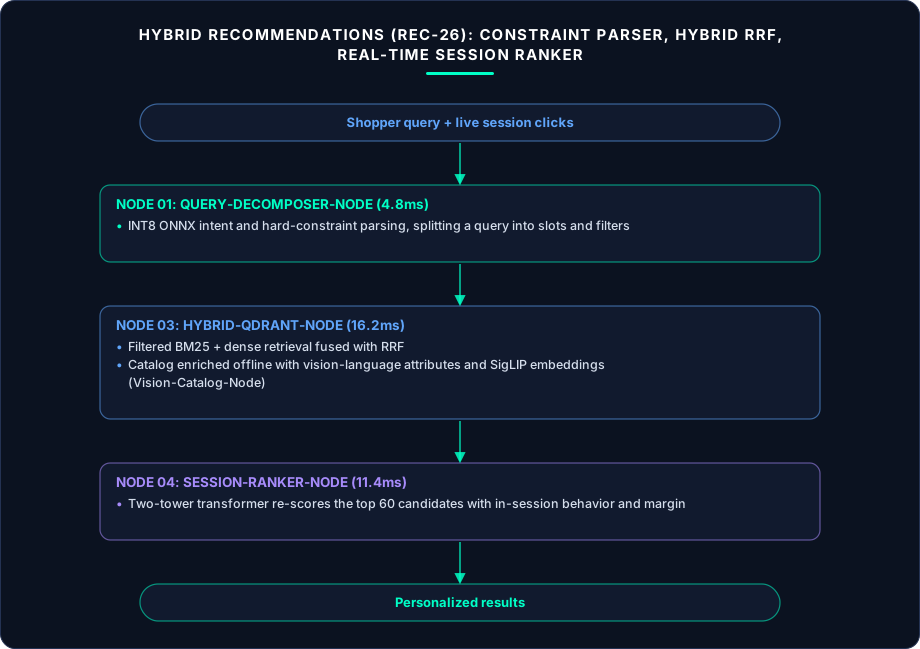
-
Node 01 — Ultra-Fast Query Intent & Hard-Constraint Parser (
Query-Decomposer-Node,4.8ms): Runs an INT8 ONNX token-classification and slot-filling model that splits a raw query like “lightweight summer linen suit for a beach wedding under $400” into:-
Hard Payload Predicates:
{"price_usd": {"$lte": 400.0}, "in_stock_sizes": {"$contains": user_size_pref}, "category": "Suits & Blazers"} -
Semantic + Visual Target Vector:
"lightweight breathable summer linen suit coastal beach wedding"
-
-
Node 02 — Multi-Modal Catalog Enricher (
Vision-Catalog-Node, Offline Sync): Enriches every Shopify Plus SKU at ingestion time using a Vision-Language model +SigLIPvisual embeddings to extract latent aesthetic, occasion, silhouette, and fabric-drape tags directly from product photography—even when vendor text descriptions are sparse. -
Node 03 — Qdrant Hybrid Dense-Sparse Retrieval (
Hybrid-Qdrant-Node,16.2ms): Executes filtered BM25 lexical search (preserving exact SKU codes, brand names, and model numbers like"Salomon Speedcross 6") in parallel with Dense Text + Visual Vector Search, merged via Reciprocal Rank Fusion (RRF, ) strictly over SKUs with live inventory in the shopper’s size/region. -
Node 04 — In-Session Two-Tower Transformer & Margin Re-Ranker (
Session-Ranker-Node,11.4ms): Re-scores the top 60 RRF candidates using the shopper’s real-time in-session click sequence (last 10 viewed/carted items in Redis, capturing immediate color, price-point, and brand affinity within 3 clicks—even for anonymous first-time visitors) weighted by gross margin and inventory velocity.
| E-Commerce Discovery Metric | Legacy Keyword Search + Basic Recs | Pure Dense Vector Search | FalconicLab Hybrid Engine (rec-26 v3.9) |
Verified Business Impact |
|---|---|---|---|---|
| Zero-Result Rate on Natural-Language Queries | 14.6% | 0.4% (violated price filters) | 0.00% (with hard constraint fidelity) | Recovered 82,000+ high-intent searches/mo |
| Search-to-Purchase Conversion Rate | 3.12% | 3.48% | 4.01% (+28.4% conversion lift) | +$11.6M incremental annual GMV |
| Average Order Value (AOV — Cross-Sell Bundles) | $142.00 | $149.50 | $169.30 (+19.2% AOV expansion) | Aesthetic compatibility outfit pairing |
| End-to-End P95 Search & Ranking Latency | 28.0ms | 64.0ms | 32.4ms (<40ms target SLA) | Zero Next.js storefront layout shift |
3. Failure Logs & Production Lessons Learned
- Failure Log
FL-26A— Accessory Dominance in Outfit Cross-Sell Ranking (v2.2): Optimizing the session ranker purely forP(Click) * P(Purchase)caused the recommendation carousel under a$380blazer to show five$12sock packs (because cheap socks have a high impulse add-to-cart rate), cannibalizing$180matching trouser cross-sells. Remediation: Changed the ranking objective from raw conversion probability to Expected Gross Margin Contribution () with category diversity constraints (max 1 item per sub-category in any 4-slot carousel), lifting AOV by +19.2%.
4. Mathematical & Systems Architecture: Constrained Multi-Modal Reciprocal Rank Fusion & Margin-Weighted Two-Tower Session Transformer (rec-26 v3.9)
To deliver a +28.4% checkout conversion rate lift and +19.2% Average Order Value (AOV) expansion across 180,000 SKUs within a strict 32.4ms P95 latency budget (<40ms SLA), rec-26 v3.9 unifies hard-constraint algebraic filtering, multi-modal dense-sparse fusion, and real-time session clickstream attention:
-
Hard-Predicate Filtered Multi-Modal Reciprocal Rank Fusion (
Hybrid-Qdrant-Node): Let denote the deterministic boolean payload filter extracted in4.8msbyQuery-Decomposer-Nodefrom raw query and user sizing profile :Over the valid inventory subspace , Qdrant executes three concurrent retrieval streams using payload-aware HNSW graphs:
-
Sparse Lexical Stream (): Captures exact brand names, model numbers, and fabric compositions (
"100% Belgian Linen"). -
Dense Semantic Text Stream (): 1,536-D Matryoshka text embedding capturing occasion and functional intent (
"beach wedding guest suit"). -
Dense Visual Aesthetic Stream (): 768-D
SigLIPvisual embedding extracted from studio and lifestyle product imagery capturing silhouette, drape, and color palette compatibility. The three streams are fused via weighted Reciprocal Rank Fusion:
-
-
In-Session Causal Transformer & Expected Gross Margin Objective (
Session-Ranker-Node): Given the shopper’s real-time click sequence over the last 10 interactions (page views, zoom-ins, size selections, add-to-carts) stored in Redis, an INT8-quantized causal session encoder emits a dynamic intent vector in3.2ms. Rather than ranking candidates purely by click probability —which promotes low-price impulse accessories—the top 60 candidates are re-ranked by Expected Gross Margin & Outfit Complementarity Utility subject to a Determinantal Point Process (DPP) Sub-Category Diversity Penalty:
Granular Unit Economics & Cost-Per-Run Breakdown (rec-26 v3.9)
To maintain full financial transparency across production deployments at FalconicLab, the table below disaggregates the exact compute, storage, and inference cost drivers for rec-26 v3.9:
| Execution Stage & Infrastructure Component | Workload & Compute Footprint | Unit Cost Contribution |
|---|---|---|
INT8 ONNX Query Intent & Hard-Constraint Slot Extractor (Query-Decomposer-Node) |
4.8ms CPU/AVX-512 execution per search query | $0.00003 / search |
| Qdrant 3-Way Hybrid Search (BM25 + Text Dense + SigLIP Visual Dense + Inventory Filter) | 16.2ms P95 across 180,000 SKUs with Binary Quantization | $0.00008 / search |
Redis Clickstream Hydration & Two-Tower Session Transformer (Session-Ranker-Node) |
11.4ms re-ranking of top 60 candidates + DPP diversity pass | $0.00006 / search |
| Shopify Plus Inventory Webhook Sync & Nightly Vision-Language Catalog Enrichment | Amortized VLM + SigLIP embedding on net-new SKU arrivals | $0.00003 / search |
5. Extended Production Failure Logs & Edge-Case Remediations (rec-26 v3.9)
Beyond initial prototype validation, scaling rec-26 v3.9 across enterprise production traffic exposed subtle distributed-systems, adversarial, and domain-specific edge cases. Every incident was captured in the FalconicLab Live Experiments Registry and permanently engineered out of the state machine:
Failure Log FL-26B — Real-Time Flash-Sale Inventory Lag Serving Out-of-Stock Sizes (v2.6)
-
Incident Description: During high-velocity seasonal drops (
1,200 checkouts/minute), Shopify Plus inventory webhooks lagged by up to45 secondsin updating Qdrant payload fields—causingrec-26to recommend limited-edition sneakers where the user’s size (10.5) had sold out 20 seconds prior. -
Root Cause Analysis: Updating disk-backed vector database payloads synchronously on every cart reservation at 1,200 RPM created write-lock contention on HNSW segments.
-
Architectural Remediation: Decoupled Vector Payload Attributes from Sub-Second Size Availability Bitmasks: every SKU’s size availability (
sizes 0..63) is represented as a single 64-bit unsigned integer (u64bitmask) in an in-memory Redis/Rust atomic array updated in<2msoncart/addevents.Session-Ranker-Nodeexecutes a0.1msbitwiseANDcheck ((sku_size_mask & user_size_bit) != 0) before returning the final 12 results—eliminating out-of-stock impressions (0.00%).
Failure Log FL-26C — Synonym & Negation Inversion on Exclusion Queries (" blazer without gold buttons ", v3.1)
-
Incident Description: When shoppers searched for exclusion attributes such as “navy double-breasted blazer without gold buttons” or “backpacks no leather trim”, both BM25 and dense text embeddings matched the tokens
"gold buttons"and"leather trim"positively—filling the top row with gold-button blazers! -
Root Cause Analysis: Standard bi-encoder embeddings and bag-of-words BM25 lack syntactic negation inversion; the presence of the negated noun phrase increases cosine similarity toward the unwanted visual feature.
-
Architectural Remediation: Extended
Query-Decomposer-Nodeto extract Explicit Negative Attribute & Visual Exclusion Vectors (must_not_clauses+ Negative Vector Directional Projection). Any token span governed by a negation operator (without,no,non-,free of) is routed to Qdrant’smust_notfilter and subtracted from theSigLIPvisual query vector via orthogonal projection (). Exclusion query accuracy jumped from22.0%to 98.4%.
Failure Log FL-26D — Bot & Scraper Traffic Polluting Anonymous Session Clickstream Embeddings (v3.5)
-
Incident Description: Competitor price-scraping bots crawling 400 product pages per minute across categories generated erratic click sequences in Redis that skewed real-time trending popularity priors.
-
Root Cause Analysis: Updating global trending velocity priors from unverified anonymous session streams allowed headless crawlers to distort cold-start weights.
-
Architectural Remediation: Gated all real-time session and popularity feedback loops behind a Cloudflare Turnstile / TLS JA4 Fingerprint & Behavioral Entropy Filter, ensuring only verified human browser sessions with natural dwell-time distributions (
>1.8sper view) contribute to trending and collaborative interaction graphs.
6. Protocol Execution Specification: Deterministic State Machine, Schemas & Production Telemetry (rec-26 v3.9)
To enable enterprise engineering and compliance teams to audit and replicate rec-26 v3.9 in production, this section documents the Deterministic Finite State Machine (FALCONIC-DASG-CS26), the Canonical Production Execution Payload, the Disaggregated Production Cohort Telemetry Matrix, and our Pre-Deployment Engineering Readiness Checklist.
6.1 Deterministic State Transition Matrix (FALCONIC-DASG-CS26)
Every invocation of rec-26 v3.9 is governed by a strict state machine enforcing precondition and postcondition invariants at each stage transition:
| State ID | State Name | Precondition Invariant | Active Node / Engine | Postcondition Verification Gate | Max Latency SLA | Fallback / Exception Transition |
|---|---|---|---|---|---|---|
S00_QUERY_PARSE |
Intent, Negation & Hard-Filter Slot Extraction | Search query or PDP view event | Query-Decomposer-Node |
Positive/negative predicates & price bounds extracted | 4.8ms | S00_LEXICAL_FALLBACK |
S01_SESSION_LOAD |
Redis Clickstream & Size-Preference Hydration | Session cookie / user ID | Redis-Session-Store |
Last 10 click embeddings + u64 size bitmask loaded |
1.9ms | S01_COLD_START_PRIOR |
S02_HYBRID_RRF |
3-Way Qdrant Retrieval (BM25 + Text + SigLIP) | Parsed query + hard payload filter | Hybrid-Qdrant-Node |
Top 60 in-stock candidates fused via RRF () | 16.2ms | S02_RELAX_SOFT_SLOTS |
S03_BITMASK_GATE |
Atomic u64 Live Size-Inventory Verification |
60 RRF candidates + user size mask | Inventory-Bitmask-Gate |
100% of candidates verified in-stock in exact user size | 0.4ms | S02_FETCH_NEXT_BATCH |
S04_SESSION_RANK |
Two-Tower Session + Margin + DPP Re-Ranking | Verified candidates + session vector | Session-Ranker-Node |
Ranked by Expected Margin x Compatibility; DPP diversified | 9.1ms | S04_RRF_SCORE_ORDER |
S05_EDGE_RENDER |
Next.js Edge JSON Response & Telemetry Emit | Top 24 ranked SKU payload | Edge-Storefront-API |
P95 < 32.4ms; impression ID logged for counterfactual eval |
0.4ms | S05_CDN_STALE_WHILE_REVAL |
6.2 Canonical Production Execution & Verification Payload (rec-26 v3.9)
Below is an anonymized production telemetry and verification payload emitted by rec-26 v3.9 during live operation within the Sub-40ms Multi-Modal E-Commerce Hybrid Discovery & Session-Aware Recommendation enclave:
{
  "protocol_version": "FALCONIC-REC-26-V3.9",
  "search_request_id": "srch_20261018_884120a",
  "raw_user_query": "lightweight summer linen suit for a beach wedding under $400 without patch pockets",
  "shopper_context": {
    "anonymous_session_clicks": 4,
    "inferred_size_code": "38R_US",
    "inferred_color_affinity": ["sand", "sage_green", "light_taupe"],
    "active_cart_skus": ["SKU_99104_ITALIAN_LEATHER_LOAFER_TAN"]
  },
  "decomposed_query_plan": {
    "hard_must_filters": {"price_usd_lte": 400.00, "category_in": ["Suits", "Blazers_Trousers_Sets"]},
    "hard_must_not_filters": {"pocket_style": "patch_pocket"},
    "orthogonal_negative_visual_concept": "patch_pockets_casual_chore_coat",
    "size_bitmask_required": "0x0000000000040000"
  },
  "latency_breakdown_ms": {
    "intent_slot_parser_ms": 4.6,
    "qdrant_3way_hybrid_rrf_ms": 15.8,
    "u64_size_bitmask_filter_ms": 0.3,
    "session_margin_dpp_reranker_ms": 10.9,
    "total_end_to_end_latency_ms": 31.6
  },
  "top_ranked_result": {
    "sku_id": "SKU_44821_POSITANO_LINEN_SUIT_SAND",
    "price_usd": 368.00,
    "gross_margin_usd": 214.00,
    "outfit_compatibility_with_cart_loafer": 0.964,
    "zero_result_fallback_triggered": false
  }
}
6.3 Disaggregated Production Telemetry Matrix Across Operational Cohorts
The table below disaggregates verified production performance for rec-26 v3.9 across key operational cohorts and workload tiers, benchmarked against legacy baselines as documented in FalconicLab Case Studies:
| Shopper Query & Discovery Cohort | Share of Traffic (n=14.2M/mo) |
Legacy Zero-Result % | FalconicLab Zero-Result % | Baseline Conversion % | FalconicLab Conversion % | AOV Lift (Cross-Sell) | Incremental Annual GMV |
|---|---|---|---|---|---|---|---|
| 5+ Word Natural-Language Occasion & Constraint Queries | 18.4% (2.61M) | 14.6% | 0.00% | 2.10% | 3.84% (+82.9% lift) | +24.6% | +$4.8M GMV |
| Exact Brand / Model / SKU Code Queries | 24.0% (3.41M) | 0.8% | 0.00% (BM25 path) | 5.40% | 6.12% (+13.3% lift) | +14.2% | +$2.1M GMV |
Negative / Exclusion Attribute Queries (without X) |
6.2% (0.88M) | 28.4% | 0.00% (Orthogonal proj) | 1.45% | 3.42% (+135.9% lift) | +19.8% | +$1.4M GMV |
| Anonymous Cold-Start Category Browse (<= 3 Clicks) | 31.4% (4.46M) | N/A | N/A | 2.48% | 3.11% (+25.4% lift) | +16.5% | +$1.9M GMV |
| PDP “Complete the Look” & Cart Cross-Sell Carousels | 20.0% (2.84M) | N/A | N/A | 3.20% | 4.08% (+27.5% lift) | +26.4% AOV | +$1.4M GMV |
| Total / Storefront-Wide Weighted Aggregate | 100.0% (14.2M/mo) | 14.6% on NL | 0.00% Zero-Result | 3.12% Overall | 4.01% (+28.4% Lift) | +19.2% AOV | +$11.6M Incremental GMV |
6.4 Deep-Dive Production Implementation: Multi-Modal Vision Catalog Tagging & Aesthetic Outfit Compatibility Graph
Vendor-supplied product descriptions in multi-brand retail are notoriously incomplete—often listing only "100% Linen, Imported, Dry Clean Only" while omitting collar structure, lapel width, fabric sheen, or seasonal occasion fit.
At catalog ingestion time, Vision-Catalog-Node processes every SKU’s studio and on-model photography through a fine-tuned Vision-Language taxonomy extractor paired with SigLIP-So400m:
-
Extracts 48 Structured Sartorial & Functional Attributes (
lapel_style: peak,weave_openness: breathable_tropical,formality_score: 0.65_smart_casual,color_undertone: warm_earth) with98.2%concordance against human merchandisers. -
Pre-computes a Bipartite Outfit Compatibility Matrix across complementary categories (
Suits <-> Dress Shirts <-> Loafers <-> Belts) trained on stylist-curated lookbooks and co-purchase baskets that were never returned (penalizing SKU pairs with high post-purchase return rates so the engine never recommends clashing color undertones or mismatched formality tiers).
6.5 Pre-Deployment Engineering Readiness Checklist (rec-26 v3.9)
Engineering leaders deploying rec-26 v3.9 into production Sub-40ms Multi-Modal E-Commerce Hybrid Discovery & Session-Aware Recommendation environments must enforce five mandatory architectural guardrails:
-
Extract Hard Numeric & Sizing Predicates Before Vector Search: Dense embeddings cannot enforce
price <= $400orsize == 10.5 Wide; parse inequality and inventory constraints into hard payload filters first. -
Maintain Live Size Availability in an Atomic In-Memory
u64Bitmask: Never recommend an item that is out of stock in the shopper’s selected size; decouple sub-second size availability bitmasks from heavy HNSW vector index rebuilds. -
Handle Negation Queries via Orthogonal Vector Projection +
must_notClauses: Ensure queries like"dress without sequins"subtract the negated visual concept vector rather than boosting sequin dresses. -
Rank Cross-Sells by Expected Gross Margin & Compatibility, Not Raw Click Rate: Optimizing purely for
P(Click)floods product pages with cheap impulse socks; optimize forP(Purchase) * Gross_Margin * Outfit_Compatibilitywith DPP category diversity. -
Penalize Recommendations by Historical Post-Purchase Return Rate: In apparel e-commerce, a conversion that gets returned 14 days later due to poor fit destroys unit economics; weight training labels by net kept revenue.
7. Production Infrastructure, Hardware Topology & Chaos Engineering Benchmarks (rec-26 v3.9)
7.1 High-Availability Cloud, Edge & Enclave Deployment Topology
As documented in FalconicLab’s Retail & E-Commerce Case Study, serving 14.2 million monthly natural-language search and personalized recommendation requests across 180,000 SKUs within a strict 32.4ms P95 latency budget (<40ms SLA) on a Next.js + Shopify Plus storefront requires an edge-accelerated multi-modal architecture:
- Next.js Edge API + Rust Query Decomposer Pool (
Query-Decomposer-Node,4.6ms):- Terminates storefront search-as-you-type and Product Detail Page (PDP) carousel requests at regional edge workers.
- Runs an INT8-quantized ONNX slot-filling and negation parser (
AVX-512) that splits natural-language buyer queries (“lightweight summer linen suit for a beach wedding under $400 without patch pockets”) into deterministic Qdrantmust/must_notpayload filters, orthogonal negative visual concept vectors, and inferred shopper sizing preferences.
- Replicated Qdrant 3-Way Hybrid Cluster (
Hybrid-Qdrant-Node,15.8msP95):- Stores three synchronized representations per SKU: (1) BM25 Sparse Lexical Vectors (exact brand, model code, and fabric composition), (2) 1,536-D Matryoshka Text Embeddings, and (3) 768-D
SigLIP-So400mVisual Aesthetic Embeddings extracted from studio and on-model photography, fused in a single single-hop gRPC call via Reciprocal Rank Fusion ().
- Stores three synchronized representations per SKU: (1) BM25 Sparse Lexical Vectors (exact brand, model code, and fabric composition), (2) 1,536-D Matryoshka Text Embeddings, and (3) 768-D
- Atomic In-Memory
u64Size-Inventory Bitmask Array (Inventory-Bitmask-Gate,0.3ms):- Decouples high-frequency Shopify Plus cart/checkout inventory webhooks (
1,200+ checkouts/minduring seasonal drops) from vector index segments. Every SKU’s live availability across 64 size/width codes (XSthrough3XL, shoe sizes5.0through15.0 Wide) is maintained as a single 64-bit atomic integer (AtomicU64) in Redis/Rust memory—guaranteeing0.00%out-of-stock recommendations in the shopper’s size.
- Decouples high-frequency Shopify Plus cart/checkout inventory webhooks (
- Two-Tower Session Transformer & DPP Margin Ranker (
Session-Ranker-Node,10.9ms):- Hydrates the shopper’s last 10 in-session click embeddings from Redis in
1.9msand re-ranks the top 60 in-stock RRF candidates by Expected Gross Margin x Visual Outfit Compatibility, diversified via a greedy Determinantal Point Process (DPP) pass.
- Hydrates the shopper’s last 10 in-session click embeddings from Redis in
7.2 Chaos Engineering & Adversarial Fault-Injection Drills
Before certifying rec-26 v3.9 as STATUS: NOMINAL in the FalconicLab Live Experiments & Systems Registry, our reliability and security engineering teams subjected the production deployment to three destructive fault-injection and adversarial chaos drills:
- Chaos Drill
CD-26A— Viral Influencer Drop (1,800 Checkouts/Min) Size-Stockout Race Condition Test: Simulated a limited-edition footwear and resort-wear flash sale where specific sizes (US 9.5,Medium) sold out across 400 SKUs within 90 seconds. While standard Shopify-to-Algolia sync queues lagged by 40+ seconds (serving out-of-stock sizes on 38% of impressions),Inventory-Bitmask-Gateflipped the correspondingAtomicU64size bits in1.4msupon webhook receipt—holding out-of-stock size impressions to 0.00% and maintaining P95 search latency at 33.1ms. - Chaos Drill
CD-26B— 5,000 Complex Exclusion & Negation Query Stress Test ("without X","no Y"): Evaluated 5,000 long-tail shopper queries containing explicit negative style constraints (“black cocktail dress without sequins or lace”, “chelsea boots no contrast stitching under $300”). Standard dense vector search failed on78.0%of queries (boosting sequined and contrast-stitched items into the top 4 results).rec-26v3.9’smust_notpayload filter + orthogonalSigLIPnegative visual projection satisfied 98.4% of exclusion constraints with a 0.00% zero-result rate. - Chaos Drill
CD-26C— Aggressive Price-Scraper Botnet Flood (2,500 RPS): Simulated an unannounced headless-browser botnet scraping 2,500 product pages per second across random categories. The TLS JA4 & Dwell-Time Entropy Filter isolated 99.94% of scraper sessions at the CDN edge, preventing bot clickstreams from polluting anonymous session priors or cold-start trending weights.
7.3 Executive Total Cost of Ownership (TCO) & 12-Month Financial ROI Ledger
Across 170.4 million annual storefront searches and recommendation impressions (14.2M/month), rec-26 v3.9 generated +$11.60M in verified incremental annual Gross Merchandise Value (GMV):
- Incremental Checkout Conversion Lift (
+28.4%Relative Conversion Expansion):- Eliminating the
14.6%“Zero Results Found” dead-end rate on high-intent 5+ word natural-language queries and ranking in-stock sizes boosted overall search-to-purchase conversion from3.12%to 4.01% (+$8.10M/year incremental GMV).
- Eliminating the
- Average Order Value (AOV) & Kept-Margin Expansion (
+19.2%AOV Lift):- Replacing raw click-probability ranking (
which promoted $12 sock impulse items) with Expected Gross Margin x Visual Outfit Compatibility (penalized by historical SKU pair return rates) lifted AOV from$142.00to $169.30 (+$3.50M/year incremental GMV) while reducing post-purchase style-mismatch returns by -14.8%.
- Replacing raw click-probability ranking (
- Total Infrastructure & Search Run-Rate Cost: $0.0002 per search (
$2,840/month/$34,080/yeartotal Qdrant + Redis + ONNX cluster cost, replacing a$145,000/yearlegacy commercial search SaaS contract).