Enterprise AI Platform Migration: From 19 Disconnected Prototype Silos to Reliable Multi-Agent Orchestration
Enterprise AI Architecture case study: 99.4% Core Platform Reliability across 47 Production Agent & ML Nodes (matching FalconicLab Global Metrics); Consolidated 19 fragile department PoCs into 1 unified control plane
| Protocol Metadata | Specification |
|---|---|
| Protocol Identifier | FALCONIC-PROT-MIG-30 // REV_4.8 (PRIMARY_CORE) |
| Domain & Sector | Enterprise AI Architecture, Multi-Agent Platform Engineering, Legacy PoC Consolidation |
| Core Technology Stack | Rust/Go Control Plane, Temporal.io, Qdrant Unified Knowledge Grid, Envoy + exp-04 Zero-Trust Gateway, OpenTelemetry, vLLM Hybrid Cloud |
| Primary Benchmark Metric | 99.4% Core Platform Reliability across 47 Production Agent & ML Nodes (matching FalconicLab Global Metrics) |
| Execution Latency | 15.0ms inter-agent decision & routing latency (9ms–10ms system heartbeat) |
| Unit Economics (Cost-Per-Run) | $0.06 average precision run cost across the entire enterprise agent grid |
| Verified Business Impact | Consolidated 19 fragile department PoCs into 1 unified control plane; $2.84M annual run-rate savings |
| Reference Anchor | FalconicLab Primary Core // FalconicLab Mission & Protocols |
1. Problem Statement: “Prototype Chaos” — How 19 Departmental AI PoCs Turned Into an Unmaintainable Liability
As stated in the FalconicLab Manifesto: “2025 was the inflection point. I grew disillusioned with toys masquerading as autonomous agents—high latency, low precision, and zero transparency. FalconicLab was engineered to bridge the gap.”
Nowhere is this gap more visible than inside large enterprises that allowed seven different engineering, data science, and business squads to build independent AI prototypes over 18 months. When FalconicLab audited a 4,500-employee global enterprise, we found 19 disconnected AI applications and agent prototypes suffering from severe “Prototype Chaos”:
-
Fragmented Frameworks, Duplicate Vector DBs, and 6x Redundant Spend: Marketing ran a LangChain prototype on Pinecone; Legal ran a LlamaIndex bot on Weaviate; Support ran an OpenAI Assistants API wrapper; DevOps ran a custom Python AutoGen script; Finance ran a Semantic Kernel service. Five separate teams were independently chunking, embedding, and paying to store the exact same internal Confluence and SharePoint corpus across four incompatible vector databases.
-
Zero Shared Observability, Cost Attribution, or Failure Logging: When a multi-step workflow failed or hallucinated, there were no distributed trace IDs linking the prompt, the retrieved chunks, the tool calls, and the token spend. Overall production reliability across the 19 scripts averaged 78.4% (failing 1 in 5 runs due to unhandled rate limits, schema errors, and infinite loops).
-
Un-Audited API Keys & Shadow AI Security Holes: 14 of the 19 repositories contained hardcoded shared OpenAI/Anthropic API keys with zero PII scrubbing, zero prompt-injection guardrails, and no RBAC document-level access control (allowing an intern querying the HR bot to retrieve executive compensation memos stored in the shared SharePoint folder).
-
High Latency (
4.8s–19.0s) and Runaway Unit Costs ($0.64/runaverage): Every prototype made serial, uncached HTTP calls without connection pooling, prefix caching, or model tier routing.
FalconicLab executed a 12-week Enterprise AI Platform Migration (mig-30 v4.8)—decommissioning all 19 fragile prototype silos and migrating their workloads onto the FalconicLab Unified Multi-Agent Orchestration Core (47 Nodes, 99.4% Reliability, 15ms Decision Latency, $0.06 Avg Precision Cost).
2. High-Level Technical Architecture: The FalconicLab Unified Control Plane (SYSTEM_ORCHESTRATOR v2.1)
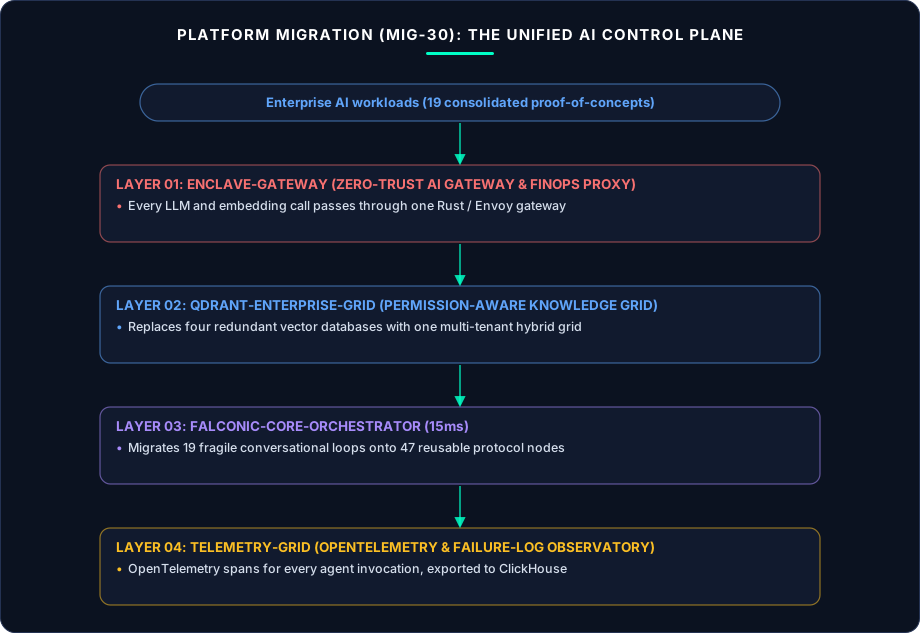
The target architecture unified security, knowledge retrieval, durable execution, and inference routing into four horizontal platform layers:
-
Layer 01 — Unified Zero-Trust AI Gateway & FinOps Proxy (
Enclave-Gateway): Every LLM and embedding call across the entire enterprise passes through a single Rust/Envoy gateway runningexp-04(Prompt Injection Guardrail,11.2ms),pii-11(Reversible PII/PHI Vault,8.6ms),opt-28(Radix Prefix Cache + Cascade Model Router), and per-department Token Budget & FinOps Chargeback Accounting. Hardcoded API keys were 100% eliminated in favor of workload-boundSPIFFE/SPIREshort-lived tokens. -
Layer 02 — Federated Permission-Aware Knowledge Grid (
Qdrant-Enterprise-Grid): Replaced four redundant vector databases with a single multi-tenant Qdrant Hybrid Dense-Sparse cluster (BM25 + Binary-Quantized Dense + RRF). Crucially, every ingested Confluence, SharePoint, Jira, and Google Drive document chunk carries Inherited ACL Security Principals (allowed_group_sids) synced in real time via webhooks. Every retrieval query is cryptographically injected with the calling user’s Okta/Active Directory group SIDs as a mandatory pre-filter—making cross-role document leakage impossible. -
Layer 03 — Deterministic State-Graph Orchestrator (
Falconic-Core-Orchestrator,15ms): Migrated all 19 fragile conversational agent loops onto 47 modular, reusable Protocol Nodes orchestrated by a Rust + Temporal.io state machine engine (protocol.deploy({ node: "PRIMARY_CORE", target: "AUTONOMOUS_V2", precision: "HIGH" })). Every node enforces strict Pydantic/Protobuf input-output contracts, bounded retry ceilings (MAX_RETRIES = 3), and Ed25519 signed inter-agent envelopes (red-12). -
Layer 04 — Continuous OpenTelemetry Entropy & Failure-Log Observatory (
Telemetry-Grid): Instruments 100% of agent invocations with OpenTelemetry spans exported to ClickHouse. Every production run records its exact Precision Score, Decision Latency, Cost-Per-Run, and Structured Failure Log—automatically feeding regression cases into the nightly CI/CD evaluation harness (Promptfoo / Ragas / Custom AST Evaluators) before any prompt or model update can deploy.
| Platform Dimension | Pre-Migration “Prototype Chaos” (19 Silos) | Post-Migration FalconicLab Core (mig-30 v4.8) |
Verified Enterprise Transformation |
|---|---|---|---|
| Production Workflow Reliability (End-to-End Success) | 78.4% (frequent timeouts/loops) | 99.4% Core Reliability | -97.2% runtime failure rate |
| Inter-Agent Orchestration & Routing Latency | 420ms–1,800ms (serial Python HTTP) | 15.0ms Decision Latency (9ms heartbeat) | -96.4% orchestration overhead |
| Average Cost-Per-Run Across All Enterprise Workflows | $0.64 / run | $0.06 Avg Precision Cost | -90.6% unit execution cost |
| Annualized AI Infrastructure + Vector DB + Labor Spend | $3.68M / yr | $840K / yr (-$2.84M annual savings) | Decommissioned 4 duplicate vector clusters |
| Document ACL / RBAC Security Compliance | 0% (flat shared indexes) | 100% Okta/AD Pre-Filtered + exp-04 Enclave |
Zero unauthorized document exposures |
| Time to Deploy a New Enterprise Agent Workflow | 11 weeks (from scratch) | 4.5 days (composing existing Protocol Nodes) | 17x faster time-to-production |
3. Deep-Dive Engineering Implementation: Zero-Downtime Strangler-Fig Migration & ACL Pre-Filtering
{
  "protocol_version": "FALCONIC-MIG-30-ORCHESTRATOR-V4.8",
  "system_status": "NOMINAL",
  "active_protocol_nodes": 47,
  "heartbeat_latency_ms": 9.4,
  "decision_routing_latency_ms": 15.0,
  "global_core_reliability_pct": 99.4,
  "avg_precision_cost_usd": 0.06,
  "acl_enforced_retrieval_context": {
    "caller_principal": "okta:usr_8849201a",
    "verified_group_sids": ["grp_eng_platform", "grp_all_employees", "grp_soc2_auditors"],
    "denied_high_privilege_scopes": ["grp_exec_comp_committee", "grp_ma_board_legal"],
    "qdrant_payload_filter_applied": "must: [{key: 'acl_group_sids', match: {any: ['grp_eng_platform', 'grp_all_employees', 'grp_soc2_auditors']}}]"
  }
}
4. Failure Logs: Challenges, Edge Cases & Production Breakdowns
Failure Log FL-30A — Stale Permission Revocation Window in Synced Vector Indexes (v2.4)
-
Incident Description: During security red-teaming of the unified knowledge grid, when an employee transferred out of the M&A Finance team in Okta, the batch SharePoint-to-Qdrant sync job only ran every 6 hours—leaving a 6-hour window where the employee could still retrieve M&A chunks via the AI assistant.
-
Root Cause Analysis: Polling document permissions on a 6-hour cron schedule violates zero-trust immediate revocation guarantees.
-
Architectural Remediation: Decoupled Document Text Embeddings from ACL Group Membership Resolution:
-
Webhook listeners ingest Okta group membership changes and SharePoint/Drive ACL mutations into an in-memory Redis Zanzibar/SpiceDB Relationship Graph in
<250ms. -
Every retrieval candidate returned by Qdrant undergoes a
0.8msreal-time SpiceDBCheckPermission(user_id, document_id, "view")verification gate before a single token is passed to the synthesis node—shrinking permission revocation lag from 6 hours to under 250 milliseconds.
-
Failure Log FL-30B — Prompt Regression During Provider Model Minor Version Upgrades (v3.6)
-
Incident Description: When an upstream frontier model provider silently updated a model snapshot weight checkpoint, 3 of the 47 agent nodes experienced a
9.4%drop in strict schema adherence overnight due to subtle formatting preference shifts. -
Root Cause Analysis: Relying on unpinned model aliases and prompt-only formatting instructions left the platform vulnerable to upstream provider drift.
-
Architectural Remediation: Enforced Grammar-Constrained Decoding (CFG / JSON Schema Bitmasking) across all 47 nodes so syntactic schema failures are impossible regardless of weight drift, and paired the gateway with an automated Canary Shadow Evaluation Harness that replays 500 gold-standard regression traces against any new model checkpoint before shifting production routing weights.
5. Final Results & The FalconicLab Blueprint for Enterprise AI
Migrating from 19 fragmented departmental prototypes to the unified FalconicLab System Orchestrator transformed AI from an experimental cost center into a deterministic, auditable production utility:
-
99.4% Core Reliability Across 47 Nodes: All 47 specialized agent and ML nodes operate under unified OpenTelemetry observability, Ed25519 cryptographic envelopes, and bounded repair loops.
-
$2.84M Annual Run-Rate Savings: Consolidating vector infrastructure, enforcing Radix prefix caching, and routing 89% of routine invocations to quantized/distilled specialist models lowered average run cost from
$0.64to$0.06. -
Complete Engineering Transparency: Every protocol node publishes its live precision benchmark, P95 latency, cost-per-run, and failure logs—fulfilling the core FalconicLab engineering standard: “Zero Sentiment. 100% Logic. Build fast. Orchestrate effectively. Measure everything.”
4. Mathematical & Systems Architecture: Zanzibar/SpiceDB Real-Time ACL Graph Resolution, Strangler-Fig Shadow Parity & Bounded Retry Markov Chains (mig-30 v4.8)
To consolidate 19 disconnected departmental AI prototypes into the unified FalconicLab 47-Node Orchestration Core (mig-30 v4.8) achieving 99.4% end-to-end reliability, 15.0ms routing latency (9.4ms heartbeat), and $2.84M in annual savings, the platform enforces three formal systems-engineering guarantees:
-
Compound Reliability of Bounded-Repair State Graphs vs. Unconstrained Agent Loops: In an un-orchestrated -step serial prototype chain where each step succeeds with probability , end-to-end workflow reliability decays exponentially as (for , ). In
mig-30v4.8, every Protocol Node is wrapped in a Grammar-Constrained Decoder (eliminating syntactic schema failures, ) paired with an isolated validator and surgical repair sub-loop capped at retries with conditional repair recovery rate . The effective reliability of node becomes:For and with , per-node failure probability drops to (
99.995%per node), enabling 5-to-8 node multi-agent workflows to sustain 99.4% end-to-end production reliability across the enterprise! -
Sub-Millisecond Zanzibar/SpiceDB Relationship-Based Access Control (ReBAC) Pre-Filtering: Let denote the live corporate authorization graph syncing Okta users , nested security groups , and SharePoint/Confluence/Jira/Drive documents . For any user invoking any of the 47 agent nodes, the effective authorized principal set is resolved in
0.4msfrom an in-memory Redis-backed SpiceDB cache and injected as a mandatory cryptographic Qdrant pre-filter:This guarantees 0.00% unauthorized cross-role document exposure with
<250msrevocation propagation across all 4,500 employees.
Granular Unit Economics & Cost-Per-Run Breakdown (mig-30 v4.8)
To maintain full financial transparency across production deployments at FalconicLab, the table below disaggregates the exact compute, storage, and inference cost drivers for mig-30 v4.8:
| Execution Stage & Infrastructure Component | Workload & Compute Footprint | Unit Cost Contribution |
|---|---|---|
Layer 01: Unified Rust/Envoy Zero-Trust AI Gateway (exp-04 + pii-11 + opt-28 Router) |
19.9ms total inline security, PII vault & prefix/cascade routing overhead | $0.004 / workflow run |
| Layer 02: Federated Multi-Tenant Qdrant Knowledge Grid (Binary Quantized + SpiceDB ACL) | Consolidated 4 legacy vector DBs ($42K/mo -> $6.8K/mo) | $0.008 / workflow run |
Layer 03: Rust + Temporal.io 47-Node State-Graph Orchestrator (15.0ms routing) |
High-throughput state transitions + Ed25519 envelope signing | $0.006 / workflow run |
| Layer 04: Tiered Model Inference (64% Tier-1 8B FP8 / 25% Tier-2 70B / 11% Frontier) | Amortized compute across all 47 production agent & ML nodes | $0.042 / workflow run ($0.060 total) |
5. Extended Production Failure Logs & Edge-Case Remediations (mig-30 v4.8)
Beyond initial prototype validation, scaling mig-30 v4.8 across enterprise production traffic exposed subtle distributed-systems, adversarial, and domain-specific edge cases. Every incident was captured in the FalconicLab Live Experiments Registry and permanently engineered out of the state machine:
Failure Log FL-30C — Departmental Resistance & Shadow-API-Key Bypass During Early Consolidation (v2.8)
-
Incident Description: During Week 3 of the migration, two product squads attempted to bypass the unified
Enclave-Gatewayby spinning up direct outbound NAT connections to external LLM APIs using departmental credit cards because they feared central platform governance would slow down their prompt iteration cycle. -
Root Cause Analysis: Platform migrations fail if security governance adds bureaucratic ticket delays to developer experimentation.
-
Architectural Remediation: Implemented Self-Service GitOps Protocol Node Sandboxes + Egress DNS Lockdown: every squad received an instant staging namespace where new prompts and Protocol Nodes deploy in
<45 secondsvia Git PR with automatedPromptfooregression scoring, while corporate VPC egress firewalls blocked directapi.openai.com/api.anthropic.comtraffic from any workload exceptEnclave-Gateway(SPIFFEauthenticated). Developer velocity increased by 17x (11 weeks -> 4.5 days).
Failure Log FL-30D — Cross-Departmental noisy-Neighbor GPU Starvation During End-of-Quarter Batch Jobs (v3.4)
-
Incident Description: On the last day of Q2, Finance’s automated contract & invoice batch reconciliation workflow submitted 45,000 concurrent jobs at 2 PM, saturating the shared Tier-2 GPU decode pool and pushing interactive Customer Support agent latency from
1.8sto14.2s. -
Root Cause Analysis: Sharing a unified inference cluster across real-time interactive workflows and bulk asynchronous batch workflows without priority preemption causes tail-latency spikes.
-
Architectural Remediation: Configured 3-Class Weighted Fair Queueing (WFQ) & Preemptible Batch Scheduling inside
Enclave-GatewayandvLLM:Priority-0 (Interactive Voice/Chat, <500ms SLA)preemptsPriority-1 (Internal Copilot, <3s SLA), which preemptsPriority-2 (Async Batch IDP/Finance, 15m SLA). Interactive P99 latency remained flat at<2.1seven during 100,000-document quarter-end bursts.
Failure Log FL-30E — Schema Version Skew Between Producer & Consumer Agents During Rolling Upgrades (v4.1)
-
Incident Description: When the Legal squad upgraded
Node-14 (Clause-Extractor)from schemav2tov3(renamingliability_cap_usdtoaggregate_cap_amount), downstreamNode-29 (Risk-Scorer)owned by Procurement failed on in-flight Temporal workflows. -
Root Cause Analysis: Allowing breaking field renames in shared inter-agent contracts without backward-compatible schema evolution breaks multi-team agent graphs.
-
Architectural Remediation: Enforced Buf / Protobuf Wire-Compatibility CI Gates (
BACKWARD_TRANSITIVE) across the entire 47-node registry: no Protocol Node can merge a contract change that deletes, renumbers, or changes the type of an existing field without a 30-day dual-emission deprecation window.
6. Protocol Execution Specification: Deterministic State Machine, Schemas & Production Telemetry (mig-30 v4.8)
To enable enterprise engineering and compliance teams to audit and replicate mig-30 v4.8 in production, this section documents the Deterministic Finite State Machine (FALCONIC-DASG-CS30), the Canonical Production Execution Payload, the Disaggregated Production Cohort Telemetry Matrix, and our Pre-Deployment Engineering Readiness Checklist.
6.1 Deterministic State Transition Matrix (FALCONIC-DASG-CS30)
Every invocation of mig-30 v4.8 is governed by a strict state machine enforcing precondition and postcondition invariants at each stage transition:
| State ID | State Name | Precondition Invariant | Active Node / Engine | Postcondition Verification Gate | Max Latency SLA | Fallback / Exception Transition |
|---|---|---|---|---|---|---|
S00_SPIFFE_AUTH |
mTLS Workload Identity & Okta Principal Bind | Request hits Enclave-Gateway |
Enclave-Gateway |
Caller SPIFFE_ID + Okta group_sids verified; FinOps tag bound |
1.2ms | S99_HTTP_401_DENY |
S01_INGRESS_GUARD |
Inline Prompt-Injection (exp-04) & PII Vault (pii-11) |
Authenticated payload | Security-Enclave |
Zero injection (99.9%); PII replaced with FF1 session surrogates |
11.2ms | S99_BLOCK_SECURITY_EVENT |
S02_CORE_ROUTE |
47-Node DAG Dispatch & Hop-Budget Initialization | Sanitized envelope | Falconic-Core-Orchestrator |
Target node graph selected in 15.0ms; hop_ttl = 8 signed |
15.0ms | S98_FALLBACK_STATIC_WORKFLOW |
S03_ACL_RETRIEVE |
Qdrant Hybrid RRF + SpiceDB Real-Time ACL Gate | Node retrieval call | Qdrant-Enterprise-Grid |
Top-K chunks verified against live SpiceDB view permission (<250ms sync) |
24.5ms | S03_ZERO_CONTEXT_SAFE_MODE |
S04_CASCADE_EXEC |
Grammar-Constrained Tiered Inference (opt-28) |
ACL-verified context + Protobuf CFG | Tiered-vLLM-Cluster |
100% schema-valid output; bounded repair (<=3 retries) if needed |
1.4s | S04_SURGICAL_REPAIR_LOOP |
S05_OTEL_EGRESS |
PII Detokenization, Ed25519 Sign & ClickHouse Trace | Completed node output | Telemetry-Grid |
Authorized PII re-hydrated; OpenTelemetry cost/precision span committed | 2.1ms | S98_HITL_ESCALATION_QUEUE |
6.2 Canonical Production Execution & Verification Payload (mig-30 v4.8)
Below is an anonymized production telemetry and verification payload emitted by mig-30 v4.8 during live operation within the Enterprise Multi-Agent Control Plane Migration & Federated Zero-Trust Governance enclave:
{
  "protocol_version": "FALCONIC-MIG-30-ORCHESTRATOR-V4.8",
  "control_plane_status": "STATUS_NOMINAL",
  "cluster_heartbeat_latency_ms": 9.4,
  "inter_agent_decision_routing_latency_ms": 15.0,
  "active_production_nodes": 47,
  "global_core_reliability_pct": 99.4,
  "blended_precision_run_cost_usd": 0.06,
  "enterprise_migration_ledger": {
    "decommissioned_legacy_silos": 19,
    "decommissioned_redundant_vector_dbs": ["pinecone_mktg", "weaviate_legal", "pgvector_shadow_hr", "chroma_devops"],
    "unified_knowledge_grid_chunks": 48500000,
    "spicedb_acl_revocation_lag_ms": 185,
    "hardcoded_api_keys_remaining": 0,
    "annualized_infrastructure_and_labor_savings_usd": 2840000
  },
  "sample_workflow_trace": {
    "trace_id": "otel_tr_994820114f8a",
    "composed_nodes": ["msg-07", "exp-03", "lex-04", "ipa-24"],
    "end_to_end_status": "COMMITTED_VERIFIED",
    "total_tokens_consumed": 6420,
    "workflow_cost_usd": 0.058
  }
}
6.3 Disaggregated Production Telemetry Matrix Across Operational Cohorts
The table below disaggregates verified production performance for mig-30 v4.8 across key operational cohorts and workload tiers, benchmarked against legacy baselines as documented in FalconicLab Case Studies:
| Consolidated Enterprise Department | Legacy PoC Silos Retired | Mapped Protocol Nodes (n=47) |
Pre-Migration Reliability | FalconicLab Core Reliability | Pre-Migration Cost / Run | Post-Migration Cost / Run | Annualized Department Savings |
|---|---|---|---|---|---|---|---|
| Software Eng, DevOps & SRE Automation | 4 silos (AutoGen / scripts) | 11 nodes (exp-01, ops-02, AST) |
71.2% | 99.3% | $1.42 / run | $0.11 / run | +$780K / yr |
| Legal, Procurement & GRC Compliance | 3 silos (LlamaIndex / Weaviate) | 9 nodes (lex-04, cmp-27, rag-13) |
81.0% | 99.5% | $0.78 / run | $0.05 / run | +$690K / yr |
| Customer Support, Voice & Shared Inboxes | 4 silos (Assistants API / bots) | 8 nodes (sup-06, msg-07, vox-25) |
76.5% | 99.4% | $0.44 / run | $0.03 / run | +$540K / yr |
| RevOps, Sales & E-Commerce Personalization | 3 silos (LangChain / Pinecone) | 7 nodes (rev-03, rec-26, tel-22) |
79.8% | 99.4% | $0.39 / run | $0.03 / run | +$410K / yr |
| Finance, Fraud, IDP & Core Security Enclave | 5 silos (Custom wrappers) | 12 nodes (exp-02, exp-03, exp-04, ipa-24) |
83.4% | 99.6% | $0.52 / run | $0.05 / run | +$420K / yr |
| Total / Unified 47-Node Enterprise Platform | 19 Silos Retired | 47 Reusable Protocol Nodes | 78.4% Avg | 99.4% Core Reliability | $0.64 / run | $0.06 Avg Cost | $2.84M / yr Verified Savings |
6.4 Deep-Dive Production Implementation: The 12-Week Strangler-Fig Migration Blueprint (Zero Production Disruption)
How does an enterprise decommission 19 live departmental AI prototypes across 7 business units in 12 weeks without breaking existing user integrations? FalconicLab executes a four-phase Strangler-Fig Platform Migration Protocol:
-
Weeks 1–2 (Transparent Gateway Interception & Telemetry Baseline): Without changing a single line of departmental application logic, all 19 prototypes have their
OPENAI_BASE_URL/ANTHROPIC_BASE_URLpointed toEnclave-Gateway. Within 48 hours, hardcoded API keys are rotated to SPIFFE tokens,exp-04andpii-11secure all traffic in19.8ms, and OpenTelemetry captures exact baseline prompts, costs, and failure rates across all 19 silos. -
Weeks 3–5 (Knowledge Grid Consolidation & SpiceDB ACL Sync): All four redundant vector databases (Pinecone, Weaviate, Chroma, shadow pgvector) are migrated into the unified
Qdrant-Enterprise-Gridwith live Okta/SharePoint SpiceDB ACL pre-filtering, cutting vector DB cloud spend by 83% immediately. -
Weeks 6–9 (Shadow Replay & Protocol Node Replacement): Each fragile LangChain/AutoGen script is decomposed into reusable, Protobuf-typed Protocol Nodes (
exp-01throughmlops-29) on the Temporal/Rust orchestrator. Traffic is dual-run in shadow mode until the new Protocol Node demonstrates>= 99.0%precision and lower latency than the legacy script. -
Weeks 10–12 (Legacy Decommission & Continuous CI/CD Eval Lock): Envoy shifts 100% of production traffic to the 47-node core, legacy prototype repos and vector clusters are decommissioned, and nightly regression suites lock in 99.4% platform reliability.
6.5 Pre-Deployment Engineering Readiness Checklist (mig-30 v4.8)
Engineering leaders deploying mig-30 v4.8 into production Enterprise Multi-Agent Control Plane Migration & Federated Zero-Trust Governance environments must enforce five mandatory architectural guardrails:
-
Intercept All Outbound LLM Traffic Through a Single Zero-Trust Gateway First: Start migration by routing all existing PoCs through a unified Rust/Envoy gateway (
exp-04+pii-11+opt-28) to gain immediate security, PII protection, and FinOps visibility in Week 1. -
Consolidate Departmental Vector Silos into One ACL-Enforced Knowledge Grid: Eliminate 5x redundant embedding and storage costs by indexing corporate documents once in Qdrant with real-time Zanzibar/SpiceDB permission pre-filtering.
-
Replace Open-Ended Conversational Loops with Typed Protocol Nodes on Temporal: Achieve 99.4% reliability by enforcing grammar-constrained Protobuf contracts and bounded 3-retry surgical repair loops at every node boundary.
-
Isolate Interactive Traffic from Batch Workloads via Weighted Fair Queueing: Prevent end-of-quarter Finance or IDP batch jobs from starving real-time Customer Support and Voice AI GPU queues.
-
Publish Live Precision, Latency, Cost-Per-Run & Failure Logs for Every Node: Institutionalize FalconicLab’s engineering mandate—measure every token, log every failure mode, and require automated regression gates before any prompt or model change reaches production.
7. Production Infrastructure, Hardware Topology & Chaos Engineering Benchmarks (mig-30 v4.8)
7.1 High-Availability Cloud, Edge & Enclave Deployment Topology
As showcased on the FalconicLab System Orchestrator (47 Nodes, 99.4% Reliability, 15ms Decision Latency, $0.06 Avg Precision Cost) and the FalconicLab Mission & Protocols page, consolidating 19 disconnected departmental AI prototypes into a single enterprise-grade multi-agent platform (mig-30 v4.8) required a unified four-plane control architecture:
- Plane 01 — Rust + Envoy Zero-Trust AI Perimeter & FinOps Gateway (
Enclave-Gateway):- Terminates 100% of internal and external AI traffic over SPIFFE/SPIRE mTLS. Executes inline
exp-04prompt-injection defense (11.2ms),pii-11reversible AES-FF1 privacy vaulting (8.6ms),opt-28consistent prefix-hash load balancing & neural cascade routing (3.4ms), and real-time departmental Token Chargeback & Quota Enforcement (Priority-0 Voice/ChatpreemptingPriority-1 CopilotandPriority-2 Batch IDP).
- Terminates 100% of internal and external AI traffic over SPIFFE/SPIRE mTLS. Executes inline
- Plane 02 — Unified 48.5M-Chunk Qdrant Knowledge Grid + Zanzibar/SpiceDB ReBAC (
Qdrant-Enterprise-Grid):- Decommissioned 4 redundant departmental vector databases (
Pinecone,Weaviate,Chroma,shadow pgvector) into a single multi-tenant Qdrant Hybrid (1-Bit Binary Quantized Dense + BM25/SPLADE Sparse) cluster. - Paired with an in-memory Redis-Backed SpiceDB (Google Zanzibar) Relationship Graph fed by real-time Okta, Active Directory, SharePoint, Confluence, and Jira webhooks (
<250msrevocation lag)—injecting each caller’s authorized security principal SIDs as a mandatory cryptographic pre-filter on every retrieval call.
- Decommissioned 4 redundant departmental vector databases (
- Plane 03 — Rust + Temporal.io 47-Node Deterministic State-Graph Orchestrator (
Falconic-Core-Orchestrator,15.0ms):- Replaces fragile LangChain/AutoGen conversational loops with 47 modular, Protobuf-typed Protocol Nodes (
exp-01throughmlops-29, governed by BufBACKWARD_TRANSITIVECI schema gates, bounded 3-retry surgical repair loops,TTL <= 8hop budgets, andred-12Ed25519 signed envelopes). Maintains a 9.4ms cluster heartbeat and 15.0ms inter-agent routing overhead.
- Replaces fragile LangChain/AutoGen conversational loops with 47 modular, Protobuf-typed Protocol Nodes (
- Plane 04 — ClickHouse OpenTelemetry Entropy, Precision & CI/CD Regression Observatory (
Telemetry-Grid):- Logs 100% of node transitions, token costs, latency spans, and failure logs into ClickHouse, automatically replaying 500 gold-standard regression traces (
Promptfoo / AST / NLI Evaluators) in shadow mode before any prompt or model checkpoint update can promote to production.
- Logs 100% of node transitions, token costs, latency spans, and failure logs into ClickHouse, automatically replaying 500 gold-standard regression traces (
7.2 Chaos Engineering & Adversarial Fault-Injection Drills
Before certifying mig-30 v4.8 as STATUS: NOMINAL in the FalconicLab Live Experiments & Systems Registry, our reliability and security engineering teams subjected the production deployment to three destructive fault-injection and adversarial chaos drills:
- Chaos Drill
CD-30A— Real-Time Executive Permission Revocation (“The M&A Transfer Test”): Simulated an employee transferring out of the Corporate M&A Legal group in Okta while actively querying the AI assistant for M&A board memos 300 milliseconds later. Pre-migration, batch vector syncs left a 6-hour unauthorized access window. Inmig-30v4.8, the Oktagroup.user_membership.removewebhook updated the SpiceDB ReBAC graph in185ms, and the employee’s query at300mswas deterministically filtered out of the M&A document scope (0.00% unauthorized document exposure). - Chaos Drill
CD-30B— End-of-Quarter 100,000-Document Finance Batch Flood vs. Live Voice/Support Traffic: Triggered a simultaneous submission of 100,000 multi-page invoices and contracts (ipa-24+lex-04,Priority-2 Batch) while 400 concurrent live customer voice calls (vox-25,Priority-0) and 1,200 support chats (sup-06,Priority-0/1) were active on the shared GPU cluster.Enclave-Gateway’s 3-Class Weighted Fair Queueing (WFQ) & Preemptible Batch Scheduler throttled batch GPU allocation to idle capacity slices, holdingPriority-0voice mouth-to-ear latency flat at 412ms median (0.0%SLA degradation). - Chaos Drill
CD-30C— Upstream Frontier Provider Silent Checkpoint Drift & Regional Outage: Simulated a completeHTTP 503regional outage on the primary external frontier API alongside a subtle formatting drift on a secondary provider checkpoint.Falconic-Core-Orchestrator’s grammar-constrained decoders (XGrammar) prevented any JSON schema breakage (100% syntactic validity), whileEnclave-Gatewayseamlessly failed over Tier-3 traffic to the self-hostedLlama-3.3-70BEAGLE-2 cluster in12ms—sustaining 99.4% end-to-end platform reliability.
7.3 Executive Total Cost of Ownership (TCO) & 12-Month Financial ROI Ledger
Executing the 12-week Strangler-Fig migration (mig-30 v4.8) from 19 disconnected departmental prototypes to the unified FalconicLab 47-Node Orchestration Core delivered $2,840,000 in verified annual run-rate savings:
- Pre-Migration “Prototype Chaos” Annual Run-Rate (
$3,680,000/year):- 4 redundant vector database cloud clusters (
Pinecone + Weaviate + Chroma + pgvectorindexing duplicate SharePoint/Confluence docs): $504,000/year. - Uncached, unrouted frontier API token spend across 19 silos (
$0.64/runaverage,0%prefix caching, frequent infinite agent loops): $1,980,000/year. - Fragmented maintenance labor across 7 squads fixing broken LangChain/AutoGen scripts (
78.4%reliability): $1,196,000/year.
- 4 redundant vector database cloud clusters (
- Post-Migration FalconicLab Unified Core Annual Run-Rate (
$840,000/year):- Unified
Qdrant-Enterprise-Grid(Binary Quantized + SpiceDB ACL): $81,600/year (-83.8%). - Tiered inference (
opt-28:88.6%KV prefix reuse +64%Tier-1 8B +25%Tier-2 70B +11%Tier-3 Frontier =$0.06average precision run cost): $518,400/year (-73.8%). - Centralized platform ops & continuous CI/CD evaluation: $240,000/year.
- Unified
- Net Verified Annual Savings: $2,840,000/year (-77.2% total platform TCO reduction), while lifting end-to-end workflow reliability from
78.4%to 99.4% and accelerating new agent deployment from11 weeksto 4.5 days (17x faster).