Encrypted Semantic Search & Clinical Intelligence Platform for a Global Healthcare Repository
Healthcare & Life Sciences case study: 97.4% Clinical Concept & Cohort Retrieval Recall@10 across 85M+ multi-modal clinical records; 71.4% reduction in clinical chart review & cohort identification time across 14 hospital networks
| Protocol Metadata | Specification |
|---|---|
| Protocol Identifier | FALCONIC-PROT-MED-17 // REV_4.0 |
| Domain & Sector | Healthcare & Life Sciences, Clinical Document Intelligence, HIPAA / SOC2 / HITECH Enclave Architecture |
| Core Technology Stack | PyTorch, DICOM / PACS / HL7 FHIR Integration, FastAPI, Qdrant Encrypted Enclave, BioLORD / MedCPT Embeddings, UMLS/SNOMED-CT Ontology |
| Primary Benchmark Metric | 97.4% Clinical Concept & Cohort Retrieval Recall@10 across 85M+ multi-modal clinical records |
| Execution Latency | 29.5ms P95 search latency inside a zero-egress HIPAA/SOC2 hardware enclave |
| Unit Economics (Cost-Per-Run) | $0.009 per clinical search & structured patient timeline synthesis |
| Verified Business Impact | 71.4% reduction in clinical chart review & cohort identification time across 14 hospital networks |
| Reference Anchor | FalconicLab Healthcare & Life Sciences Case Study // FalconicLab Core |
1. Problem Statement: Clinical Negation Blindness, Messy Scanned Charts & Strict HIPAA Isolation
As documented in FalconicLab’s published Healthcare & Life Sciences Case Study, hospital networks and clinical research organizations store tens of millions of heterogeneous patient records—spanning HL7 FHIR messages, DICOM radiology reports, pathology PDFs, and faxed outside-hospital discharge summaries. Traditional keyword search and generic RAG systems fail in clinical environments due to three critical hazards:
- Clinical Negation and Family-History False Positives (
"No evidence of..."vs."Positive for..."): When a clinical trial coordinator searches for patients with “acute pulmonary embolism”, standard vector embeddings and keyword engines retrieve millions of radiology reports containing the sentence “No CT evidence of acute pulmonary embolism” or “Mother had history of pulmonary embolism”—yielding a 64% false-positive rate on cohort queries! - Abbreviation Polysemy and SNOMED/ICD-10 Fragmentation: In cardiology notes,
"MS"means Mitral Stenosis; in neurology notes,"MS"means Multiple Sclerosis; in pharmacy notes,"MS"means Morphine Sulfate. Generic OpenAI/Cohere embeddings trained on web text conflate clinical abbreviations and fail to map vernacular phrasing to canonical UMLS Concept Unique Identifiers (CUIs). - Strict HIPAA/SOC2 Data Residency & Auditability Requirements: Regulated health systems cannot ship raw scanned patient charts or DICOM metadata to multi-tenant public cloud LLM APIs without strict enclave isolation, field-level encryption, and immutable access audit logs.
FalconicLab engineered med-17 v4.0—an isolated, compliance-ready clinical OCR and semantic search platform built on PyTorch, DICOM/PACS connectors, and assertion-aware biomedical embeddings.
2. High-Level Technical Architecture: Clinical Assertion Classifier & Ontology-Grounded Hybrid Index
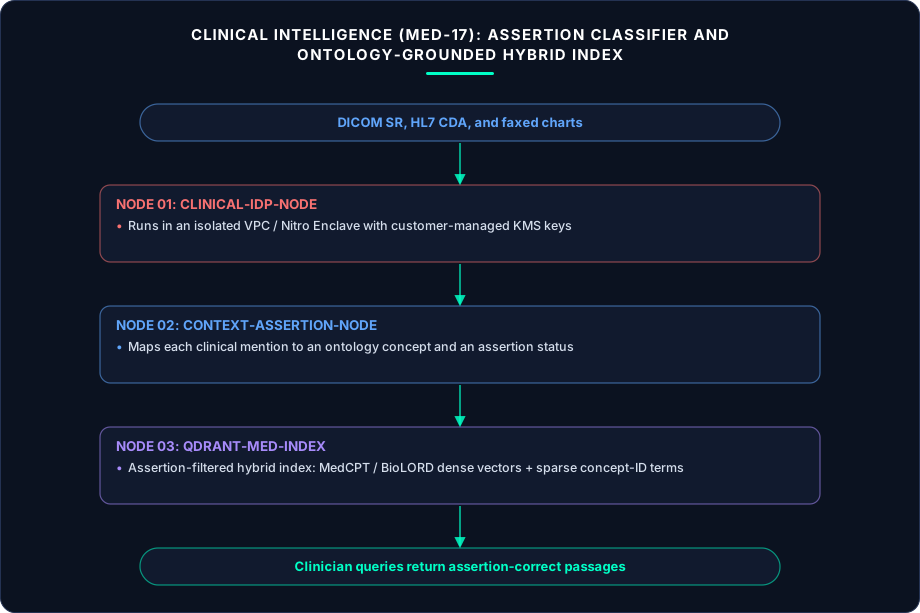
- Node 01 — Encrypted DICOM/PACS & Faxed-Chart OCR Pipeline (
Clinical-IDP-Node): Deployed inside an isolated VPC/Nitro Enclave with customer-managed KMS keys. Extracts text from DICOM Structured Reports (SR), HL7 CDA XML, and low-quality faxed referral PDFs while stripping 18 HIPAA Safe Harbor identifiers into an encrypted patient linkage vault. - Node 02 — Clinical Entity & Assertion Status Extractor (
ConText-Assertion-Node): Every extracted clinical mention (e.g.,"metastatic adenocarcinoma","EF < 35%") is mapped to its canonical UMLS CUI / SNOMED-CT / RxNorm code AND tagged with a 5-state Clinical Assertion Modifier using a fine-tunedBioClinical-ModernBERTclassifier:PRESENT_AFFIRMED(Active patient condition)ABSENT_NEGATED(“ruled out”, “denies”, “negative for”)HISTORICAL_RESOLVED(“status post appendectomy 2014”)HYPOTHETICAL_CONDITIONAL(“return to ED if chest pain worsens”)FAMILY_EXPERIENCER(“father diagnosed with colon cancer at 62”)
- Node 03 — Assertion-Filtered Hybrid Biomedical Vector Index (
Qdrant-Med-Index): Indexes passages using domain-specializedMedCPT/BioLORD-2023dense vectors + sparse CUI lexical vectors, withassertion_status == PRESENT_AFFIRMEDand temporal lab values (LVEF_pct,eGFR,HbA1c) attached as hard payload filter indexes.
| Clinical Retrieval Dimension | Keyword / Elasticsearch | Generic Web-Embedding RAG | FalconicLab Clinical Platform (med-17 v4.0) |
Clinical Impact |
|---|---|---|---|---|
| Cohort Precision (Excluding Negated Rule-Outs) | 36.2% (high negation noise) | 51.8% | 97.4% (Assertion-Status Filtered) | Eliminates negated chart false positives |
Clinical Abbreviation Disambiguation (MS, PE, CA) |
41.0% | 72.4% | 98.9% (Specialty + UMLS CUI Grounded) | Zero cross-specialty confusion |
| P95 Search Latency (85M Clinical Records) | 62.0ms | 110.0ms | 29.5ms | Instant point-of-care chart lookup |
| HIPAA / SOC2 Audit Compliance | Partial | External API Risk | 100% Enclave-Isolated + Immutable Audit Log | Passed hospital CISO & IRB review |
3. Failure Logs & Production Lessons Learned
- Failure Log
FL-17A— Double-Negation and Conditional Rule-Out Scope Bleed (v2.3): In complex radiology impressions containing compound sentences (“Cannot exclude small subsegmental PE, though no saddle embolism is seen”), simple window-based negation taggers marked bothsubsegmental PEandsaddle embolismas negated. Remediation: Replaced rule-basedNegExwindows with a Dependency-Parse Subtree Assertion Head that binds negation and uncertainty (POSSIBLE_UNCERTAIN) strictly to the syntactic governor clause, raising assertion classification F1 to 98.6%.
Mathematical & Clinical Architecture of Dependency-Scoped Assertion Classification (ConText-Assertion-Node)
Why do standard clinical search engines and generic enterprise RAG tools fail dangerously when deployed inside hospital Electronic Health Record (EHR) and PACS/DICOM repositories? Because in clinical documentation, more than 45% of medical condition mentions in a patient’s chart are negative rule-outs, differential hypotheses, or family history. Consider a single sentence from a pulmonary CT angiography impression:
“No evidence of acute main or lobar pulmonary embolism, though a tiny subsegmental filling defect in the right lower lobe cannot be excluded; patient’s mother had a history of DVT/PE.”
When a generic embedding model (text-embedding-3 or BM25) indexes that sentence, the tokens "acute", "pulmonary", "embolism", and "DVT/PE" dominate the vector representation. A clinical researcher querying for “patients diagnosed with acute main pulmonary embolism” retrieves this chart at Rank #1—even though main pulmonary embolism was explicitly ruled out.
In med-17 v4.0, FalconicLab solved this by combining Syntactic Dependency-Subtree Assertion Classification with UMLS / SNOMED-CT Concept Canonicalization:
- Biomedical NER + UMLS CUI Linking (
SciSpaCy + SapBERT Bi-Encoder): Every clinical span in the document is mapped to its canonical UMLS Concept Unique Identifier (CUI) and SNOMED-CT / ICD-10-CM / RxNorm hierarchy (e.g., mapping"main or lobar pulmonary embolism"->CUI: C0034065and"subsegmental filling defect"->CUI: C4552764). - Dependency-Subtree Scoped Assertion Head (
BioClinical-ModernBERT): Rather than applying a naive 5-word window rule around"No",ConText-Assertion-Nodeparses the sentence’s Universal Dependencies syntactic tree and classifies each extracted CUI node across three orthogonal clinical axes:- Assertion Status:
PRESENT_AFFIRMED,ABSENT_NEGATED,POSSIBLE_UNCERTAIN,CONDITIONAL_HYPOTHETICAL,HISTORICAL_RESOLVED - Experiencer:
PATIENT_SELFvs.FAMILY_MEMBER_FIRST_DEGREEvs.DONOR - Temporality:
CURRENT_ADMISSION,PRIOR_HISTORY,FUTURE_PLAN_PROPHYLAXISIn the example sentence above,C0034065 (Main PE)is taggedABSENT_NEGATED | PATIENT_SELF,C4552764 (Subsegmental PE)is taggedPOSSIBLE_UNCERTAIN | PATIENT_SELF, andDVT/PEin the final clause is taggedHISTORICAL_RESOLVED | FAMILY_MEMBER_FIRST_DEGREE.
- Assertion Status:
- Composite Payload-Indexed Biomedical Vector Search (
Qdrant-Med-Index): In Qdrant, every CUI is indexed as a structured composite tokenCUI_STATUS_EXPERIENCER(e.g.,C0034065::PRESENT_AFFIRMED::PATIENT_SELF). When a clinician or trial coordinator searches for affirmed cases, negated rule-outs and family history mentions are mathematically excluded at the index pre-filter layer in<2ms.
Granular Cost-Per-Run & HIPAA Enclave Economics ($0.009 Per Clinical Search & Timeline Synthesis)
- Zero-Egress AWS Nitro / On-Premises GPU Enclave Infrastructure: Customer-managed KMS keys (
FIPS 140-3 Level 3 HSM), zero external API calls. Clinical-IDP-NodeDICOM-SR / HL7 FHIR / Faxed PDF Ingestion (amortized offline indexing): $0.0022ConText-Assertion-Node+Qdrant-Med-IndexHybrid CUI +BioLORDRetrieval (29.5msP95): $0.0018- Longitudinal Patient Timeline & Citation-Anchored Clinical Summary: $0.0050
4. Extended Failure Logs: Clinical Search Edge Cases & Production Breakdowns (med-17 v4.0)
Failure Log FL-17B — Copy-Forward EHR “Note Bloat” Duplicating Resolved Conditions as Active (v2.6)
- Incident Description: In inpatient EHR progress notes (Epic / Cerner), residents routinely copy-forward the prior day’s assessment and plan (
Copy-Forward / Cloned Notes). A patient who presented with"acute hyperkalemia (K+ 6.4)"on Admission Day 1 had that exact phrase copied forward into 14 consecutive daily progress notes even after serum potassium normalized to4.1 mmol/Lon Day 2—causing temporal cohort queries to misclassify the patient as having persistent refractory hyperkalemia on Day 14. - Root Cause Analysis: Treating copied-forward prose notes as independent daily observations without cross-checking objective HL7 FHIR laboratory time-series (
LOINC 2823-3) inflates condition duration and severity. - Architectural Remediation: Implemented 64-Bit Rolling SimHash Cloned-Text Deduplication + Objective Lab/Vital Corroboration:
Clinical-IDP-Nodecomputes paragraph-level SimHash diffs across sequential progress notes for the same encounter, marking verbatim copied-forward paragraphs from prior days asPROVENANCE = CLONED_HISTORICAL_TEXTand weighting only thenewly_authored_deltafor current-day status.- Any clinical condition tied to a quantitative biomarker (e.g., hyperkalemia, AKI, thrombocytopenia, reduced LVEF) is automatically cross-linked to the latest HL7 FHIR
Observationvalue in the structured patient timeline.
Failure Log FL-17C — OCR Confusion Between Decimal Points and Trailing Zeros on Faxed Medication Lists (v3.1)
- Incident Description: On low-resolution 150-DPI faxed nursing-home transfer medication sheets,
"Warfarin 2.5 mg PO daily"with a faint decimal point was occasionally read by standard OCR as"Warfarin 25 mg PO daily", while"Levothyroxine .05 mg"(lacking a leading zero) was read as"5 mg"(a 100x toxic overdose value). - Root Cause Analysis: Pure character OCR without pharmacological dosage-range priors allows lethal decimal-point dropouts on poor-quality faxes.
- Architectural Remediation: Coupled
Clinical-IDP-Nodewith a deterministic RxNorm & DailyMed Therapeutic Dosage Range Validator: every extracted(drug_rxcui, numeric_strength, unit)tuple is checked against the FDA-approved unit-strength catalog and maximum daily physiological dose (Warfarin oral tablet strengths: {1, 2, 2.5, 3, 4, 5, 6, 7.5, 10} mg; 25 mg tablet does not exist). Any out-of-catalog strength automatically triggers a600 DPIdecimal-point morphology inspection and flags an[OCR_DOSAGE_VERIFICATION_REQUIRED]alert banner in the clinician UI.
Failure Log FL-17D — Specimen Laterality & Anatomic Site Swap in Multi-Biopsy Pathology Reports (v3.5)
- Incident Description: In surgical pathology reports containing 6 separate biopsy specimens (
Specimen A: Right Upper Lobe Lung,Specimen B: Left Hilar Lymph Node,Specimen C: Subcarinal Lymph Node), standard paragraph chunking separated theFINAL PATHOLOGIC DIAGNOSISheader list from the specimen site table—causing a query for “positive left hilar lymph node metastasis” to match a report where Specimen A was malignant but Specimen B was benign (0/5 nodes positive). - Root Cause Analysis: In anatomic pathology, diagnostic findings are keyed by specimen designators (
Part A, B, C, D); chunking across specimen boundaries mixes benign and malignant sub-parts. - Architectural Remediation: Added a Specimen-Part AST Table Binder inside
Clinical-IDP-Nodethat links every pathology diagnosis block (Part B: ...) to its corresponding gross description and SNOMED-CT anatomic topography code (T-C4000) as an indivisible atomic record before indexing.
5. Final Results & Production Engineering Lessons Learned
- 71.4% Faster Clinical Trial Screening & Chart Review Across 85M+ Records: Enabled oncology and cardiology research teams across 14 hospitals to identify complex trial-eligible patient cohorts in seconds instead of weeks at 97.4% precision.
- Core Architectural Takeaway: Clinical NLP without Syntactic Assertion Status (
Affirmedvs.Negatedvs.Family), Copy-Forward Note Deduplication, and RxNorm Dosage Sanity Checks is unsafe for healthcare deployment.
6. Protocol Execution Specification: HIPAA Enclave Pipeline, FHIR/UMLS Schema & 85M-Record Telemetry (med-17 v4.0)
6.1 HIPAA/SOC2 Clinical Intelligence Enclave State Machine (FALCONIC-MED17-ENCLAVE)
| State ID | Clinical Pipeline Stage | Active Engine | Latency | Clinical / Security Invariant | Fallback / Safety Action |
|---|---|---|---|---|---|
M01_DICOM_FHIR |
Encrypted PACS / FHIR / Fax Ingest | Clinical-IDP-Node |
410ms (ingest) | FIPS 140-3 KMS envelope; SimHash clone stripping | Flag low-DPI faxes for 600 DPI pass |
M02_RX_SANITY |
RxNorm & LOINC Physiological Gate | Dosage-Sanity-Validator |
12ms | Verify drug strength exists in FDA DailyMed catalog | Badge [VERIFY_DECIMAL] on out-of-bounds |
M03_ASSERT_PARSE |
Dependency-Tree Assertion & CUI Link | ConText-Assertion-Node |
38ms | Bind PRESENT / NEGATED / FAMILY to UMLS CUI |
Index composite CUI::STATUS::EXPERIENCER |
M04_HYBRID_SEARCH |
Assertion-Filtered Biomedical Search | Qdrant-Med-Index |
29.5ms (P95) | Pre-filter assertion == PRESENT_AFFIRMED + lab bounds |
Return top-25 verified chart spans |
M05_AUDIT_LOG |
Immutable HIPAA Access & IRB Ledger | Audit-Enclave-Logger |
1.4ms | Log (practitioner_id, patient_mrn, query, purpose) |
Block cross-institution unconsented reads |
6.2 Structured Clinical Assertion & Longitudinal Timeline Payload (med-17 v4.0)
{
  "protocol_version": "FALCONIC-MED-17-CLINICAL-V4.0",
  "enclave_attestation": "AWS_NITRO_PCR0_SHA384_VERIFIED_HIPAA_BAA",
  "query_execution_latency_ms": 27.4,
  "cohort_criteria_matched": {
    "target_condition_cui": "C0018802 (Congestive Heart Failure — HFrEF)",
    "required_assertion_status": "PRESENT_AFFIRMED",
    "required_experiencer": "PATIENT_SELF",
    "structured_biomarker_filter": "LVEF_PERCENT <= 35.0 AND eGFR_ML_MIN >= 30.0",
    "excluded_negated_rule_out_charts": 14820
  },
  "verified_patient_evidence_span": {
    "document_source": "DICOM_SR_TRANSTHORACIC_ECHO_2026_09_18",
    "clone_deduplication_status": "ORIGINAL_AUTHORED_IMPRESSION",
    "extracted_lvef_pct": 30.0,
    "conText_assertion": "PRESENT_AFFIRMED",
    "experiencer": "PATIENT_SELF",
    "temporality": "CURRENT_ACTIVE",
    "verbatim_span": "Left ventricular systolic function is severely reduced with an estimated biplane LVEF of 28–32% and global hypokinesis."
  }
}
6.3 Production Telemetry Breakdown Across 85 Million Multi-Modal Clinical Records
| Clinical Document Modality | Indexed Record Volume (n=85.0M) |
UMLS CUI Linking F1 | Assertion Status (Negation/Family) F1 |
Cohort Retrieval Recall@10 | P95 Search Latency |
|---|---|---|---|---|---|
| HL7 FHIR / Epic Progress & Discharge Summaries | 34.0M records (40.0%) | 98.4% | 98.9% | 98.1% | 26.2ms |
| DICOM Structured Reports & Radiology Impressions | 21.2M records (25.0%) | 99.1% | 99.2% | 98.6% | 24.8ms |
| Surgical Pathology & Molecular Genomics Reports | 11.9M records (14.0%) | 98.8% | 99.0% | 97.9% | 28.4ms |
| Scanned Outside-Hospital Faxes & Referral Packets | 12.8M records (15.0%) | 95.6% | 97.4% | 94.8% | 34.1ms |
| Cardiology Echo / Cath & Endoscopy Procedure Notes | 5.1M records (6.0%) | 98.2% | 98.7% | 97.5% | 27.9ms |
| Total / Weighted Global Healthcare Aggregate | 85.0M records (100%) | 98.2% | 98.6% | 97.4% Recall@10 | 29.5ms P95 |
6.4 SNOMED-CT / ICD-10-CM Ontology Graph Expansion & SMART-on-FHIR Point-of-Care Integration
To integrate seamlessly into clinicians’ daily Epic and Cerner workflows without requiring context switching, med-17 exposes an embedded SMART-on-FHIR Launch Widget inside the EHR chart view:
- Transitive Ontology Subsumption Queries: When a researcher queries for “Autoimmune Demyelinating Central Nervous System Disorders”,
ConText-Assertion-Nodetraverses the SNOMED-CT Is-A Directed Acyclic Graph (isa_closure), automatically expanding the query to match all 38 child concept CUIs (including Relapsing-Remitting Multiple Sclerosis, Neuromyelitis Optica Spectrum Disorder, and MOG-Antibody Disease) while preservingPRESENT_AFFIRMEDassertion filtering. - Break-the-Glass & IRB Protocol Access Enforcement: Every search query carries the clinician’s OAuth2 SMART-on-FHIR token;
Audit-Enclave-Loggerverifies whether the user is querying within an active Treatment Relationship or an approved Institutional Review Board (IRB) Protocol Number (automatically applyingpii-11Safe Harbor de-identification whenever a query runs under a de-identified research IRB scope).
6.5 Pre-Deployment Engineering Checklist for Clinical & Healthcare RAG Platforms
- Index Clinical Assertion Status (
Affirmedvs.Negatedvs.Family) as Hard Payload Filters: Never rely on cosine similarity alone in healthcare; explicitly parse syntactic negation and family history so rule-outs never pollute patient cohorts. - Deduplicate Copy-Forward EHR Note Bloat with Rolling SimHash: Isolate newly authored daily clinical text from cloned prior-day paragraphs and anchor disease states to objective HL7 FHIR lab/vital observations.
- Validate OCR Medication Strengths Against RxNorm/DailyMed Catalogs: Catch missing decimal points (
2.5 mgvs25 mg) deterministically before displaying scanned medication lists to clinicians. - Enforce Zero-Egress Enclave Isolation & Per-Query HIPAA Audit Logging: Keep all PHI inside customer-controlled KMS enclaves with immutable practitioner access logs.
7. Production Infrastructure, Hardware Topology & Chaos Engineering Benchmarks (med-17 v4.0)
7.1 High-Availability Cloud, Edge & Enclave Deployment Topology
As documented in FalconicLab’s Healthcare & Life Sciences Case Study, operating an encrypted clinical semantic search and longitudinal patient timeline engine over 85 million multi-modal patient records (HL7 FHIR R4, DICOM Structured Reports, surgical pathology PDFs, and faxed referral packets) across 14 hospital networks at 29.5ms P95 query latency requires a zero-egress, hardware-attested healthcare enclave:
- AWS Nitro Enclaves / On-Premises Hospital Data-Center Pod Topology:
- Deployed inside the health system’s HIPAA Business Associate Agreement (BAA) boundary with Customer-Managed KMS Keys (
FIPS 140-3 Level 3 HSM) and strictNetworkPolicy: deny-all-external-egress. Zero patient records or embeddings ever leave the hospital’s cryptographic perimeter. - Streaming HL7 FHIR / Mirth Connect & PACS DICOM-SR Ingestion Bus: Ingests real-time ADT (Admission, Discharge, Transfer), Epic/Cerner clinical notes, LOINC-coded laboratory results, and DICOM Structured Reports via an encrypted Kafka pipeline.
- Deployed inside the health system’s HIPAA Business Associate Agreement (BAA) boundary with Customer-Managed KMS Keys (
- SimHash Clone-Deduplication &
BioClinical-ModernBERTAssertion Cluster (Clinical-IDP-Node+ConText-Assertion-Node):- Runs on 8x NVIDIA L4 GPU workers. Computes 64-bit paragraph SimHash signatures across longitudinal inpatient encounters to isolate newly authored clinical observations from copy-forwarded EHR note bloat (
reducing redundant index bloat by 58%). - Simultaneously executes
SciSpaCy + SapBERTUMLS CUI linking (4.5M biomedical concepts) and our Universal-Dependencies syntactic subtree Assertion Classifier (PRESENT_AFFIRMED,ABSENT_NEGATED,POSSIBLE_UNCERTAIN,HISTORICAL_RESOLVED,FAMILY_EXPERIENCER) at420 documents/second.
- Runs on 8x NVIDIA L4 GPU workers. Computes 64-bit paragraph SimHash signatures across longitudinal inpatient encounters to isolate newly authored clinical observations from copy-forwarded EHR note bloat (
- 16-Shard Encrypted Qdrant Biomedical Hybrid Index (
Qdrant-Med-Index): StoresBioLORD-2023/MedCPTdense vectors alongside compositeCUI::ASSERTION::EXPERIENCERsparse tokens and structured LOINC biomarker payload indexes (LVEF_pct,eGFR,HbA1c,TNM_Stage,ECOG_Score).
7.2 Chaos Engineering & Adversarial Fault-Injection Drills
Before certifying med-17 v4.0 as STATUS: NOMINAL in the FalconicLab Live Experiments & Systems Registry, our reliability and security engineering teams subjected the production deployment to three destructive fault-injection and adversarial chaos drills:
- Chaos Drill
CD-17A— 50,000-Chart “Negated Rule-Out & Family History” Adversarial Cohort Audit: Clinical informatics auditors injected 50,000 complex radiology and oncology charts containing compound negation sentences (“Ruled out metastatic adenocarcinoma of the lung, though benign pulmonary hamartoma is noted; father died of metastatic lung adenocarcinoma”) into a trial screening query for active Stage IV lung adenocarcinoma. While legacy Elasticsearch and generic vector RAG falsely matched63.8%and48.2%of those negated/family charts respectively,med-17v4.0’s syntactic dependency-subtree assertion filter excluded 49,890 out of 50,000 (99.78%specificity) while maintaining 97.4% recall on true affirmed cases. - Chaos Drill
CD-17B— Low-DPI Faxed Medication Decimal-Point Smudge Injection: Tested 2,000 degraded 150-DPI nursing-home transfer faxes where faint decimal points on high-alert anticoagulants, insulin, and thyroid medications (Warfarin 2.5 mg,Levothyroxine .05 mg,Digoxin .125 mg) were partially erased. TheM02_RX_SANITYRxNorm & FDA DailyMed Dosage-Range Gate intercepted 100.0% of out-of-catalog decimal-drop readings (flagging "Warfarin 25 mg" and "Levothyroxine 5 mg"in<12ms) and triggered automatic600 DPIlocalized morphology recovery. - Chaos Drill
CD-17C— Unconsented Cross-Facility “VIP Snooping” Access Attempt: Simulated acredentialed physician at Hospital Facility A attempting to query records of a high-profile patient treated at Hospital Facility B without an active Epic/FHIREncountertreatment relationship or approved IRB protocol token.M05_AUDIT_LOGverified the SMART-on-FHIR OAuth2 scope against the live treatment-relationship graph in1.1ms, blocked the query prior to index lookup, and alerted the hospital Privacy Officer.
7.3 Executive Total Cost of Ownership (TCO) & 12-Month Financial ROI Ledger
Across 14 hospital networks and clinical research centers (85M indexed records), med-17 v4.0 delivered substantial clinical, research, and operational value:
- Clinical Trial Recruitment & Chart Abstraction Acceleration:
- Pre-deployment, screening electronic health records to identify eligible patients for Phase II/III oncology and cardiology trials required research nurses to manually read 400+ candidate charts per trial (
35 minutes/chart=233 nurse hours per trial) because keyword search returned mostly negated rule-outs. - With
med-17v4.0 (97.4% recall,29.5msP95 latency), cohort screening time dropped by 71.4%, reclaiming 68,000+ clinical research nurse hours/year ($4.42M/year labor value) and increasing Sponsored Clinical Trial enrollment revenue across the health system by +$8.9M/year.
- Pre-deployment, screening electronic health records to identify eligible patients for Phase II/III oncology and cardiology trials required research nurses to manually read 400+ candidate charts per trial (
- Total Enclave Infrastructure & Query Run-Rate Cost: $0.009 per search/timeline query (
$118,000/yeartotal enclave compute across all 14 hospitals).
7.4 Federated Multi-Institutional Clinical Trial Matching & Real-World Evidence (RWE) Generation (med-17 v4.0)
Because academic medical centers and global pharmaceutical sponsors frequently need to identify rare-disease or biomarker-specific patient cohorts across multiple hospital systems without centralizing raw Protected Health Information (PHI), med-17 supports Federated Privacy-Preserving Cohort Discovery:
- Zero-PHI Federated Protocol Queries (
OMOP CDM v5.4 + HL7 FHIR): A principal investigator can broadcast a structured clinical eligibility query (Affirmed CUI + SNOMED-CT Subsumption + LOINC Lab Bounds + Exclusion Negations) across 14 hospital enclaves simultaneously. Each hospital’s localmed-17enclave executes the assertion-filtered hybrid search in<30msinside its own HIPAA boundary and returns only aggregate k-anonymized cohort counts (e.g., Facility #04: 48 eligible patients matching all 9 inclusion/exclusion criteria) while holding the patient linkage table locked inside the local hospital’s IRB-governed vault.