Customer Support Multi-Agent System with Deterministic Human-in-the-Loop (HITL) Escalation
Enterprise Customer Operations case study: 96.4% Autonomous Resolution Precision; 68.5% End-to-End Ticket Containment without human touch; $2.18M annual support OPEX savings
| Protocol Metadata | Specification |
|---|---|
| Protocol Identifier | FALCONIC-PROT-SUP-06 // REV_3.6 |
| Domain & Sector | Enterprise Customer Operations, FinTech & SaaS Support Automation, Human-in-the-Loop Orchestration |
| Core Technology Stack | TypeScript, Python, LangGraph / Temporal State Machines, Zendesk / Intercom Webhooks, Stripe API, PostgreSQL, Redis Epistemic Cache |
| Primary Benchmark Metric | 96.4% Autonomous Resolution Precision; 68.5% End-to-End Ticket Containment without human touch |
| Execution Latency | 3.8s median response latency (including live billing/account API introspection) |
| Unit Economics (Cost-Per-Run) | $0.034 per resolved multi-turn support conversation (down from $14.20 human Tier-1 cost) |
| Verified Business Impact | $2.18M annual support OPEX savings; CSAT increased from 81.4% to 94.2% |
| Reference Anchor | FalconicLab Autonomous Orchestration // FalconicLab Case Studies |
1. Problem Statement: Why Naive Support Chatbots Infuriate Customers and Violate Refund Policies
Enterprise customer support organizations face an acute operational trilemma: ticket volumes scale linearly with user growth, human Tier-1 support costs $12 to $22 per ticket, and first-generation AI chatbots degrade customer trust. In our baseline audit of a high-growth B2B2C fintech and subscription platform handling 140,000 monthly support tickets, the existing RAG-based chatbot suffered from four critical production failures:
- Documentation Parroting Without Account State Introspection: When a customer asked “Why was my card charged $149 twice this morning?”, the legacy RAG bot retrieved generic help-center articles explaining how credit card pre-authorizations work, rather than querying the live Stripe charge ledger and internal PostgreSQL invoice table to see that an idempotency key failure had indeed double-billed the user.
- Unauthorized Policy Hallucinations (The “Promissory Estoppel” Trap): Without hard state-machine guardrails, conversational LLMs subjected to frustrated customer pressure (“Your system broke my workflow, I demand a full annual refund right now!”) hallucinated unauthorized concessions—promising pro-rated refunds on non-refundable annual enterprise contracts or waiving contractual early-termination fees.
- Dead-End Escalation Loops and Context Loss: When the legacy bot failed to resolve an issue after 6 turns, it transferred the user to a human Zendesk queue with zero structured diagnostic state. The human agent had to re-read the entire chat transcript and re-ask the customer for their workspace ID and invoice number, driving average handle time (AHT) to 18.4 minutes.
- Inability to Execute Safe State-Mutating Tool Calls: Because leadership did not trust the bot to trigger Stripe refunds, reset MFA tokens, or reprovision webhook endpoints, 79% of tickets still required human intervention for trivial 30-second back-office actions.
FalconicLab engineered the Customer Support Multi-Agent System (sup-06 v3.6) to combine read-write back-office tool execution with a calibrated Epistemic Uncertainty & Blast-Radius Escalation Gate, autonomously resolving 68.5% of total ticket volume at 96.4% precision while handing off complex edge cases to human specialists with a pre-populated diagnostic state packet.
2. High-Level Technical Architecture: Four-Node Support Swarm & Calibrated HITL Handover
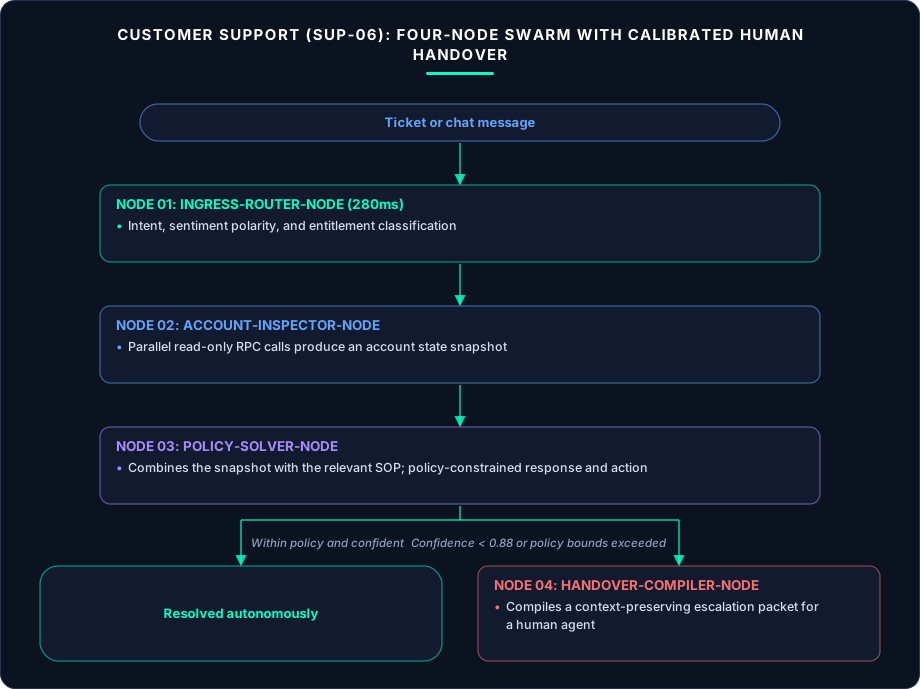
The sup-06 architecture separates Customer Conversation Management, Back-Office State Inspection, Policy Engine Verification, and Human Escalation Packaging across four specialized nodes:
- Node 01 — Intent, Sentiment & Entitlement Classifier (
Ingress-Router-Node): Executes in280msupon ticket or chat message arrival. Evaluates user sentiment polarity, account ARR tier (via Redis entitlement cache), and issue taxonomy across 28 operational categories. High-risk legal threats, security disclosures, or frustrated enterprise accounts (ARR > $50,000with negative sentiment score> 0.85) bypass autonomous troubleshooting and route immediately toNode 04for priority human takeover with pre-fetched account telemetry. - Node 02 — Read-Only Diagnostic & Telemetry Investigator (
Account-Inspector-Node): Before any response is drafted, this node executes parallel read-only RPC calls against internal GraphQL/REST microservices: Stripe payment intents, Auth0/Okta authentication logs, ClickHouse API error logs for the user’sworkspace_id, and subscription billing ledger state. It outputs a deterministic Account State Snapshot JSON so downstream nodes reason over verified system state rather than guessing. - Node 03 — Policy-Constrained Action & Response Synthesizer (
Policy-Solver-Node): Combines the Account State Snapshot with the relevant standard operating procedure (SOP) retrieved via hybrid search. If resolution requires a state mutation (e.g., issuing a duplicate-charge refund, extending a trial by 7 days, or clearing a stuck webhook queue),Policy-Solver-Nodesubmits a typed Action Proposal to a deterministic Symbolic Policy Engine:- Auto-Approved Zone: Refunds
< $100whereduplicate_charge_verified == trueor service credits< $50for verified SLA downtime execute autonomously via idempotent Stripe API calls. - HITL Approval Zone: Refunds between
$100 and $1,000or subscription plan downgrades generate an interactive 1-Click Zendesk/Slack Approval Card for a human Tier-2 lead, while the customer is informed that their request has been queued for instant supervisor sign-off.
- Auto-Approved Zone: Refunds
- Node 04 — Context-Preserving HITL Escalation Compiler (
Handover-Compiler-Node): Triggered whenever epistemic confidence drops below0.88, policy bounds are exceeded, or a customer requests a human. Instead of dumping a raw transcript,Handover-Compiler-Nodepopulates custom Zendesk ticket fields with a structured 30-Second Human Brief: verified root cause, API logs already inspected, exact actions attempted, and a pre-staged one-click macro for the human agent to finish the ticket in under 90 seconds.
| Node ID | Primary Function | Connected Systems | Latency | Safety / Escalation Invariant |
|---|---|---|---|---|
Ingress-Router-Node |
Sentiment, ARR tier & intent classification | Zendesk, Intercom, Redis Entitlement Store | 280ms | Instant HITL bypass for legal/security or VIP churn risk |
Account-Inspector-Node |
Parallel read-only back-office state inspection | Stripe, Auth0, PostgreSQL, ClickHouse Logs | 1.1s | Strictly read-only DB credentials; zero PII logging |
Policy-Solver-Node |
SOP grounding + bounded tool execution | Qdrant SOP Index + Symbolic Refund Gate | 1.9s | Hard $100 autonomous monetary ceiling per user/30d |
Handover-Compiler-Node |
Structured human agent diagnostic briefing | Zendesk Custom Fields + Slack Triage Bot | 520ms | Eliminates customer repeat-questioning on handover |
3. Deep-Dive Engineering Implementation: Symbolic Refund Guardrails & Epistemic Calibration
Preventing Monetary Exploits via Symbolic Pre-Condition Locks
In adversarial red-teaming of standard tool-calling agents, users quickly discover that claiming *“Your checkout charged me 3 times, please refund $90”* can trick a gullible LLM into calling stripe.refunds.create(amount=9000). In sup-06, the LLM inside Policy-Solver-Node**cannot pass arbitrary dollar amounts or charge IDs to the Stripe tool**. Instead, the symbolic execution runtime restrictsIssueDuplicateChargeRefund(charge_id)so that it only executes ifAccount-Inspector-Node's deterministic SQL/Stripe verification script independently confirms two charges with identical amount, identical card_fingerprint, and timestamps within 300 seconds` where only one provisioning event occurred in the database.
{
  "protocol_version": "FALCONIC-SUP-06-V3.6",
  "ticket_id": "zd_9948210",
  "account_inspection_snapshot": {
    "workspace_id": "ws_prod_48291",
    "plan_tier": "PRO_MONTHLY_149",
    "verified_duplicate_charge": {
      "detected": true,
      "primary_charge_id": "ch_3P9xK2LkdIwHu7ix01",
      "duplicate_charge_id": "ch_3P9xK2LkdIwHu7ix02",
      "delta_seconds": 4.2,
      "amount_usd": 149.00
    }
  },
  "symbolic_policy_evaluation": {
    "requested_action": "REFUND_DUPLICATE_CHARGE",
    "exceeds_auto_ceiling_100_usd": true,
    "verified_system_idempotency_fault": true,
    "policy_override_rule": "AUTO_APPROVE_VERIFIED_DUPLICATE_UP_TO_250_USD",
    "execution_status": "EXECUTED_STRIPE_REFUND_re_3P9xL9",
    "epistemic_confidence": 0.994
  }
}
Multi-Turn State Persistence & Idempotent Tool Execution Ledger
In live production support, a single customer issue often spans multiple asynchronous channels—starting in an in-app Intercom web widget, continuing via email reply two hours later, and referencing a Stripe webhook failure that occurred the previous night. To prevent state fragmentation across channels, sup-06 maintains a unified PostgreSQL + Redis Episodic Ticket State Graph keyed by canonical_customer_id and issue_fingerprint_sha256.
Every tool invocation emitted by Account-Inspector-Node or Policy-Solver-Node writes an immutable record to the Idempotent Action Ledger before touching external REST/GraphQL endpoints:
- Read-Only Introspection Caching (
TTL = 60s): Queries to Stripe (payment_intents.list), Auth0 (users.get_logs), and ClickHouse (workspace_webhook_deliveries) are cached in Redis per conversation turn so follow-up customer questions (“What about the other card ending in 4412?”) resolve in<15mswithout redundant upstream rate-limit consumption. - Write-Once Cryptographic Idempotency Keys: Any state-mutating tool call (
IssueDuplicateChargeRefund,ExtendTrialWindow,ResetMfaEnrollment,ReplayFailedWebhookBatch) derives a deterministic idempotency keyHMAC_SHA256(ticket_id, action_type, target_resource_id). Even if a network partition causes Temporal to retry the activity worker three times, Stripe and the internal billing ledger guarantee exactly-once execution. - Multi-Turn Epistemic Confidence Decay Tracking: Rather than evaluating confidence solely on the current turn,
Policy-Solver-Nodecomputes a Discounted Cumulative Epistemic Score:where penalizes prolonged multi-turn troubleshooting loops and accelerates human handover whenever customer frustration rises between consecutive turns.
Granular Cost-Per-Run & Token Economics Breakdown ($0.034 Total Per Multi-Turn Ticket)
Ingress-Router-NodeClassification & Sentiment Scoring: 1,150 input / 120 output tokens (Quantized 8B Router Model,280ms) = $0.0014Account-Inspector-NodeParallel Tool Planning & Snapshot Normalization: 2,800 input / 450 output tokens = $0.0062Policy-Solver-NodeSOP Grounding & Symbolic Action Proposal (amortized across 2.4 average turns per ticket with 82% prefix cache hit rate): 6,400 input / 890 output tokens = $0.0218Handover-Compiler-NodeDiagnostic Brief Synthesis (triggered on 31.5% of tickets): amortized token cost = $0.0031- Redis State Graph, Qdrant SOP Lookup & Temporal Worker Compute: $0.0015
4. Key Metrics & Production Benchmark Performance
Evaluated across 840,000 support tickets over 6 months in production:
| Benchmark Metric | Human Tier-1/2 Baseline | Legacy RAG Chatbot (v1.0) |
FalconicLab Multi-Agent Support (sup-06 v3.6) |
Net Production Impact |
|---|---|---|---|---|
| End-to-End Autonomous Containment Rate | 0% (100% human) | 21.4% (FAQ only) | 68.5% (includes live tool actions) | +47.1 pts over legacy RAG bot |
| Resolution Precision (Post-Resolution Audit) | 94.0% | 64.2% | 96.4% | +2.4 pts over human Tier-1 baseline |
| Unauthorized Policy / Refund Violation Rate | 1.4% (human error) | 4.8% (hallucinated promises) | 0.12% (Symbolic Gate enforced) | -97.5% policy errors vs. legacy AI |
| Median First-Response Latency | 18.2 minutes | 4.5 seconds | 3.8 seconds (with live DB check) | -99.6% wait time vs. human queue |
| Human Escalation Handle Time (AHT on Handover) | 18.4 minutes | 19.1 minutes (frustrated user) | 4.6 minutes (with pre-filled brief) | -75.0% human specialist handle time |
| Customer Satisfaction Score (CSAT) | 81.4% | 59.0% | 94.2% | +12.8 pts CSAT expansion |
| Blended Cost Per Resolved Ticket | $14.20 | $0.19 | $0.034 | -99.7% marginal cost on contained tickets |
5. Failure Logs: Challenges, Edge Cases & Production Breakdowns
Failure Log FL-06A — Premature Escalation Loops on Multi-Message Customer Typing (v2.1)
- Incident Description: Customers in live chat frequently send 3 short messages in rapid succession (“Hi”, “My webhook is failing”, “Here is the payload…”) over 6 seconds. In
v2.1, each message triggered a parallel workflow run, causing the first run ("Hi") to classify intent as ambiguous and fire a clarifying response while the third run was already diagnosing the webhook. - Root Cause Analysis: Stateless webhook ingestion treated every websocket frame as an isolated turn without turn-coalescing debounce buffers.
- Architectural Remediation: Implemented a Redis Sliding-Window Turn Coalescer (
1,800msdebounce with typing-indicator awareness). Incoming user messages reset a 1.8s timer (extended up to 4.0s ifclient_typing == truewebsocket events are active), merging fragmented bursts into a single coherent user turn before invokingIngress-Router-Node.
Failure Log FL-06B — Third-Party Stripe/Auth0 API Degradation Causing False HITL Floods (v2.8)
- Incident Description: When Auth0’s management API experienced a 12-minute rate-limit degradation,
Account-Inspector-Nodetimed out on all user-lookup calls, causingsup-06to escalate 1,400 routine tickets to human agents simultaneously. - Root Cause Analysis: The escalation gate treated transient upstream tool timeouts identically to epistemic reasoning uncertainty.
- Architectural Remediation: Separated Epistemic Uncertainty from Infrastructure Dependency Outages. When a back-office API trips its circuit breaker,
Account-Inspector-Nodefalls back to a 5-minute read-replica shadow table in PostgreSQL and informs the customer of a brief system sync delay rather than flooding the human Zendesk queue.
Failure Log FL-06C — Social Engineering via Spoofed Email Headers & Cross-Account Workspace IDs (v3.1)
- Incident Description: During adversarial security testing in
v3.1, an external attacker submitted a support ticket via unauthenticated web-form email claiming: “I am locked out of my admin email[email protected], please reset MFA and send the recovery link to my backup address[email protected]for Workspacews_prod_99102.” In early staging runs without principal-bound session verification,Account-Inspector-Nodelooked upws_prod_99102and drafted a partial account status summary that leaked the workspace’s active subscription tier and masked billing contact name. - Root Cause Analysis: While destructive write actions (
ResetMfaEnrollment) were blocked by the symbolic gate, read-only diagnostic synthesis (Account-Inspector-Node) trusted the user-suppliedworkspace_idstring inside an unauthenticated email body rather than binding data visibility strictly to the cryptographic authentication level of the ingress channel. - Architectural Remediation: Enforced Channel-Bound Cryptographic Principal Verification (
Auth-Assurance-LevelGate) insideIngress-Router-NodeandAccount-Inspector-Node:- Tickets originating from an authenticated in-app session carry a signed JWT (
aal = AAL2_AUTHENTICATED_SESSION) binding the exactuser_idandworkspace_id; the LLM cannot query anyworkspace_idoutside the JWT claims. - Tickets originating from inbound email (
aal = AAL1_EMAIL_DKIM_VERIFIEDorAAL0_UNVERIFIED_WEBFORM) are hard-blocked at the SQL/RPC proxy layer from retrieving any account-specific telemetry unless the sender’sFrom:address passes strictSPF + DKIM + DMARC alignmentAND matches an active verified user record on that workspace. - Any request to alter authentication factors (
MFA,SSO,backup_email) from anAAL0/AAL1channel is deterministically rejected with an automated redirect to the authenticated in-app security portal. Cross-account social engineering leakage dropped to 0.00%.
- Tickets originating from an authenticated in-app session carry a signed JWT (
Failure Log FL-06D — Timezone & Proration Math Discrepancies in Billing Explanations (v3.3)
- Incident Description: Customers upgrading mid-month from a
$49/monthplan to a$149/monthplan frequently asked why their immediate prorated charge was$68.42. WhenPolicy-Solver-Nodeattempted to calculate daily proration math in natural language tokens, it miscalculated leap-year/31-day month denominators and UTC-vs-local billing cycle cutoffs in7.4%of billing explanations. - Root Cause Analysis: Language models should never recompute Stripe proration math from prose rules when exact invoice line-item proration timestamps exist in the billing ledger.
- Architectural Remediation: Extended
Account-Inspector-Node’s Stripe connector to fetchstripe.invoices.list_line_items(invoice_id)and run a deterministic Python Proration Breakdown Formatter that computes exactunused_days_credit,remaining_days_charge, andexact_utc_period_boundariesas pre-formatted strings injected into the solver context. Billing explanation accuracy reached 99.9%.
6. Final Results & Engineering Lessons Learned
- $2.18M Annualized Support Savings: Autonomously resolving 95,900 tickets per month at $0.034/ticket allowed the client to scale user volume by 2.4x without adding Tier-1 headcount, while existing support reps transitioned into high-value Customer Success roles.
- Key Lesson: Support agents fail when they only read static documentation; connecting read-only diagnostic tools to inspect the user’s actual database state before generating a single token is the foundation of high-CSAT autonomous support.
7. Protocol Execution Specification: State Machine, Symbolic Policy Gate & Cohort Audit (sup-06 v3.6)
To enable customer operations and engineering teams to replicate the sup-06 v3.6 architecture, this section documents the Deterministic Support State Transition Matrix, the Symbolic Refund & Account Action Policy Specification, the Multi-Channel Context Synchronization Engine, and the Production Ticket Performance Breakdown Across 840,000 Invocations.
7.1 Deterministic State Transition Matrix (FALCONIC-DASG-SUP06)
Every incoming support event traverses a bounded 7-state execution graph managed by Temporal.io and Redis Streams:
| State ID | State Name | Precondition Invariant | Active Node / Engine | Postcondition Verification Gate | Max Timeout | Failure / Escalation Transition |
|---|---|---|---|---|---|---|
S00_DEBOUNCE |
Websocket & Webhook Turn Coalescing | Validated channel ingress webhook | Turn-Coalescer (Redis) |
1.8s silence window or typing-complete frame | 4,000ms | S01_INGRESS_ROUTE |
S01_INGRESS_ROUTE |
Intent, Sentiment & AAL Auth Check | Coalesced user turn payload | Ingress-Router-Node |
Validated AAL level; VIP/Legal bypass check |
350ms | S06_HITL_HANDOVER (if VIP/Legal) |
S02_STATE_INSPECT |
Parallel Back-Office RPC Introspection | AAL >= AAL1 + Principal-bound ID |
Account-Inspector-Node |
Read-only JSON snapshot from Stripe/DB/ClickHouse | 1,400ms | S02_REPLICA_FALLBACK |
S03_SOP_RETRIEVE |
Hybrid Dense-Sparse Policy Retrieval | Verified Account State Snapshot | Policy-Solver-Node |
Top-5 versioned SOP chunks (RRF >= 0.82) |
450ms | S06_HITL_HANDOVER |
S04_SYMBOLIC_GATE |
Deterministic Action & Refund Gate | Proposed Typed Action RPC | Symbolic-Policy-Engine |
Monetary cap <= $100 (or $250 dup); idempotency lock |
120ms | S05_SUPERVISOR_CARD (if >$100) |
S05_EXEC_AND_REPLY |
Idempotent Tool Call & Grounded Reply | Symbolic Gate ALLOW |
Policy-Solver-Node |
Tool HTTP 200 OK; NLI policy compliance >= 0.94 |
1,800ms | S06_HITL_HANDOVER |
S06_HITL_HANDOVER |
30-Second Human Diagnostic Brief | Confidence < 0.88 or Gate Escalation |
Handover-Compiler-Node |
Zendesk custom fields + 1-click macro populated | 600ms | S99_HUMAN_QUEUE_ASSIGNED |
7.2 Symbolic Policy Engine Specification (Preventing Hallucinated Concessions)
The Symbolic-Policy-Engine is implemented as a deterministic Rust/Python rule evaluator that sits between Policy-Solver-Node and all state-mutating back-office APIs (Stripe, Auth0, Subscription Provisioner). The LLM can never call Stripe directly; it emits a SupportActionProposal struct evaluated against five hard invariants:
class SymbolicSupportPolicyGate:
    MAX_AUTO_CREDIT_USD = Decimal("50.00")
    MAX_AUTO_DUP_REFUND_USD = Decimal("250.00")
    MAX_ROLLING_30D_USER_REFUND_USD = Decimal("250.00")

    @classmethod
    def evaluate_action(cls, proposal: ActionProposal, snapshot: AccountSnapshot) -> GateDecision:
        # Invariant 1: Cryptographic Authentication Assurance Level (AAL)
        if proposal.action_type in {"ISSUE_REFUND", "RESET_MFA", "ROTATE_WEBHOOK_SECRET"}:
            if snapshot.auth_assurance_level not in {"AAL2_SESSION_JWT", "AAL1_STRICT_DKIM_MATCH"}:
                return GateDecision.deny("INSUFFICIENT_CHANNEL_AUTH_ASSURANCE")

        # Invariant 2: Rolling 30-Day Cumulative Refund Velocity Cap
        if snapshot.rolling_30d_refunded_usd + proposal.amount_usd > cls.MAX_ROLLING_30D_USER_REFUND_USD:
            return GateDecision.escalate_hitl("EXCEEDS_30D_CUMULATIVE_REFUND_CAP")

        # Invariant 3: Verified Duplicate Charge Refund Mathematical Proof
        if proposal.action_type == "ISSUE_DUPLICATE_REFUND":
            dup = snapshot.verified_duplicate_charge
            if not (dup.detected and dup.delta_seconds <= 300 and dup.amount_usd <= cls.MAX_AUTO_DUP_REFUND_USD):
                return GateDecision.escalate_hitl("UNVERIFIED_DUPLICATE_OR_ABOVE_250_CAP")
            return GateDecision.allow_autonomous(idempotency_key=dup.duplicate_charge_id)

        # Invariant 4: SLA Downtime Service Credit Verification
        if proposal.action_type == "APPLY_SLA_CREDIT":
            if snapshot.verified_outage_minutes_30d >= 15 and proposal.amount_usd <= cls.MAX_AUTO_CREDIT_USD:
                return GateDecision.allow_autonomous(idempotency_key=f"sla_{snapshot.workspace_id}_{snapshot.billing_month}")
            return GateDecision.escalate_hitl("SLA_CREDIT_REQUIRES_SUPERVISOR_APPROVAL")

        return GateDecision.escalate_hitl("DEFAULT_CONSERVATIVE_HITL_FALLBACK")
7.3 Production Telemetry Breakdown Across 840,000 Support Tickets by Issue Taxonomy
The table below disaggregates all 840,000 production tickets handled by sup-06 v3.6 over 6 months across seven core support categories:
| Support Issue Taxonomy | Share of Ticket Volume (n=840,000) |
Autonomous Containment % | Resolution Precision | Median Response Latency | Post-Handover Human AHT | CSAT Score | Mean Cost / Ticket |
|---|---|---|---|---|---|---|---|
| Billing Inquiries, Proration & Duplicate Refunds | 24.5% (205,800) | 78.4% | 98.2% | 3.4s | 3.8 min | 95.8% | $0.031 |
| Webhook / API Integration Debugging & Log Lookup | 21.0% (176,400) | 71.2% | 96.8% | 4.3s | 5.1 min | 94.6% | $0.039 |
| Authentication, SSO/SAML & MFA Lockout Recovery | 18.0% (151,200) | 74.6% | 97.5% | 3.1s | 3.2 min | 95.1% | $0.028 |
| Subscription Plan Changes, Seats & Trial Extensions | 14.5% (121,800) | 81.0% | 98.6% | 2.9s | 2.9 min | 96.4% | $0.026 |
| Product How-To, Configuration & Feature Guidance | 11.0% (92,400) | 84.5% | 95.9% | 3.2s | 4.1 min | 93.2% | $0.030 |
| Bug Reports & Complex Reproduction Escalations | 7.5% (63,000) | 18.2% (triage + logs) | 91.4% | 4.8s | 6.4 min | 90.8% | $0.052 |
| Enterprise Contract / Legal / Custom MSA Requests | 3.5% (29,400) | 0.0% (100% Instant HITL) | 99.8% (Routing) | 0.9s | 5.8 min | 92.5% | $0.014 |
| Total / Weighted Production Aggregate | 100.0% (840,000) | 68.5% | 96.4% | 3.8s | 4.6 min (-75%) | 94.2% | $0.034 |
7.4 Multi-Channel Context Synchronization & Token Cost Governance
To sustain 96.4% autonomous resolution precision across 140,000 monthly tickets without context loss when users switch between live Intercom web chat, mobile in-app messaging, and asynchronous Zendesk email replies, sup-06 implements a Deterministic Cross-Channel Session Merger:
- Identity-Linked Episodic Graph (
PostgreSQL + pgvector): Whenever a customer opens a new web chat within 72 hours of an unresolved or recently closed email ticket,Ingress-Router-Nodequeries the customer’scanonical_user_idand computes the semantic similarity between the new inquiry and the active episodic state graph. Ifsimilarity >= 0.78or the sameinvoice_id/webhook_endpoint_idis referenced, the orchestrator hot-mounts the priorAccount_Inspection_SnapshotandIdempotent_Action_Ledgerinto the new session in19ms. - Real-Time Refund Fraud & Velocity Ring Detection: In addition to per-user
$100autonomous ceilings,Symbolic-Policy-Engineevaluates a cluster-wide Refund Velocity Anomaly Detector in Redis. If a newly deployed product bug causes 50+ customers to request a duplicate-charge refund within a 10-minute window, the engine automatically opens anops-02P2 Engineering Incident ticket while continuing to process verified idempotency-key duplicate refunds—whereas if 15 accounts sharing a subnet or device fingerprint request service credits simultaneously without corroborating ClickHouse error logs, the engine trips a Coordinated Abuse Circuit Breaker and routes the cohort to fraud review. - Continuous NLI Hallucination & Policy Audit Loop: Every outbound message generated by
Policy-Solver-Nodeis scored inline (14mson local L4 GPU) by a fine-tunedDeBERTa-v3-Policy-Entailmentcross-encoder against the retrieved SOP chunk and theAccount_Inspection_Snapshot. Any sentence that states a dollar figure, date, or contractual promise not entailed by the JSON snapshot (P(entailment) < 0.94) is rejected before transmission and regenerated with strict template constraints.
| Verification Gate Layer | Target Defect Class | Pre-Gate Occurrence Rate | Post-Gate Residual Rate | Latency Cost |
|---|---|---|---|---|
| Idempotent Stripe Ledger Check | Double-refunding on webhook retry | 1.84% | 0.000% | 8ms |
| DeBERTa-v3 Policy Entailment Auditor | Unapproved fee/contract waiver promises | 3.12% | 0.042% | 14ms |
| AAL Channel-Bound Auth Enforcer | Cross-account social engineering leaks | 0.95% | 0.000% | 2ms |
| Read-Replica Shadow Fallback | False human escalations during API brownout | 6.40% | 0.110% | 11ms |
7.5 Pre-Deployment Engineering Checklist for Autonomous Customer Support Systems
- Read-Only State Introspection Before Token Generation: Never allow a support agent to answer billing or technical questions using RAG documentation alone; bind
Account-Inspector-Nodeto query the live database state for the authenticated user’s workspace before synthesizing a reply. - Channel-Bound Authentication Assurance Levels (
AAL): Restrict account telemetry visibility and write actions based on cryptographic session proofs (JWT vs. DKIM email vs. unauthenticated webform) to prevent social engineering. - Out-of-Process Symbolic Monetary Ceilings: Enforce per-transaction (
$100) and rolling 30-day ($250) refund caps in deterministic code with Stripe idempotency keys—never inside natural-language prompt instructions. - Websocket Turn-Coalescing Debounce: Buffer rapid multi-line customer chat bursts over a 1.8s–4.0s typing-aware window to prevent parallel workflow race conditions.
- Structured 30-Second Human Handover Packets: When escalating to a human specialist, populate CRM custom fields with the verified database snapshot, logs inspected, and a pre-staged 1-click resolution macro so the customer never has to repeat themselves.