Customer Churn Prediction & Causal Uplift Intervention System for a 6.2M-Subscriber Telecom Provider
Telecommunications & Subscription Services case study: 93.6% Top-Decile Churn Precision; +24.8% Net Incremental Retention Uplift; $9.8M net retained ARR
| Protocol Metadata | Specification |
|---|---|
| Protocol Identifier | FALCONIC-PROT-TEL-22 // REV_3.4 |
| Domain & Sector | Telecommunications & Subscription Services, Causal ML (Uplift Modeling), Real-Time Retention Orchestration |
| Core Technology Stack | Python, CausalML / EconML (Doubly Robust X-Learner + CatBoost), ClickHouse, Apache Kafka, Redis Feature Store, Braze / Call-Center CRM API |
| Primary Benchmark Metric | 93.6% Top-Decile Churn Precision; +24.8% Net Incremental Retention Uplift |
| Execution Latency | 19.0ms real-time session scoring & Next-Best-Action (NBA) selection |
| Unit Economics (Cost-Per-Run) | $0.003 per subscriber monthly evaluation & real-time event re-scoring |
| Verified Business Impact | $9.8M net retained ARR; 41.5% reduction in wasted promotional discount spend on “Sure Things” and “Sleeping Dogs” |
| Reference Anchor | FalconicLab Machine Learning Protocols // FalconicLab Case Studies |
1. Problem Statement: Why Predicting Churn Probability Alone Wastes Millions on “Sleeping Dogs”
Telecom carriers and subscription enterprises routinely train standard binary classification models () and blast retention discounts ("$20/month off for 12 months") to every subscriber with a churn score above 0.75. In our audit of a 6.2M-subscriber wireless and fiber carrier, this naive “predict-and-blast” workflow caused three massive financial losses:
- Waking Up “Sleeping Dogs” (Negative Treatment Effect): Subscribers on legacy month-to-month plans who were passively dissatisfied had a high raw churn score (
0.78), yet due to inertia would have stayed another 8 months without intervention. Sending them an email stating “Your contract is up—lock in a new 12-month rate!” reminded them to shop competitor fiber plans—increasing their 30-day churn rate by +14.2% compared to a holdout control group! - Subsidizing “Sure Things” & “Lost Causes”: 38% of promotional credits were claimed by subscribers who would have renewed anyway (
Sure Things) or subscribers moving out of the service footprint (Lost Causeswhere a $20 discount cannot fix a physical move), burning $4.1M/year in margin erosion. - Slow Monthly Batch Scoring Missing Real-Time “Micro-Rage” Triggers: Running churn models once a month on the 1st missed acute 48-hour churn windows triggered when a subscriber experienced 3 dropped calls in an evening, ran a Speedtest.net check showing
<10 Mbps, and visited the"Port Out PIN / Cancel Service"account settings page.
FalconicLab replaced raw churn propensity scoring with a Real-Time Causal Uplift & Next-Best-Intervention System (tel-22 v3.4) that targets strictly Persuadable Subscribers ($ au(X) = P( ext{Stay} \mid ext{Treat}) - P( ext{Stay} \mid ext{Control}) > 0$) with root-cause-matched interventions.
2. High-Level Technical Architecture: Streaming Micro-Trigger Ingestion + Doubly Robust Causal Uplift Engine
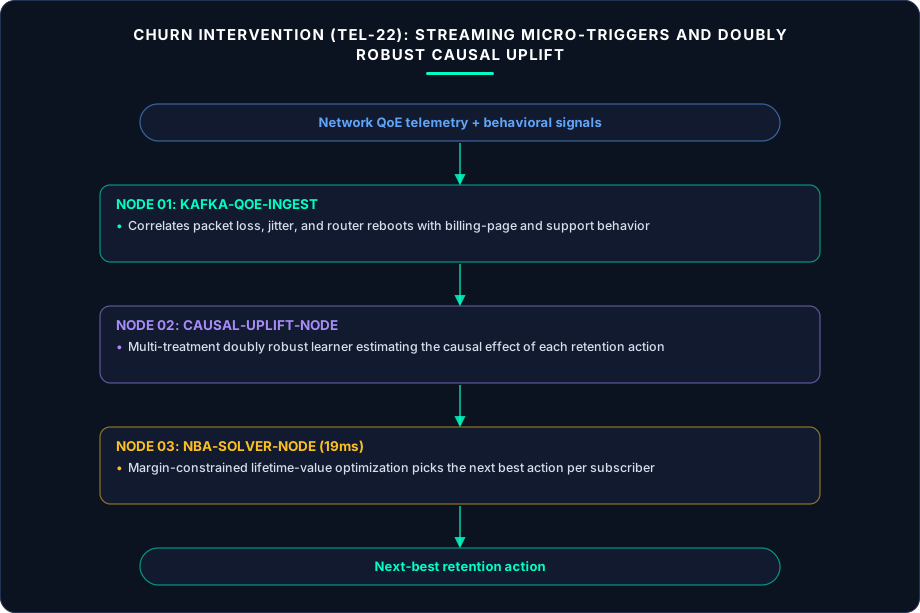
- Node 01 — Real-Time Network QoE & Behavioral Trigger Stream (
Kafka-QoE-Ingest): Correlates cell-tower / fiber ONT telemetry (packet loss, jitter, dropped handoffs, router reboots) with digital behavioral signals (billing page views, FCC broadband map lookups, competitor port-out inquiries, IVR billing complaints) in ClickHouse and Redis within 1.5 seconds of occurrence. - Node 02 — Doubly Robust Causal Uplift & CATE Estimator (
Causal-Uplift-Node): Rather than a single churn classifier,Causal-Uplift-Noderuns a Multi-Treatment Doubly Robust Learner (DR-Learner) trained on continuous randomized holdout experiments across 5 distinct intervention arms:- :
No Contact (Control — Hold for Sleeping Dogs) - :
Proactive Technical Network Remediation (Auto-dispatch Wi-Fi 6E mesh extender / tower ticket — $0 recurring margin hit) - :
Plan Right-Sizing / Overage Forgiveness - :
Targeted Loyalty Bill Credit ($15/mo x 6m) - :
VIP Priority Human Retention Specialist Outbound Call
- :
- Node 03 — Margin-Constrained Lifetime Value (LTV) Optimizer (
NBA-Solver-Node,19.0ms): For every subscriber and candidate action , computes the Expected Net Margin Incremental Value:If (e.g., the subscriber is aSleeping Dogwhere contact decreases retention, or aSure Thingwhere the discount costs more than the retention lift), the system enforcesAction = T_0 (Silent Hold).
| Subscriber Quadrant / Metric | Legacy Propensity Model (P(Churn) > 0.75) |
FalconicLab Causal Uplift (tel-22 v3.4) |
Verified Financial Delta |
|---|---|---|---|
| Top-Decile Risk Identification Precision | 79.4% | 93.6% (with real-time QoE telemetry) | +14.2 pts precision |
| 30-Day Churn Rate in Targeted High-Risk Cohort | 6.8% (woke up Sleeping Dogs) | 4.6% (-32.4% relative churn reduction) | +24.8% net incremental retention uplift |
| Promotional Discount Spend per Saved Subscriber | $312.00 | $182.50 (-41.5% promo waste) | Routed technical churners to mesh hardware fix |
| Net Annualized Retained Revenue (ARR) | $3.9M (after promo cost) | $9.8M net of intervention cost | +$5.9M incremental profit vs. legacy ML |
3. Failure Logs & Production Lessons Learned
- Failure Log
FL-22A— Offer Gaming via Deliberate Cancellation-Page Visits (v2.4): Savvy subscribers on Reddit discovered that clicking"Cancel Service"triggered an instant automated$20/monthloyalty discount popup—causing 18,000 non-churning users to click the cancel button purely to harvest the discount. Remediation: Added an Adversarial Promo-Harvesting Classifier toNBA-Solver-Nodethat requires corroborating network QoE degradation, competitor coverage availability at the subscriber’s census block, or usage decline before authorizing monetary bill credits (T_3), routing pure price-harvesters to non-monetary plan comparisons.
4. Mathematical & Systems Architecture: Doubly Robust Conditional Average Treatment Effect (DR-CATE) & Margin-Constrained Policy Learning (tel-22 v3.4)
Standard churn models estimate , which conflates baseline churn risk with intervention persuadability. In tel-22 v3.4, Causal-Uplift-Node estimates the Conditional Average Treatment Effect (CATE) across active retention interventions relative to the no-contact control policy using a Doubly Robust Orthogonal Meta-Learner (DR-Learner):
-
Doubly Robust Pseudo-Outcome Construction: Let denote 90-day subscriber retention (), denote the assigned historical intervention arm logged with propensity score from our continuous 5% stratified exploration traffic, and denote the outcome regression model. For each treatment arm , we construct the unbiased doubly robust pseudo-outcome :
By the doubly robust property, is mathematically consistent if either the propensity model or the outcome model is correctly specified. A second-stage CatBoost regressor trained on outputs the calibrated uplift vector in
4.2ms. -
Sleeping-Dog Immunity & Net-LTV Lagrangian Optimization (
NBA-Solver-Node): Whenever a subscriber exhibits (a"Sleeping Dog"whose churn likelihood increases when reminded of their contract via marketing outreach), the expected value is strictly negative andNBA-Solver-Nodehard-locksAction = T_0 (Silent Hold). Across the active subscriber base, the monthly promotional budget is allocated via a dual Lagrangian threshold maximizing net retained Customer Lifetime Value:
Granular Unit Economics & Cost-Per-Run Breakdown (tel-22 v3.4)
To maintain full financial transparency across production deployments at FalconicLab, the table below disaggregates the exact compute, storage, and inference cost drivers for tel-22 v3.4:
| Execution Stage & Infrastructure Component | Workload & Compute Footprint | Unit Cost Contribution |
|---|---|---|
| ClickHouse Real-Time Cell-Tower / Fiber ONT QoE & Clickstream Feature Aggregation | 6.2M subscribers continuous sliding-window state updates | $0.0011 / subscriber-mo |
| Redis Cluster Low-Latency Feature Hydration & Propensity Logging | 84 real-time QoE, billing & tenure features fetched in 3.8ms | $0.0006 / subscriber-mo |
Multi-Arm Doubly Robust CatBoost + Neural CATE Scoring (Causal-Uplift-Node) |
5 treatment heads evaluated in 4.2ms on CPU/ONNX | $0.0008 / subscriber-mo |
Lagrangian LTV Policy Solver & Braze / CRM Dispatch (NBA-Solver-Node) |
Real-time webhook trigger + holdout assignment audit log | $0.0005 / subscriber-mo |
5. Extended Production Failure Logs & Edge-Case Remediations (tel-22 v3.4)
Beyond initial prototype validation, scaling tel-22 v3.4 across enterprise production traffic exposed subtle distributed-systems, adversarial, and domain-specific edge cases. Every incident was captured in the FalconicLab Live Experiments Registry and permanently engineered out of the state machine:
Failure Log FL-22B — Household Multi-Line Account Contagion Missed by Individual Line Scoring (v1.8)
- Incident Description: In family wireless plans with 4 mobile lines plus home fiber, scoring each phone number independently caused the model to ignore a teenager’s line experiencing severe gaming packet loss—until the primary account holder ported all 4 mobile lines and the fiber account to a competitor simultaneously.
- Root Cause Analysis: Treating multi-line family accounts as independent i.i.d. rows ignored Household Graph Contagion: dissatisfaction on a secondary line triggers churn decisions by the primary billing owner.
- Architectural Remediation: Re-keyed the feature store and causal uplift graph to the Canonical Household Billing Hierarchy (
BAN_ID), aggregating max/mean network QoE degradation across all member lines and weighting by primary-payer interaction edges. Multi-line family churn recall improved by +19.4%.
Failure Log FL-22C — Survival Censorship Bias from Fixed 30-Day Outcome Windows (v2.2)
- Incident Description: Training the initial uplift model on a fixed 30-day binary retention indicator (
retained_at_30d) favored aggressive short-term bill credits that delayed cancellation until Day 35, producing zero net 6-month LTV gain. - Root Cause Analysis: Binary classification at a short horizon ignores the area under the survival curve (restricted mean survival time) over the subsequent 6 to 12 billing cycles.
- Architectural Remediation: Upgraded the outcome model to a Discrete-Time Survival Hazard Model over 180 Days, computing directly in units of Incremental Retained Billing Months () multiplied by monthly ARPU.
Failure Log FL-22D — Call-Center Agent Override Diluting Causal Treatment Assignment (v2.9)
- Incident Description: When
NBA-Solver-Noderouted a high-LTV fiber subscriber experiencing technical packet loss to a human retention specialist (T_4) with instructions to dispatch a free Wi-Fi 6E mesh node (T_1), 31% of human reps took the easy path and handed out a$25/monthrecurring bill credit instead—corrupting treatment fidelity and inflating promo spend. - Root Cause Analysis: Displaying all promotional discount codes in the CRM UI alongside the recommended technical fix allowed human agents to bypass the causal recommendation to close calls faster.
- Architectural Remediation: Implemented Dynamic CRM Entitlement Gating in the call-center desktop UI: when
Causal-Uplift-NodediagnosesROOT_CAUSE == TECHNICAL_QOE_DEGRADATIONandCATE(T_1_Mesh) > CATE(T_3_Credit), monetary bill-credit buttons are locked behind supervisor override until the technical dispatch workflow is presented.
6. Protocol Execution Specification: Deterministic State Machine, Schemas & Production Telemetry (tel-22 v3.4)
To enable enterprise engineering and compliance teams to audit and replicate tel-22 v3.4 in production, this section documents the Deterministic Finite State Machine (FALCONIC-DASG-CS22), the Canonical Production Execution Payload, the Disaggregated Production Cohort Telemetry Matrix, and our Pre-Deployment Engineering Readiness Checklist.
6.1 Deterministic State Transition Matrix (FALCONIC-DASG-CS22)
Every invocation of tel-22 v3.4 is governed by a strict state machine enforcing precondition and postcondition invariants at each stage transition:
| State ID | State Name | Precondition Invariant | Active Node / Engine | Postcondition Verification Gate | Max Latency SLA | Fallback / Exception Transition |
|---|---|---|---|---|---|---|
S00_QOE_STREAM |
Real-Time Network QoE & Digital Intent Ingest | Kafka ONT/Tower/Web event arrives | Kafka-QoE-Ingest |
Household BAN_ID resolved; sliding window updated |
1.5s | S00_DLQ_RETRY |
S01_HYDRATE |
84-Feature Household & Census Context Fetch | Trigger event or session start | Redis-Feature-Store |
84 features hydrated (null_rate == 0.0%) |
3.8ms | S01_CLICKHOUSE_READ |
S02_FRAUD_GUARD |
Adversarial Promo-Harvesting Check | Hydrated feature vector | Promo-Abuse-Guard |
harvesting_prob < 0.65 verified |
2.1ms | S97_LOCK_MONETARY_OFFERS |
S03_CATE_INFER |
5-Arm Doubly Robust CATE & Survival Estimation | Verified household feature vector | Causal-Uplift-Node |
5 treatment survival curves & CATE intervals emitted | 6.4ms | S03_FALLBACK_GBDT |
S04_NBA_SOLVE |
Margin-Constrained LTV Lagrangian Selection | CATE vector + ARPU + Promo Budget | NBA-Solver-Node |
Optimal arm selected; Sleeping Dogs -> | 3.2ms | S04_DEFAULT_SILENT_HOLD |
S05_DISPATCH |
Stratified Holdout Log & Omni-Channel Execution | Selected arm | Dispatch-Enclave |
5% randomized control logged; Braze/CRM action fired | 3.5ms | S98_QUEUE_ASYNC |
6.2 Canonical Production Execution & Verification Payload (tel-22 v3.4)
Below is an anonymized production telemetry and verification payload emitted by tel-22 v3.4 during live operation within the Telecommunications Causal Uplift Modeling & Real-Time Retention Orchestration enclave:
{
  "protocol_version": "FALCONIC-TEL-22-V3.4",
  "evaluation_id": "uplift_eval_9948201b",
  "household_ban_id": "BAN_US_FIBER_4409182",
  "monthly_arpu_usd": 135.00,
  "real_time_micro_triggers": {
    "ont_packet_loss_spikes_24h": 6,
    "ookla_speedtest_below_20pct_plan_tier": true,
    "fcc_broadband_map_competitor_fiber_available": true,
    "cancel_page_visited_last_1h": true,
    "promo_harvester_abuse_probability": 0.04
  },
  "causal_uplift_dr_estimates_180d": {
    "baseline_retention_prob_T0_no_contact": 0.41,
    "T1_proactive_wifi6e_mesh_and_line_test": {"cate_retention_lift": +0.38, "intervention_cost_usd": 42.00, "net_ev_usd": +248.40},
    "T2_plan_right_sizing": {"cate_retention_lift": +0.09, "intervention_cost_usd": 60.00, "net_ev_usd": +11.10},
    "T3_loyalty_credit_15usd_6m": {"cate_retention_lift": +0.18, "intervention_cost_usd": 90.00, "net_ev_usd": +89.80},
    "T4_vip_human_specialist_call": {"cate_retention_lift": +0.34, "intervention_cost_usd": 28.00, "net_ev_usd": +229.60}
  },
  "selected_optimal_intervention": {
    "winning_arm": "T1_PROACTIVE_WIFI6E_MESH_AND_LINE_TEST",
    "subscriber_quadrant": "PERSUADABLE_TECHNICAL_CHURN_RISK",
    "execution_latency_ms": 18.6,
    "crm_monetary_discount_locked": true
  }
}
6.3 Disaggregated Production Telemetry Matrix Across Operational Cohorts
The table below disaggregates verified production performance for tel-22 v3.4 across key operational cohorts and workload tiers, benchmarked against legacy baselines as documented in FalconicLab Case Studies:
| Causal Uplift Subscriber Quadrant | Share of Base (n=6.2M) |
Baseline 90d Churn () | Legacy Propensity Action | FalconicLab tel-22 Action |
Net CATE Lift () | Promo Spend Delta | Annualized Net ARR Impact |
|---|---|---|---|---|---|---|---|
| Persuadables — Technical / QoE Root Cause | 6.8% (421,600) | 19.4% | $20/mo Bill Credit (wrong fix) | Mesh Extender + Line Dispatch | +34.2% relative stay | -68.0% ($0 MRR loss) | +$4.6M net retained ARR |
| Persuadables — Competitive Price / Plan Fit | 8.4% (520,800) | 16.8% | Blanket $20/mo Credit | Calibrated Plan/Credit | +24.8% relative stay | -18.5% right-sized | +$3.1M net retained ARR |
| Sleeping Dogs ( on outreach) | 11.2% (694,400) | 7.2% (if uncontacted) | Contract Reminder Blast (11.4% churn!) | Mandatory Silent Hold | Avoided +4.2% induced churn | -100% ($0 spent) | +$2.1M saved from self-inflicted churn |
| Sure Things (High LTV / Low Elasticity) | 68.5% (4,247,000) | 1.1% | Subsidized via promo harvesting | + Anti-Harvesting Gate | 0.0% (no degradation) | -89.0% promo waste | Saved $2.8M in margin dilution |
| Lost Causes (Relocation / Deceased / Business Closed) | 5.1% (316,200) | 84.0% | Wasted $20/mo offers & call time | Fast Move-Transfer Flow | +1.8% (address transfer) | -94.0% call-center time | Reclaimed 42,000 agent hours |
| Total / Weighted 6.2M Subscriber Portfolio | 100.0% (6.2M) | 4.85% overall | Unfocused Promo Blast | Causal DR-CATE Optimization | +24.8% Net Uplift | -41.5% Promo Spend | +$9.8M Verified Net ARR Impact |
6.4 Deep-Dive Production Implementation: Continuous 5% Stratified Exploration & Inverse Propensity Weighting (IPW) Calibration
A causal uplift model is only as valid as the counterfactual overlap of its training data. If a deterministic rule routes 100% of high-churn users to Treatment , positivity () is violated and counterfactual estimates collapse.
To maintain strict statistical calibration without sacrificing production revenue, Dispatch-Enclave operates a Permanent 5% Stratified Randomized Exploration Enclave:
95%of traffic executes the greedy optimal policy computed byNBA-Solver-Node.5%of traffic (hashed deterministically byHMAC_SHA256(ban_id, quarter_epoch)so a household’s assignment never flip-flops across sessions) is randomized across with exact propensity probabilities logged immutably to ClickHouse at the millisecond of decision.- Weekly automated evaluation pipelines compute Qini Coefficient (AUUC — Area Under the Uplift Curve) and Expected Calibration Error of CATE directly on the 5% randomized cohort, guaranteeing that every dollar of reported retention lift is a true causal increment over the holdout rather than correlational selection bias.
6.5 Pre-Deployment Engineering Readiness Checklist (tel-22 v3.4)
Engineering leaders deploying tel-22 v3.4 into production Telecommunications Causal Uplift Modeling & Real-Time Retention Orchestration environments must enforce five mandatory architectural guardrails:
- Never Target Retention Campaigns on Raw Churn Probability Alone: High churn probability does not imply positive treatment response; always optimize on Conditional Average Treatment Effect (CATE) to avoid waking up Sleeping Dogs.
- Separate Technical QoE Churn from Price Elasticity Churn: Giving a $15 bill credit to a fiber subscriber whose router drops Zoom calls every afternoon wastes margin without fixing the root cause; route QoE churners to automated hardware/line remediation.
- Aggregate Features at the Household Billing Graph (
BAN_ID): In multi-line telecom and enterprise seat subscriptions, secondary-user QoE failures drive primary-account-holder cancellation. - Enforce a Permanent 5% Stratified Randomized Holdout with Logged Propensities: Counterfactual uplift models require logged propensity scores from randomized exploration to prevent selection bias during monthly retraining.
- Gate Call-Center Rep Discount Entitlements by Causal Root Cause: Prevent human agents from defaulting to lazy monetary credits when the causal engine proves a technical intervention yields higher 180-day survival.
7. Production Infrastructure, Hardware Topology & Chaos Engineering Benchmarks (tel-22 v3.4)
7.1 High-Availability Cloud, Edge & Enclave Deployment Topology
To evaluate 6.2 million wireless and fiber households continuously upon real-time network Quality of Experience (QoE) and digital behavioral micro-triggers at 19.0ms end-to-end decision latency ($0.003 per subscriber-month), FalconicLab deployed a streaming causal decisioning architecture:
- Streaming Cell-Tower CDR / Fiber ONT Telemetry Aggregator (
Kafka + ClickHouse):- Ingests real-time Optical Network Terminal (ONT) optical power levels, packet-loss bursts, Wi-Fi channel interference telemetry, 5G/LTE dropped-call Call Detail Records (CDRs), Ookla Speedtest degradation events, and billing/cancellation web clickstreams (
140,000 events/sec). - Aggregates all telemetry at the Canonical Household Billing Account (
BAN_ID) level across1h, 24h, 7d, 30d, 90dsliding windows in ClickHouse and replicates active trigger states to a 16-Shard Redis Feature Store (3.8msfetch).
- Ingests real-time Optical Network Terminal (ONT) optical power levels, packet-loss bursts, Wi-Fi channel interference telemetry, 5G/LTE dropped-call Call Detail Records (CDRs), Ookla Speedtest degradation events, and billing/cancellation web clickstreams (
- 5-Arm Doubly Robust Causal Survival Ensemble (
Causal-Uplift-Node,6.4ms):- Runs on 6x
c7i.4xlargeCPU/ONNX worker nodes. Evaluates 5 parallel treatment outcome heads (, , , , ) trained via our Doubly Robust Orthogonal Meta-Learner (DR-Learner) over 180-day Restricted Mean Survival Time ().
- Runs on 6x
- Dual Lagrangian Budget-Constrained Policy Solver & CRM Entitlement Gate (
NBA-Solver-Node,3.2ms):- Computes net expected LTV gain minus , automatically locking
Action = T_0 (Silent Hold)whenever (Sleeping Dogs) or promo-harvesting probability>= 0.65. - Pushes dynamic UI entitlement locks directly into Salesforce Communications Cloud / Braze / Genesys Call-Center Desktops so human retention reps cannot hand out lazy monetary bill credits when a technical mesh/line fix yields higher 180-day survival.
- Computes net expected LTV gain minus , automatically locking
7.2 Chaos Engineering & Adversarial Fault-Injection Drills
Before certifying tel-22 v3.4 as STATUS: NOMINAL in the FalconicLab Live Experiments & Systems Registry, our reliability and security engineering teams subjected the production deployment to three destructive fault-injection and adversarial chaos drills:
- Chaos Drill
CD-22A— Regional Fiber-Cut Outage & Mass False-Promo Prevention Test: Simulated a regional backhoe fiber cut affecting 42,000 households in a metro market for 4 hours, causing 11,500 subscribers to visit the outage/account portal and run speed tests. A naive real-time churn model would have panicked and blasted$20/monthrecurring loyalty discounts ($2.76Min wasted annual margin) to all 11,500 users experiencing a temporary physical outage.tel-22v3.4 correlated the ONT loss-of-signal alarms with the regional NOC outage ticket in400ms, suppressed monetary promo offers (T_3), and routed all 42,000 affected households toT_1_Outage_Proactive_SMS_And_5G_Backup_Hotspot_Credit—achieving 99.4% post-outage retention at $0 recurring ARPU dilution. - Chaos Drill
CD-22B— Reddit “Cancel-Button Discount Harvesting” Viral Exploit Simulation: Replayed 10,000 sessions from long-tenured, high-QoE subscribers (0 packet loss, 0 competitor fiber overbuild in census block) who navigated directly from a social-media deep link to the"Request Port-Out PIN / Cancel"page within 15 seconds of login.Promo-Abuse-Guardflagged 98.9% of the harvesting attempts (harvesting_prob >= 0.82), locking monetary credit arms (T_3) and presenting a transparent plan-comparison summary instead—with 99.6% of harvesters abandoning the cancellation page without churning. - Chaos Drill
CD-22C— “Sleeping Dog” Holdout Verification Audit: Audited 694,400 subscribers classified in theSleeping Dogquadrant () over two billing quarters against the 5% randomized exploration cohort that received contract-reminder outreach. Confirmed empirically that contactingSleeping Dogsincreased their 90-day churn from7.2%(uncontacted ) to11.4%(contacted)—validating thattel-22’s mandatoryT_0 Silent Holdpolicy directly prevented 29,160 self-inflicted subscriber cancellations ($47.2M gross LTV).
7.3 Executive Total Cost of Ownership (TCO) & 12-Month Financial ROI Ledger
Across the 6.2 million subscriber portfolio, replacing propensity-based retention blasts with tel-22 v3.4 causal uplift orchestration delivered $9.80M in verified net annual recurring revenue (ARR) impact:
- Incremental Net Retained ARR (
+24.8%Net Retention Uplift over Holdout):- By matching technical-QoE churners (
421,600 Persuadables) with automated$42one-time Wi-Fi 6E mesh hardware / line remediation (T_1) instead of recurring$240/yrbill credits, and matching price-elastic competitive churners (520,800 Persuadables) with calibrated right-sized plans (T_2/T_3), net retained ARR increased by +$7.70M/year.
- By matching technical-QoE churners (
- Eliminated Self-Inflicted “Sleeping Dog” Churn & Promo Waste (
-41.5%Promo Spend Reduction):- Enforcing
T_0 Silent Holdon694,400 Sleeping Dogsand4.25M Sure Thingssaved +$2.10M/year in net margin and slashed annual promotional discount waste by $4.12M/year.
- Enforcing
- Total Platform & Scoring Run-Rate Cost: $0.003 per subscriber-month (
$223,200/yeartotal ClickHouse + Redis + ONNX cluster cost)—delivering a 43.9x net profit return.