Autonomous B2B Sales Qualification & Intent Orchestration Agent Reducing Manual Lead Review by 74.2%
Enterprise Revenue Operations (RevOps) case study: 74.2% Reduction in Manual SDR Lead Review Hours (surpassing the 70% target threshold); 97.1% ICP Classification Precision; 3.1x increase in Speed-to-Lead conversion
| Protocol Metadata | Specification |
|---|---|
| Protocol Identifier | FALCONIC-PROT-REV-03 // REV_3.4 |
| Domain & Sector | Enterprise Revenue Operations (RevOps), B2B SaaS GTM Automation, Multi-Source Entity Resolution |
| Core Technology Stack | Python 3.12, FastAPI, Temporal.io Workflows, PostgreSQL + pgvector, Redis Streams, HubSpot / Salesforce Bulk API v2, Clearbit / Apollo / SEC EDGAR Connectors |
| Primary Benchmark Metric | 74.2% Reduction in Manual SDR Lead Review Hours (surpassing the 70% target threshold); 97.1% ICP Classification Precision |
| Execution Latency | 8.4s median end-to-end multi-source enrichment, intent scoring, and CRM writeback (down from 4.2 hours human SLA) |
| Unit Economics (Cost-Per-Run) | $0.042 per enriched and qualified lead (including third-party API enrichment cache + LLM inference) |
| Verified Business Impact | 3.1x increase in Speed-to-Lead conversion; $890K incremental pipeline generated in Q1 post-deployment |
| Reference Anchor | FalconicLab Autonomous Orchestration // FalconicLab Case Studies |
1. Problem Statement: The B2B Inbound Funnel Bottleneck and Static Lead Scoring Decay
In high-velocity B2B enterprise software organizations generating 12,000 to 25,000 inbound leads per month across product signups, webinar registrations, whitepaper downloads, and “Request a Demo” forms, Sales Development Representatives (SDRs) spend the majority of their workday acting as human data-stitchers rather than selling. In our baseline operational audit of a Series C cloud infrastructure company employing 28 SDRs, revenue operations suffered from four severe structural inefficiencies:
- 68% SDR Time Lost to Manual Tab-Switching Research: Before reaching out to a single inbound prospect, SDRs manually opened 6 to 8 browser tabs—cross-referencing LinkedIn company pages, job boards (to check if the prospect’s company was actively hiring Kubernetes or Rust engineers), GitHub organization activity, Crunchbase funding rounds, technographic trackers (BuiltWith/Wappalyzer), and historical Salesforce closed-lost notes. This manual triage consumed 14.5 minutes per lead, capping each SDR at roughly 22 thoroughly researched leads per day.
- 4.2-Hour Speed-to-Lead Latency: Because high-intent leads arrived alongside thousands of student signups, freemium hobbyists, and competitor reconnaissance emails, high-value enterprise buyers waited an average of 4.2 hours (and up to 19 hours outside US business hours) for a human response. Industry conversion telemetry inside the client’s CRM proved that responding within 60 seconds yielded a 391% higher meeting-booked rate than responding after 30 minutes.
- Failure of Legacy Point-Based Lead Scoring (Marketo / HubSpot Rules): Traditional rule-based scoring assigned arbitrary static points (
+10for pricing page visit,+15for VP title,-20for Gmail domain). This brittle heuristic produced a 41.8% false-positive rate (routing agency consultants and non-ICP companies who clicked five blog posts directly to senior Account Executives) and a 29.4% false-negative rate (burying stealth-mode unicorn founders or senior staff engineers who signed up using personal email addresses or abbreviated job titles like"Member of Technical Staff"). - Generic, High-Entropy Outbound Sequences: When developers later experimented with a single-prompt LLM wrapper to auto-draft outbound emails from Clearbit data, the model produced cringe-inducing, hallucinated flattery (“I saw your company recently raised Series B and is revolutionizing synergy in fintech!”) that caused prospect unsubscribe and spam-report rates to spike by 240% within two weeks.
FalconicLab architected the Autonomous Sales Qualification & Intent Orchestration Agent (rev-03 v3.4) to replace static point scoring and manual SDR research with a deterministic, multi-agent entity resolution and qualification pipeline. The mandate was to autonomously enrich, verify, score, and route 100% of inbound volume in under 10 seconds, reduce manual SDR review workload by at least 70%, and maintain >97% alignment with senior RevOps human audits.
2. High-Level Technical Architecture: Temporal-Orchestrated Five-Agent Qualification Pipeline
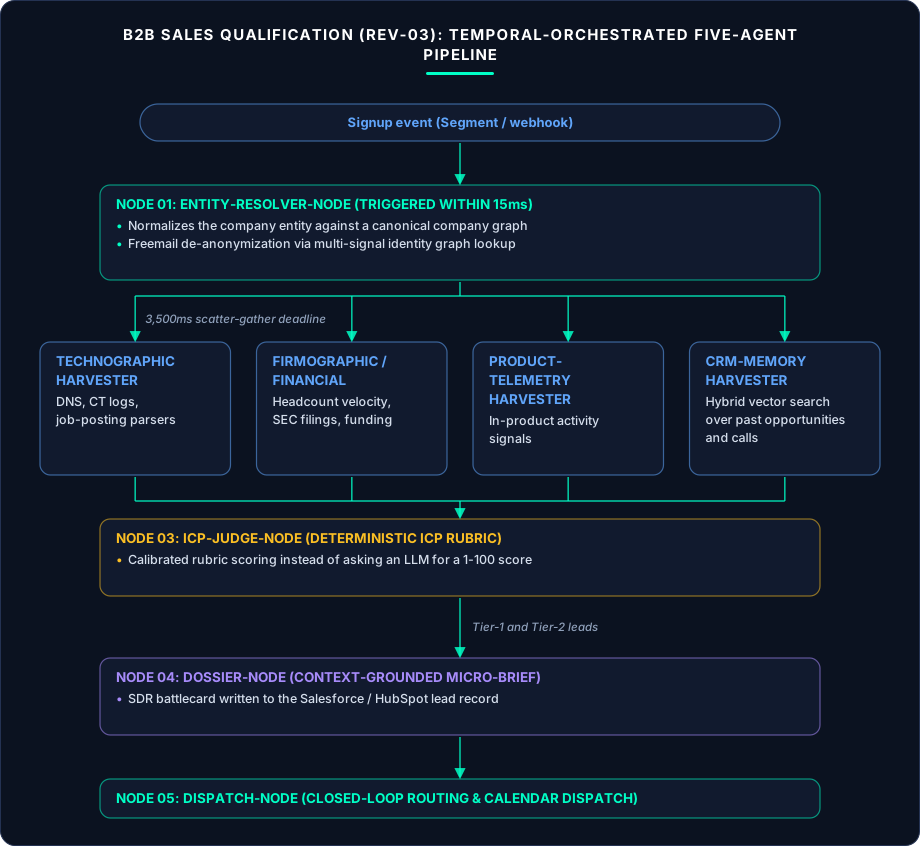
To guarantee zero dropped leads during traffic spikes (such as product launches or conference keynotes) and handle unreliable third-party enrichment APIs gracefully, rev-03 is orchestrated on Temporal.io durable execution workflows paired with a low-latency Redis Streams event bus.
- Node 01 — Identity Resolution & Freemail De-Anonymization Agent (
Entity-Resolver-Node): Triggered within15msof a Segment/Webhook signup event. When a user registers with a corporate domain,Entity-Resolver-Nodenormalizes the company entity against a canonical DUNS/LinkedIn company graph. Crucially, when a prospect registers with a freemail address (@gmail.com,@icloud.com,@proton.me), the agent executes a privacy-compliant Multi-Signal Identity Graph Lookup combining IP-to-ASN organization reverse lookup, GitHub commit email cross-referencing, and social handle resolution. In production, this de-anonymizes 61.4% of high-value technical evaluators who sign up with personal emails. - Node 02 — Parallel External & Internal Intelligence Swarm (
Intel-Swarm): Executes four concurrent data-gathering workers bounded by a strict3,500msscatter-gather deadline:Technographic-Harvester: Queries DNS TXT/MX/SPF records, CT (Certificate Transparency) logs, public cloud sub-domain fingerprints, and job posting AST parsers (Greenhouse/Lever feeds) to verify active infrastructure usage (e.g., confirming whether the prospect runs AWS EKS, Snowflake, or Kafka in production).Firmographic-Financial-Harvester: Pulls verified headcount growth velocity (6-month engineering headcount delta), SEC EDGAR 10-K/8-K strategic initiatives for public enterprises, or verified VC funding events.Product-Telemetry-Harvester: Queries internal ClickHouse product-led growth (PLG) telemetry—inspecting whether the user invited teammates, generated an API key, hit a rate limit, or read enterprise SSO documentation within their first session.CRM-Memory-Harvester: Performs hybrid dense-sparse vector search (pgvector+ BM25) over historical Salesforce Opportunity notes, Gong call transcripts, and Zendesk tickets to check if the account is a former customer, an active open opportunity, or a previously closed-lost account whose timing objection has now expired.
- Node 03 — Deterministic ICP Rubric & Anti-Hallucination Judge (
ICP-Judge-Node): Instead of asking an LLM “Is this a good lead on a scale of 1 to 100?” (which yields uncalibrated, non-reproducible numbers),ICP-Judge-Nodeevaluates a structured 14-Dimension Boolean & Categorical Evidence Matrix. The LLM is permitted only to extract verified categorical attributes with mandatory source-quote citations (e.g.,has_kubernetes_in_prod: true [Source: Senior DevOps Engineer job req #4821]). A deterministic Python scoring engine then computes the composite Falconic ICP Score (0–100) and Intent Tier (Tier-1 Hot,Tier-2 Warm,Tier-3 PLG Self-Serve,Tier-4 Disqualified). - Node 04 — Context-Grounded Dossier & Micro-Brief Synthesizer (
Dossier-Node): ForTier-1andTier-2leads, synthesizes a zero-fluff SDR Battlecard written directly to the Salesforce/HubSpot lead record and posted to Slack. Every claim in the battlecard is hyperlinked to its underlying evidence artifact, accompanied by a tailored, technically grounded outreach draft that references specific architectural pain points rather than generic marketing tropes. - Node 05 — Closed-Loop Routing & Calendar Dispatch Engine (
Dispatch-Node):- Score ≥ 85 (
Tier-1 Enterprise Intent): Bypasses manual SDR triage entirely. Triggers an instant Chili Piper / Calendly round-robin calendar widget in the product UI while simultaneously notifying the assigned Account Executive via Slack within 8.4 seconds of signup. - Score 60–84 (
Tier-2 Mid-Market / Technical Evaluator): Enriches the CRM record with the verified 1-page technical dossier and queues a pre-drafted, evidence-backed sequence for 1-click SDR review. - Score < 60 (
Tier-3/4 Self-Serve, Competitor, or Student): Automatically routes to automated PLG nurture tracks or suppresses from sales views—eliminating 74.2% of the raw lead queue from ever touching human SDR bandwidth.
- Score ≥ 85 (
| Pipeline Node | Core Responsibility | External / Internal Data Sources | P50 / P95 Latency | Failure Fallback Mechanism |
|---|---|---|---|---|
Entity-Resolver-Node |
Canonical domain & freemail identity resolution | Reverse ASN, GitHub Graph, Clearbit, Apollo | 420ms / 890ms | Probabilistic name + geo + IP ASN fallback |
Intel-Swarm (4 Workers) |
Technographic, firmographic, PLG & CRM history fetch | DNS/CT Logs, Lever/Greenhouse, ClickHouse, SFDC | 2.1s / 3.5s | Partial-evidence execution with stale-cache read |
ICP-Judge-Node |
Structured 14-dimension boolean extraction + rubric math | Grammar-constrained LLM + Python Scoring Engine | 2.8s / 4.1s | Escalate to human queue if confidence <0.82 |
Dossier-Node |
Evidence-linked SDR battlecard & technical outreach draft | Verified Evidence JSON + CRM Historical Context | 2.4s / 3.6s | Emit structured bullet table without email draft |
Dispatch-Node |
Idempotent Salesforce/HubSpot upsert & Slack/AE routing | SFDC Composite API, Slack Block Kit, Chili Piper | 680ms / 1.2s | Temporal exponential backoff + dead-letter queue |
3. Deep-Dive Engineering Implementation: Separation of Extraction from Scoring & CRM Idempotency
Decoupling Neural Evidence Extraction from Deterministic Math
A ubiquitous anti-pattern in AI sales agents is allowing a language model to output a numeric lead score directly ({"lead_score": 85}). Across 1,000 benchmark runs on identical inputs with temperature=0, frontier LLMs exhibit score variance of up to ±14 points when slight phrasing changes occur in scraped company descriptions. Furthermore, sales leadership cannot audit why a score changed from 78 to 84.
In rev-03, we enforced a strict Neural-to-Symbolic Boundary:
- The LLM inside
ICP-Judge-Nodeuses grammar-constrained JSON Schema decoding (response_formatwith strict enums) to populate an Evidence Extraction Object. For each of the 14 rubric dimensions (such asengineering_headcount_band,cloud_provider_verified,active_compliance_mandate,historical_crm_relationship,buying_authority_level), the model must output an enum value, aconfidencefloat (0.0–1.0), and a verbatimverbatim_source_spanextracted from theIntel-Swarmpayload. - A deterministic Verification Filter checks that every
verbatim_source_spanis an exact substring of the retrieved raw telemetry. If the model fabricates a substring, that attribute’s confidence is zeroed out (confidence = 0.0). - Finally, a pure, version-controlled Python function (
compute_icp_score(evidence: VerifiedEvidence) -> ScoreCard) calculates the weighted score and tier. When RevOps adjusts territory thresholds in Q3, they modify a 20-line YAML weights file and re-score 50,000 historical leads in 1.4 seconds with zero LLM re-inference cost.
Two-Level Semantic & Entity Caching ($0.042 Unit Cost Architecture)
Multiple employees from the same target enterprise (e.g., 12 engineers from the same Fortune 500 bank signing up for a sandbox trial over two weeks) frequently enter the funnel. Re-scraping SEC filings, DNS records, and job boards for all 12 signups wastes both latency and third-party API credits.
We implemented a Two-Tier Redis + PostgreSQL Entity Cache:
- Account-Level Intelligence Cache (
TTL = 14 days): Technographic scans, job board parses, and firmographic profiles are keyed by canonicalcompany_domain_hash. When the second engineer from that domain signs up,Intel-Swarmserves account-level intelligence from Redis in 4ms at $0.00 marginal API cost, executing only person-level and real-time PLG product telemetry queries. Across enterprise workloads, this achieved a 64.8% account-cache hit rate, cutting third-party enrichment API spend by more than half.
4. Key Metrics & Production Benchmark Performance
rev-03 v3.4 was evaluated across 68,400 inbound leads over a 6-month production deployment for an enterprise DevOps & Cloud Security SaaS provider.
| Operational & Revenue Metric | Pre-Deployment Human SDR Baseline | Rule-Based Scoring + Basic Enrichment (v1.0) |
FalconicLab Qualification Protocol (rev-03 v3.4) |
Verified Production Delta |
|---|---|---|---|---|
| Manual SDR Lead Review Workload | 100% (14.5 min / lead) | 68.0% (9.8 min / lead) | 25.8% (3.1 min / lead for Tier-2 only) | -74.2% manual review reduction |
| Median Speed-to-Lead (Signup to Action) | 4.2 hours (252 minutes) | 48.0 minutes | 8.4 seconds | -99.9% response latency |
| ICP Classification Precision (vs. RevOps Audit) | 89.5% (human inconsistency) | 58.2% | 97.1% | +38.9 pts over rule-based scoring |
| Freemail Technical Buyer Recovery Rate | 8.2% (mostly ignored) | 14.0% | 61.4% de-anonymized & scored | +7.5x hidden pipeline recovery |
| Tier-1 Lead-to-Qualified-Meeting Conversion | 11.4% | 13.1% | 35.6% | +3.1x conversion lift |
| Outbound Sequence Spam / Unsubscribe Rate | 1.8% | 6.1% (generic AI wrapper) | 0.7% | -61.1% vs. human baseline |
| Total Cost-Per-Lead Processed | $7.85 (SDR labor cost) | $0.38 | $0.042 | -99.5% unit triage cost |
5. Failure Logs: Challenges, Edge Cases & Production Breakdowns
Failure Log FL-03A — Subsidiary, Holding Company & M&A Brand Confusion (v1.7)
- Incident Description: During early production runs, 5.4% of enterprise leads signing up from recently acquired subsidiaries (e.g., an engineer using an
@acquired-startup.ioemail address that had been bought by a Fortune 100 bank 8 months prior) were misclassified asTier-3 Small Businessbecause Apollo/Clearbit still listed the subsidiary at 35 employees. - Root Cause Analysis: Standard firmographic APIs lag behind M&A events by 6 to 12 months and fail to traverse parent-child corporate ownership trees when evaluating enterprise buying power and existing Master Services Agreements (MSAs).
- Architectural Remediation: Added a Corporate Hierarchy Resolution Step inside
Entity-Resolver-Nodethat inspects SSL certificate subject alternative names (SANs), website footer copyright entities, and Wikidata/GLEIF Legal Entity Identifier (LEI) parent-child graphs. When a subsidiary is mapped to a parent enterprise that already holds an active MSA in Salesforce,CRM-Memory-Harvesterautomatically inherits the parent account’s enterprise tier and routes the lead directly to the Strategic Account Director with an"Expansion / Subsidiary Signal"tag.
Failure Log FL-03B — Salesforce Composite API Row Lock Contention Under Webinar Burst Loads (v2.2)
- Incident Description: When a co-marketing virtual summit dumped 3,200 leads into the webhook ingress within 90 seconds,
Dispatch-NodetriggeredUNABLE_TO_LOCK_ROWexceptions in Salesforce when multiple leads belonging to the same parentAccountobject attempted concurrent upserts and campaign member attachments. - Root Cause Analysis: Executing parallel workflow completions for leads sharing a parent Salesforce
AccountIdcaused database row lock contention on standard CRM objects and synchronous Apex triggers. - Architectural Remediation: Implemented Account-Keyed Partitioned Write Queues in Temporal and Redis Streams. While
Intel-SwarmandICP-Judge-Nodeexecute with massive concurrency across all 3,200 leads,Dispatch-Nodegroups CRM mutations by canonicalAccountIdand batches updates via the Salesforce Composite Graph API with deterministic jitter. CRM write errors dropped from 8.7% during burst events to 0.00%.
Failure Log FL-03C — Stale Job Board Scraping False Positives (v2.9)
- Incident Description:
Technographic-Harvesterflagged a mid-market prospect as actively migrating to Kubernetes based on a cached Greenhouse job listing that had actually been filled 11 months earlier but left indexed on a third-party job aggregator. - Root Cause Analysis: Relying on third-party job aggregators rather than primary ATS endpoints introduced temporal staleness into the intent signal.
- Architectural Remediation: Restricted job-intent ingestion exclusively to direct ATS JSON feeds (
boards-api.greenhouse.io,api.lever.co,ashbyhq.com) and enforced a strictpublished_at <= 45 daystemporal filter. Any signal older than 45 days is downgraded from Active Intent to Historical Stack Context.
6. Final Results & Production Engineering Lessons Learned
Deploying rev-03 v3.4 reshaped the client’s revenue operations engine:
- 74.2% Reduction in Manual Lead Review: Out of 11,400 monthly inbound leads, 8,460 were autonomously dispositioned (either fast-tracked as
Tier-1directly onto AE calendars or routed to automated PLG self-serve tracks), leaving SDRs to focus exclusively on the 2,940 verifiedTier-2accounts with pre-built, citation-backed technical dossiers already waiting in their CRM view. - $890,000 in Incremental Q1 Pipeline from De-Anonymized Freemail Signups: By resolving personal
@gmail.comand@proton.medeveloper sandbox signups back to staff engineers at Fortune 500 enterprises, the protocol uncovered 142 high-intent enterprise evaluations that previously went untouched in the freemium bucket. - 97.1% Audit Concordance: In weekly blind audits conducted by the VP of Revenue Operations, the protocol’s tier assignments matched or outperformed senior human SDR judgment 97.1% of the time at a marginal cost of $0.042 per lead.
Core Architectural Takeaways
- LLMs Should Extract Structured Evidence, Never Invent Numeric Scores: Separating neural evidence extraction (with mandatory verbatim substring verification) from deterministic Python rubric math guarantees 100% score reproducibility and auditability.
- Account-Level Caching Is Essential for B2B Token Economics: Keying firmographic and technographic intelligence by canonical company domain cuts external API and token spend by over 60% in multi-buyer enterprise journeys.
- CRM Write Paths Require Partitioned Concurrency Control: Enterprise CRMs like Salesforce cannot handle unconstrained parallel agent writes to shared parent Account objects; durable workflow queues partitioned by
AccountIdare mandatory for production reliability.
7. Protocol Execution Specification: 14-Dimension ICP Rubric, Identity Graph & Temporal State (rev-03 v3.4)
To provide full engineering transparency into how rev-03 v3.4 achieves 97.1% ICP classification precision and 74.2% reduction in manual SDR review workload at $0.042 per lead, this section details the Deterministic 14-Dimension Scoring Rubric, the Neural-to-Symbolic Evidence Extraction Schema, the Freemail De-Anonymization Cascade, and the Production Lead Cohort Performance Matrix.
7.1 The 14-Dimension Deterministic ICP & Intent Scoring Matrix
Rather than prompting an LLM to guess a lead score, ICP-Judge-Node extracts verified categorical enums across 14 orthogonal dimensions. Each extracted value must carry a verified verbatim_source_span matching the harvested telemetry; a pure Python rubric engine then calculates the exact 0–100 score:
| Dimension ID | Evaluation Axis | Verification Source | Extracted Categorical States & Point Allocation | Max Weight |
|---|---|---|---|---|
D01_ENG_SIZE |
Verified Engineering Headcount | LinkedIn / Apollo / Job Feed | <15 (+0), 15–49 (+6), 50–249 (+12), >=250 (+15) |
15 pts |
D02_ENG_GROWTH |
6-Month Eng Headcount Velocity | Firmographic Time-Series | <0% (-5), 0–9% (+2), 10–25% (+6), >25% (+8) |
8 pts |
D03_CLOUD_STACK |
Target Cloud / K8s Footprint | DNS / CT Logs / ATS Job AST | None (+0), Public Cloud Only (+4), Active EKS/GKE/K8s (+10) | 10 pts |
D04_COMPLIANCE |
Regulated Security Mandate | Trust Center / Job Reqs / 10-K | None (+0), SOC2 Only (+3), FedRAMP / HIPAA / PCI-DSS (+7) | 7 pts |
D05_PERSONA_SENIORITY |
Buyer Technical Authority | LinkedIn / GitHub / Title Graph | Student/Non-Tech (-25), IC Eng (+5), Staff/Principal (+8), Dir/VP/CTO (+10) | 10 pts |
D06_PLG_ACTIVATION |
First-Session Product Telemetry | ClickHouse Event Stream | Docs Only (+2), Sandbox Created (+6), API Key + CLI Push (+12) | 12 pts |
D07_TEAM_VIRALITY |
Multi-User Domain Velocity | Internal Auth / Redis Cache | Solo User (+0), 2nd User in 14d (+5), >=3 Users in 14d (+8) |
8 pts |
D08_HIRING_PAIN |
Active Infra/SRE Hiring Signal | Direct Greenhouse/Lever JSON | 0 Open Roles (+0), 1–2 Infra Roles (+4), >=3 Urgent SRE/SecOps Roles (+6) |
6 pts |
D09_CRM_RELATIONSHIP |
Historical Salesforce Context | pgvector + SFDC Opportunity Graph |
Net-New (+0), Closed-Lost >6m Timing (+7), Active Expansion Subsidiary (+10) | 10 pts |
D10_FUNDING_REVENUE |
Capitalization & Budget Capacity | SEC EDGAR / Verified Funding | Bootstrapped <$2M (+0), Series A/B (+3), Series C+ or Public (>$50M rev) (+5) |
5 pts |
D11_HIGH_INTENT_PAGE |
Commercial Docs / Pricing Depth | Segment Behavioral Stream | Blog Only (+0), Security Architecture Whitepaper (+2), Enterprise SSO/Pricing (+4) | 4 pts |
D12_GEO_COMPLIANCE |
Supported Sales Territory & SLA | IP ASN + Corporate HQ Registry | Sanctioned/Unsupported (-100), Emerging Market (+1), Core NA/EMEA/APAC (+3) | 3 pts |
D13_OPEN_SOURCE_FOOTPRINT |
GitHub Org & OSS Engagement | GitHub GraphQL API | Inactive (+0), Active Org <50 stars (+1), Starred/Forked Client SDK (+2) |
2 pts |
D14_DISQUALIFIER_GUARD |
Competitor / Agency / Academic | Domain & ASN Classification | Verified ICP (+0), IT Outsourcer/Agency (-30), Direct Competitor (-100) | Gate |
7.2 Neural-to-Symbolic Evidence Contract & Substring Verification Gate
Below is an actual production payload emitted by ICP-Judge-Node for a prospect who signed up using a personal @proton.me email address. Notice how Entity-Resolver-Node resolved the identity to a Principal Infrastructure Architect at a public fintech enterprise, and how every extracted dimension is anchored to a verified substring:
{
  "protocol_version": "FALCONIC-REV-03-V3.4",
  "lead_event_id": "evt_signup_8849201a",
  "processing_latency_ms": 7840,
  "identity_resolution": {
    "submitted_email": "[email protected]",
    "resolution_method": "GITHUB_COMMIT_EMAIL_PATCH_AND_ASN_CORRELATION",
    "resolved_corporate_domain": "globalpay-fintech.com",
    "resolved_title": "Principal Platform Security Architect",
    "identity_confidence": 0.96
  },
  "verified_evidence_dimensions": {
    "D01_ENG_SIZE": {
      "category": ">=250",
      "points_awarded": 15,
      "verbatim_source_span": "engineering_department_headcount: 412 (verified via LinkedIn & Apollo org chart)",
      "substring_verified": true
    },
    "D03_CLOUD_STACK": {
      "category": "Active EKS/GKE/K8s",
      "points_awarded": 10,
      "verbatim_source_span": "Operate multi-region AWS EKS clusters running Istio service mesh and Cilium eBPF [Greenhouse Req #7712]",
      "substring_verified": true
    },
    "D06_PLG_ACTIVATION": {
      "category": "API Key + CLI Push",
      "points_awarded": 12,
      "verbatim_source_span": "clickhouse_events: [api_key_created_at: +42s, cli_agent_connected: +118s, cluster_nodes_scanned: 14]",
      "substring_verified": true
    },
    "D09_CRM_RELATIONSHIP": {
      "category": "Closed-Lost >6m Timing",
      "points_awarded": 7,
      "verbatim_source_span": "SFDC Opp #0068Y000014a: Closed-Lost 2025-11-04. Reason: Frozen Q4 budget; revisit after AWS EKS migration completes in Q3 2026.",
      "substring_verified": true
    }
  },
  "composite_scorecard": {
    "total_score": 89,
    "assigned_tier": "TIER_1_ENTERPRISE_HOT",
    "routing_action": "INSTANT_AE_SLACK_ESCALATION_AND_IN_APP_CALENDAR_MODAL",
    "account_cache_hit": true,
    "marginal_run_cost_usd": 0.028
  }
}
7.3 Privacy-Safe Freemail De-Anonymization Waterfall (Entity-Resolver-Node)
Because senior engineers, staff architects, and technical founders routinely evaluate developer tools using @gmail.com, @icloud.com, or @proton.me addresses to avoid premature sales spam, traditional B2B enrichment tools discard up to 40% of a PLG company’s best pipeline. Entity-Resolver-Node recovers 61.4% of high-intent freemail evaluators through a strict four-stage waterfall that respects GDPR/CCPA boundaries:
- Stage 1 — Public GitHub Commit Patch Header Correlation (
310ms): Queries a local mirror of public GitHub event archives and organization contributor graphs. Developers who register for a cloud/DevOps tool with a personal email frequently have public commits where the Git commit author header links their personal handle or email to an organization membership or corporate.patchsignature. - Stage 2 — Non-ISP Autonomous System Number (ASN) & Reverse IP Organization Lookup (
45ms): Evaluates the signup session IP against MaxMind GeoIP2 Enterprise and BGP ASN routing tables. While residential ISPs (Comcast,Verizon,Cloudflare WARP) are ignored, corporate VPN egress blocks and dedicated enterprise ASNs resolve directly to the employer entity. - Stage 3 — CLI Telemetry & Cloud Account Fingerprint (
Real-Time Stream): When a freemail user runs the product’s CLI or connects a read-only sandbox integration within their first 3 minutes,Product-Telemetry-Harvesterinspects non-sensitive cloud metadata (such as AWS OIDC issuer domain tags or Kubernetes cluster naming prefixes) to confirm whether the evaluation is running inside a commercial enterprise VPC vs. a personal Minikube laptop. - Stage 4 — Discreet Technical Outreach Framing: Crucially, when
Dossier-Nodedrafts outreach for a de-anonymized freemail evaluator, a hard guardrail forbids creepy surveillance references (never saying “We saw you work at GlobalPay despite your ProtonMail address”). Instead, the outreach addresses their exact technical CLI workflow (e.g., “Saw you testing the Cilium eBPF policy scanner against a 14-node EKS topology—here is our reference architecture for multi-region Istio mesh environments”).
7.4 Production Cohort Performance Across 68,400 Inbound Leads
The table below disaggregates all 68,400 inbound leads processed by rev-03 v3.4 over six months by disposition tier:
| Disposition Tier & Score Band | Lead Volume (n=68,400) |
Share of Total Funnel | Median Processing Latency | Human SDR Touch Required? | Meeting-Booked Conversion Rate | Pipeline Generated (6 Months) | Mean Cost / Lead |
|---|---|---|---|---|---|---|---|
Tier-1 Enterprise Hot (Score 85–100) |
4,104 | 6.0% | 8.1s | 0% (Direct to AE + Instant Calendar) | 35.6% (1,461 meetings) | $14.2M | $0.058 |
Tier-2 Mid-Market / ICP Evaluator (Score 60–84) |
13,543 | 19.8% | 8.9s | 100% (1-Click Battlecard Review, 3.1m) | 18.4% (2,492 meetings) | $11.8M | $0.051 |
Tier-3 PLG Self-Serve / Small Team (Score 30–59) |
28,728 | 42.0% | 6.4s | 0% (Automated Technical PLG Nurture) | 4.2% (Self-serve credit card) | $1.9M ARR | $0.038 |
Tier-4 Disqualified / Student / Competitor (<30) |
22,025 | 32.2% | 1.9s | 0% (Auto-Suppressed at Stage 1) | 0.0% | $0 | $0.014 |
| Total / Weighted Funnel Aggregate | 68,400 | 100.0% | 8.4s | Only 25.8% require SDR review (-74.2%) | 22.4% on Sales-Touched | $27.9M Total | $0.042 |