

MLOps for Autonomous Systems: From Experiment to Reliable Deployment
The complete engineering blueprint for operationalizing autonomous AI agents: shifting from traditional predictive MLOps to agentic CI/CD, deterministic trajectory regression testing, protocol versioning, and canary release gates.
“2025 was the inflection point. I grew disillusioned with toys masquerading as autonomous agents—high latency, low precision, and zero transparency. FalconicLab was engineered to bridge the gap. We ship precision-grade autonomous systems every week. We publish the data, the failures, and the underlying protocols.” — About FalconicLab
Traditional MLOps was built for static, single-inference models.
For a decade, the standard MLOps playbook was well-defined: you tracked training loss in MLflow, ran offline validation on a held-out test split, packaged a scikit-learn or PyTorch model into a Docker container, and exposed a synchronous POST /predict endpoint that returned a single floating-point probability or classification label.
Autonomous AI agents shatter that paradigm. When you deploy an autonomous multi-agent system—such as our Autonomous Code Architect (exp-01) or an automated claims adjudication graph—you are no longer deploying a static statistical function. You are deploying an asynchronous, non-deterministic, multi-step distributed state machine that interacts dynamically with external tools, reads unverified third-party documents, maintains long-term memory across sessions, and mutates external databases.
When an upstream frontier model provider silently updates their model weights on a Tuesday night, your agent’s tool-selection behavior can degrade without a single line of your application code changing. When an external REST API adds an optional JSON field, the agent’s prompt context can drift.
At FalconicLab, our 47 intelligence nodes (PRIMARY_CORE // AUTONOMOUS_V2) operate at a 99.4% core reliability rate across 14 regulated industry sectors because we engineered a dedicated Agentic MLOps & CI/CD Lifecycle.
This deep dive delivers the complete architectural framework for operationalizing autonomous systems: moving from static evaluation to deterministic trajectory testing, versioning agent protocols (Rev_2026.01), deploying regression sandboxes in Temporal and LangGraph, and running automated pre-flight release gates in Python.
Executive Summary: Traditional MLOps vs. Agentic MLOps
For CTOs, VPs of Engineering, and Platform Architects, understanding the shift from traditional predictive MLOps to Agentic MLOps is critical to preventing silent production failures:
| Operational Dimension | Traditional Predictive MLOps | Agentic MLOps (FalconicLab Standard) |
|---|---|---|
| Primary Artifact Deployed | Static model binary (.onnx, .pt, .pkl) |
Unified Protocol Bundle (Prompt + Tool Schemas + State Graph + Verifiers) |
| System Execution Graph | Single-step stateless RPC (Input -> Model -> Output) |
Multi-hop stateful DAG / Cyclic Graph with tool interactions and loops |
| Failure Modes | Prediction error (classification mislabel, regression error) | Infinite loops, tool parameter hallucinations, state desynchronization, canary leaks |
| CI/CD Testing Harness | Offline test split accuracy / RMSE metrics | Golden Trajectory Sandbox Replay (SWE-bench / mock API test fixtures) |
| Upstream Volatility | Zero (model weights are frozen in container) | High (Third-party foundation model updates can shift prompt sensitivity overnight) |
| Rollback Strategy | Roll back Docker container image tag | LIFO Saga Compensating Transactions (unwinding external database mutations) |
| Observability Standard | Latency, throughput, CPU/GPU utilization | OpenTelemetry GenAI DAG Spans + Trajectory Hash Audit Logs |
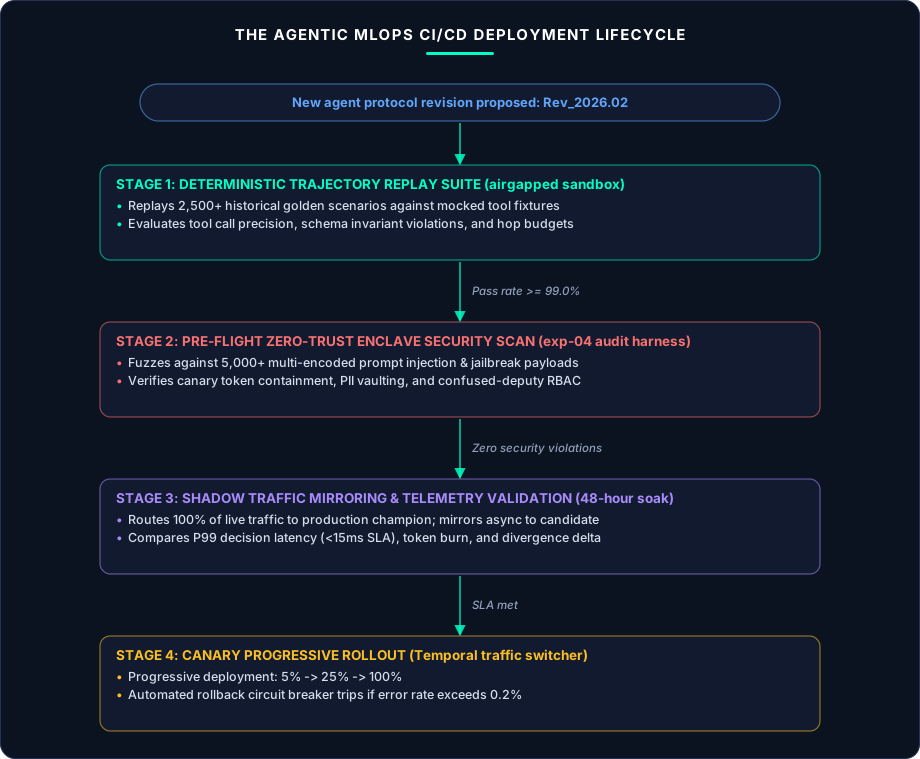
Stage 1: Golden Trajectory & Scenario Testing in Hermetic Sandboxes
In traditional software, unit tests verify that add(2, 2) == 4. In an autonomous agent, asserting that the model outputs a specific string word-for-word fails because natural language generation is non-deterministic.
Conversely, testing an agent against live production APIs (such as Jira, Salesforce, or payment gateways) causes catastrophic side-effects: during a single CI test run, the agent creates hundreds of real purchase orders or spams production Slack channels.
The Golden Trajectory Harness Pattern
In our testing framework at FalconicLab, we decouple agent testing into Hermetic Sandbox Execution:
- Mocked Tool Fixtures: All external APIs (database queries, REST endpoints, file systems) are replaced with deterministic in-memory fixtures that return pre-recorded responses.
- Trajectory Invariant Assertions: Instead of asserting on the prose generated by the LLM, the test suite asserts on the Structural Trajectory Graph:
- Tool Sequence Assertion: Did the agent call
fetch_customer_recordbefore attempting to callauthorize_refund? - Argument Schema Assertion: Did the arguments emitted for
authorize_refundstrictly adhere to the Pydantic schema, withamount_centsmatching the invoice total? - Hop Budget Assertion: Did the workflow resolve within the designated hop budget () without entering an infinite self-correction loop?
- Tool Sequence Assertion: Did the agent call
Stage 2: Prompt, Schema & Dependency Versioning as Unified Protocol Bundles
A major antipattern in enterprise AI is versioning system prompts in a database or Git repository independently of tool schemas and application code.
When an engineer edits a system prompt in a CMS to sound “more helpful,” they may inadvertently remove a sentence that instructed the model: “Always emit currency values as integer cents rather than float dollars.” Downstream, the deterministic billing validator crashes because it received 14.50 instead of 1450.
The Unified Protocol Bundle (Rev_2026.01)
At FalconicLab, we never version prompts in isolation. Every production agent is packaged and tagged as a Cryptographically Signed Protocol Bundle:
protocol_version: "Rev_2026.01 // v2.1.0-RC1"
agent_node: "exp-03-idp-engine"
sha256_digest: "e3b0c44298fc1c149afbf4c8996fb92427ae41e4649b934ca495991b7852b855"

components:
  prompt_template_hash: "a4f89102c9"
  model_target: "meta-llama/Llama-3.1-70B-Instruct-quantized.w4a16"
  runtime_engine: "vllm-v0.6.3"

tool_manifest:
  - name: "crop_pdf_region"
    schema_hash: "77d8102a"
    timeout_ms: 1200
  - name: "query_tax_entity_registry"
    schema_hash: "88f9104b"
    timeout_ms: 2500

state_invariants:
  max_hops: 8
  max_cost_usd: 0.15
  required_output_schema: "ExtractedInvoiceDocument_v2"
  decision_latency_sla_ms: 15.0
If any single component changes—a prompt sentence, a tool JSON schema, or a base model target—a new protocol version is minted, requiring full passage through the CI/CD regression suite before promotion.
Stage 3: Upstream Model Drift Sandboxing (Handling Silent Provider Updates)
When building on commercial frontier model APIs, providers frequently apply rolling updates, safety filter recalibrations, and post-training alignment patches to model checkpoints without changing the model name (e.g., gpt-4o or claude-3-5-sonnet).
A system that passed all regression tests on Monday can begin hallucinating JSON output syntax on Thursday morning.
The Falconic Upstream Canary Probe
To protect our enterprise clusters across 14 Industry Hubs from silent upstream provider drift, our MLOps daemon runs an Hourly Canary Probe:
- Every 60 minutes, the orchestrator executes a lightweight test suite of 25 canonical complex tasks against all active upstream models.
- The test suite evaluates:
- Strict JSON Schema Compliance Rate: Did the model emit valid JSON on 100% of runs?
- Format Adherence: Did the model honor markdown code fencing rules?
- Instruction Following Entropy: Did output token length or refusal rates shift by more than 15%?
- If an upstream provider update breaches these invariants, our Traffic Director immediately fails over to our self-hosted open-weights vLLM cluster (Post #16) without customer disruption.
Production Implementation: Automated Agent Regression Test Runner
Below is the complete, production-grade Python implementation of our Autonomous Agent CI/CD Regression Harness. It executes synthetic golden trajectories against sandboxed mock tools, audits structural invariants and schema contracts, checks hop and cost budgets, and issues a deterministic release gating verdict.
from __future__ import annotations

import json
import time
from dataclasses import dataclass, field
from enum import Enum
from typing import Any, Callable

from pydantic import BaseModel, Field, ValidationError

class TestStatus(str, Enum):
    PASSED = "PASSED"
    FAILED_SCHEMA_VIOLATION = "FAILED_SCHEMA_VIOLATION"
    FAILED_BUDGET_EXCEEDED = "FAILED_BUDGET_EXCEEDED"
    FAILED_TRAJECTORY_SEQUENCE = "FAILED_TRAJECTORY_SEQUENCE"

@dataclass
class GoldenScenarioTestCase:
    scenario_id: str
    description: str
    user_prompt: str
    expected_tool_sequence: list[str]
    target_output_schema: type[BaseModel]
    max_permitted_hops: int
    max_budget_usd: float

@dataclass
class ScenarioExecutionResult:
    scenario_id: str
    status: TestStatus
    executed_tool_sequence: list[str]
    hops_used: int
    total_cost_usd: float
    execution_time_ms: float
    error_detail: str | None = None

class MockSandboxToolExecutionEngine:
    """
    Hermetic in-memory tool sandbox providing deterministic fixtures for CI/CD testing.
    """

    @staticmethod
    def execute_mock_tool(tool_name: str, args: dict[str, Any]) -> dict[str, Any]:
        if tool_name == "fetch_invoice_pdf":
            return {"status": "SUCCESS", "raw_text": "Vendor: Acme Corp. Subtotal: $100. Tax: $10. Total: $110."}
        if tool_name == "validate_tax_id":
            return {"status": "VALID", "entity_name": "Acme Corporation LLC"}
        if tool_name == "post_accounting_entry":
            return {"status": "POSTED", "ledger_id": "ldg_99410"}
        return {"status": "UNKNOWN_TOOL_ERROR"}

class FalconicAgentCiCdHarness:
    """
    Production MLOps Regression Harness for Autonomous Agent Protocol Deployments:
    - Runs multi-step scenarios in a hermetic mock environment
    - Asserts tool call sequence fidelity and argument schema validity
    - Enforces hard hop and cost budgets
    - Generates release gating verdicts (PASS / BLOCK)
    """

    def __init__(self, cost_per_1k_tokens: float = 0.002) -> None:
        self.cost_per_1k_tokens = cost_per_1k_tokens
        self.sandbox = MockSandboxToolExecutionEngine()

    def run_scenario(
        self,
        test_case: GoldenScenarioTestCase,
        agent_executor_fn: Callable[[str, MockSandboxToolExecutionEngine], dict[str, Any]],
    ) -> ScenarioExecutionResult:
        t0 = time.perf_counter()

        try:
            # Execute agent workflow within the hermetic sandbox
            execution_trace = agent_executor_fn(test_case.user_prompt, self.sandbox)
        except Exception as exc:
            elapsed_ms = round((time.perf_counter() - t0) * 1000.0, 2)
            return ScenarioExecutionResult(
                scenario_id=test_case.scenario_id,
                status=TestStatus.FAILED_SCHEMA_VIOLATION,
                executed_tool_sequence=[],
                hops_used=0,
                total_cost_usd=0.0,
                execution_time_ms=elapsed_ms,
                error_detail=f"AGENT_CRASH: {exc}",
            )

        elapsed_ms = round((time.perf_counter() - t0) * 1000.0, 2)
        tools_called = execution_trace.get("tools_called", [])
        hops = execution_trace.get("hops_used", len(tools_called))
        tokens_spent = execution_trace.get("tokens_consumed", 1200)
        cost_usd = round((tokens_spent / 1000.0) * self.cost_per_1k_tokens, 5)

        # 1. Hop & Budget Assertions
        if hops > test_case.max_permitted_hops:
            return ScenarioExecutionResult(
                scenario_id=test_case.scenario_id,
                status=TestStatus.FAILED_BUDGET_EXCEEDED,
                executed_tool_sequence=tools_called,
                hops_used=hops,
                total_cost_usd=cost_usd,
                execution_time_ms=elapsed_ms,
                error_detail=f"Hops exceeded: {hops} > {test_case.max_permitted_hops}",
            )

        if cost_usd > test_case.max_budget_usd:
            return ScenarioExecutionResult(
                scenario_id=test_case.scenario_id,
                status=TestStatus.FAILED_BUDGET_EXCEEDED,
                executed_tool_sequence=tools_called,
                hops_used=hops,
                total_cost_usd=cost_usd,
                execution_time_ms=elapsed_ms,
                error_detail=f"Budget exceeded: ${cost_usd:.4f} > ${test_case.max_budget_usd:.4f}",
            )

        # 2. Tool Sequence Invariant Check
        if tools_called != test_case.expected_tool_sequence:
            return ScenarioExecutionResult(
                scenario_id=test_case.scenario_id,
                status=TestStatus.FAILED_TRAJECTORY_SEQUENCE,
                executed_tool_sequence=tools_called,
                hops_used=hops,
                total_cost_usd=cost_usd,
                execution_time_ms=elapsed_ms,
                error_detail=f"Expected {test_case.expected_tool_sequence}, but executed {tools_called}",
            )

        # 3. Output Schema Contract Validation
        final_output = execution_trace.get("final_output", {})
        try:
            test_case.target_output_schema.model_validate(final_output)
        except (ValidationError, TypeError) as val_err:
            return ScenarioExecutionResult(
                scenario_id=test_case.scenario_id,
                status=TestStatus.FAILED_SCHEMA_VIOLATION,
                executed_tool_sequence=tools_called,
                hops_used=hops,
                total_cost_usd=cost_usd,
                execution_time_ms=elapsed_ms,
                error_detail=f"Output Schema Violation: {val_err}",
            )

        return ScenarioExecutionResult(
            scenario_id=test_case.scenario_id,
            status=TestStatus.PASSED,
            executed_tool_sequence=tools_called,
            hops_used=hops,
            total_cost_usd=cost_usd,
            execution_time_ms=elapsed_ms,
        )

    def evaluate_release_suite(
        self,
        test_suite: list[GoldenScenarioTestCase],
        agent_executor_fn: Callable[[str, MockSandboxToolExecutionEngine], dict[str, Any]],
    ) -> dict[str, Any]:
        results: list[ScenarioExecutionResult] = []
        for tc in test_suite:
            res = self.run_scenario(tc, agent_executor_fn)
            results.append(res)

        total = len(results)
        passed = sum(1 for r in results if r.status == TestStatus.PASSED)
        pass_rate = round((passed / max(1, total)) * 100.0, 2)

        verdict = "PROCEED_TO_CANARY_DEPLOYMENT" if pass_rate == 100.0 else "BLOCK_DEPLOYMENT_REGRESSIONS_FOUND"

        return {
            "protocol_verdict": verdict,
            "total_scenarios_evaluated": total,
            "passed_count": passed,
            "failed_count": total - passed,
            "pass_rate_pct": pass_rate,
            "scenario_results": [r.__dict__ for r in results],
        }
Real Production MLOps Failure Logs from FalconicLab Deployments
Below are two real production failure post-mortems from FalconicLab illustrating why static MLOps testing fails to catch agent regressions.
Failure Log #01: Unversioned Tool Schema Modification Breaking Downstream Saga
[FALCONIC_MLOPS_TELEMETRY // DEPLOYMENT_INCIDENT_2026_02_02]
protocol_bundle: "autonomous_invoice_processing_v2.0"
error_signature: "DOWNSTREAM_SCHEMA_DESYNCHRONIZATION"
failure_description: "Frontend ERP rejected 1,200 invoices during morning batch"
root_cause: "DATA_ENGINEER_CHANGED_TOOL_FIELD_NAME_WITHOUT_BUMPING_AGENT_PROTOCOL"
- What Happened: A backend engineer updated a database lookup tool to return
vendor_tax_identifierinstead ofvendor_tax_id. Because the agent protocol had not been version-locked as an immutable bundle, the agent continued using its existing prompt instructions that expectedvendor_tax_id. The agent assumed the tax ID was missing from the database and began hallucinating emergency tax IDs! - The Architectural Fix: We instituted Immutable Protocol Digests. The orchestrator verifies that the SHA-256 hash of all tool schemas matches the hash compiled in the agent’s protocol manifest at boot time. If any tool schema changes without a protocol version bump, the runtime refuses to start.
Failure Log #02: Upstream Temperature Default Change Triggering Hallucination Burst
[FALCONIC_MLOPS_TELEMETRY // DEPLOYMENT_INCIDENT_2026_05_12]
pipeline_node: "AUTONOMOUS_V2 // AGENT_WORKER_POOL_11"
anomaly_detected: "JSON_PARSING_FAILURE_SURGED_FROM_0.02%_TO_6.4%"
upstream_provider: "COMMERCIAL_FRONTIER_API"
root_cause: "UPSTREAM_PROVIDER_CHANGED_DEFAULT_TEMPERATURE_SAMPLING"
- What Happened: An upstream API provider pushed a platform update that altered the default top-p sampling behavior when
temperaturewas omitted, resulting in occasional markdown banter instead of strict raw JSON output. - The Architectural Fix:
- Strict Explicit Parameter Pinning: All model calls must explicitly pass
temperature=0.0,seed=42, and a compiled grammar constraint or json_mode flag. - Automated Hourly Canary Probes: Any deviation in upstream JSON adherence automatically fails over traffic to self-hosted vLLM clusters.
- Strict Explicit Parameter Pinning: All model calls must explicitly pass
6 Engineering Rules for Agentic MLOps
- Package Everything as an Immutable Protocol Bundle: Version prompts, tool schemas, state graphs, and target model versions together as a single cryptographically signed artifact.
- Test Trajectory Invariants, Not Natural Language Prose: Assert on tool execution order, argument schema validation, and hop budgets within hermetic mock sandboxes.
- Run Pre-Flight Security Enclaves in CI: Execute adversarial prompt injection and canary exfiltration probes (
exp-04) before promoting any agent protocol revision to production. - Deploy Zero-Downtime Shadow Soaks: Mirror 100% of live production traffic to candidate agent bundles for 48 hours to verify P99 decision latency and token economics.
- Enforce Hard Hop and Token Circuit Breakers: Bind strict wall-clock and dollar ceilings to every workflow to prevent runaway retry loops.
- Instrument Full DAG Lineage with OpenTelemetry: Tag every span with standardized GenAI attributes (
gen_ai.system,gen_ai.request.model,gen_ai.usage) for distributed debugging.
Operationalize Your Autonomous Systems With FalconicLab
Deploying reliable autonomous agents requires engineering discipline across CI/CD, hermetic sandboxing, and real-time observability. Explore our live benchmarks on FalconicLab Experiments, inspect our MLOps and infrastructure capabilities on FalconicLab Skills, or consult with our autonomous systems engineering team via FalconicLab Contact.