

How We Evaluate AI Systems: Benchmarks Over Promises
A comprehensive executive and engineering guide to discarding synthetic benchmark vanity: how FalconicLab tests autonomous AI systems against deterministic invariants, compound multi-hop entropy, and real production workloads across 47 intelligence nodes.
“We publish our benchmarks, failure logs, and cost-per-run data for every system we ship — so you can evaluate results, not promises.” — FalconicLab & About FalconicLab
In the enterprise software industry, AI benchmarks have become marketing collateral rather than engineering instruments.
Every week, a new model card or startup press release claims “state-of-the-art” performance on MMLU, GSM8K, or HumanEval. Enterprise buyers read these claims and assume that a model scoring 91% on a multiple-choice academic exam will seamlessly automate commercial invoice reconciliation, clinical prior-authorization triage, or complex full-stack software refactors.
In enterprise production—across Banking & Financial Services, Healthcare & Life Sciences, and Manufacturing & Smart Industry—academic benchmarks correlate poorly with operational reliability. A model that achieves 92% on HumanEval coding puzzles will routinely hallucinate non-existent package dependencies, drop database transaction boundaries, or fail to parse multi-page table geometries.
Synthetic benchmarks fail enterprise evaluation on three fundamental grounds:
- Contamination and Overfitting: Many publicly available benchmarks have leaked directly into the pre-training and reinforcement learning datasets of frontier foundation models. The model is not reasoning; it is retrieving memorized test answers.
- Single-Turn Isolation: Academic benchmarks evaluate single-turn, stateless generation. They tell you nothing about how a system behaves over an 8-hop state graph where stochastic errors compound exponentially ().
- Absence of Negative Invariants: Standard benchmarks test whether a model can generate a correct response to a clean question. They do not test whether the system properly rejects adversarial prompt injections, respects tenant authorization boundaries, or maintains straight-through processing precision when upstream third-party APIs return HTTP 504 timeouts.
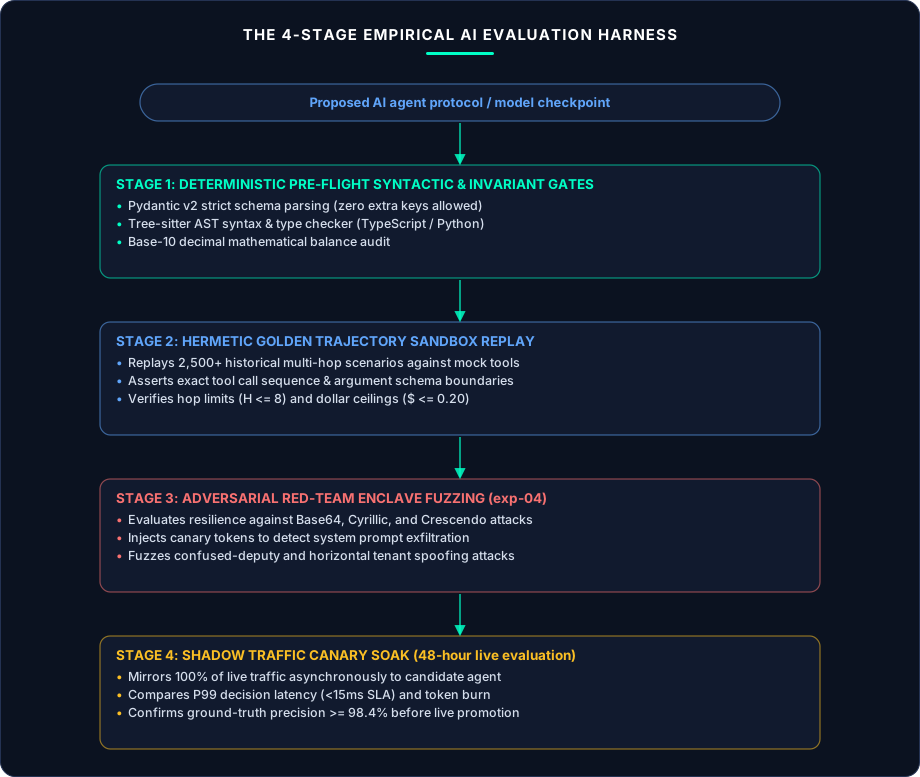
At FalconicLab, our 47 intelligence nodes (PRIMARY_CORE // AUTONOMOUS_V2) operate at a verified 99.4% core reliability rate, a 15ms orchestration decision latency, and an average precision cost of $0.06 per run on FalconicLab Experiments because we evaluate AI systems like mission-critical aerospace control software: using Deterministic Invariant Assertion Suites, Hermetic Sandbox Replay, and Empirical Straight-Through Processing (STP) Audits.
This guide outlines our complete evaluation framework for engineering leaders (CTOs, VPs of Quality, and Chief Risk Officers) and AI platform engineers, complete with mathematical formulation, production failure signatures, and a runnable Python evaluation engine.
Executive Summary: Academic Benchmarks vs. Production Invariant Auditing
For enterprise decision-makers, evaluating an AI system requires abandoning synthetic accuracy metrics in favor of decision-grade operational indicators:
| Evaluation Attribute | Academic Benchmarks (MMLU, HumanEval) | Enterprise Reality | FalconicLab Empirical Evaluation Standard (Rev_2026.01) |
|---|---|---|---|
| Test Environment | Single-shot prompt; no tools; static strings | Complex 8–15 hop state machines with external REST APIs and DBs | Hermetic Mock Sandbox Replay with AST and API mutation fixtures |
| Measurement Target | Perplexity or token overlap (ROUGE / BLEU) | Task completion without human rework or data corruption | Straight-Through Processing (STP) Precision & Brier Calibration |
| Error Handling | Incorrect answer counts as -1 score | Partial mutation, duplicate billing, silent data corruption | LIFO Saga Rollback Verification & Trajectory Loop Budgets |
| Cost & FinOps Accounting | Ignored completely | Quadratic context inflation and runaway retry storms | Cost-per-Verified-Outcome (CPVO) factoring in human triage labor |
| Adversarial Resilience | Neutral prompts | Prompt injections, canary exfiltration, toxic payloads | 10,000+ Automated Multi-Encoded Red-Team Probes (exp-04) |
| Audit Artifact | Markdown score report | Unauditable text dumps | Full OpenTelemetry GenAI DAG Spans & Cryptographic State Hashes |
Architectural Pillar 1: The Fallacy of Token Accuracy and Word Overlap
In standard software engineering, a function is either correct or incorrect. In generative AI, teams often rely on token-level overlap metrics (such as BLEU, ROUGE, or cosine similarity between embeddings) to score output quality.
In enterprise production, token overlap is actively misleading:
- If an AI extraction agent reading an invoice generates:
"The total balance due is $4,250.00."when the ground-truth document says"The total balance due is $4,250.00.", token overlap is 1.00 (100%). - If the agent drops a single character and generates:
"The total balance due is $4,250.08.", token overlap is still 0.95 (95%). - Yet, in accounting, an $0.08 discrepancy halts general-ledger reconciliation, triggers an automated fraud alert, and requires an accountant to spend 15 minutes manually investigating the invoice.
The Metric That Matters: Straight-Through Processing (STP) Precision
At FalconicLab, we evaluate all extraction and reasoning nodes—such as our Intelligent Document Processing Engine (exp-03)—using Straight-Through Processing (STP) Precision:
A transaction only passes STP if:
- Every numeric figure satisfies horizontal and vertical math checks (
sum(items) + tax == total) using base-10Decimalarithmetic. - Every output field adheres strictly to the compiled Pydantic JSON schema with zero extra or missing keys.
- Every cited assertion carries an exact verbatim substring match and bounding-box coordinates to the source document.
Across 3,890+ benchmarked enterprise document runs on exp-03, our pipeline achieves 97.8% verified STP precision at $0.05 unit cost (FalconicLab Experiments).
Architectural Pillar 2: Multi-Hop Trajectory Evaluation vs. Single-Turn Grading
When an autonomous system operates across multiple hops—such as our Autonomous Code Architect (exp-01)—evaluating the final output alone is insufficient. You must evaluate the Structural Trajectory:
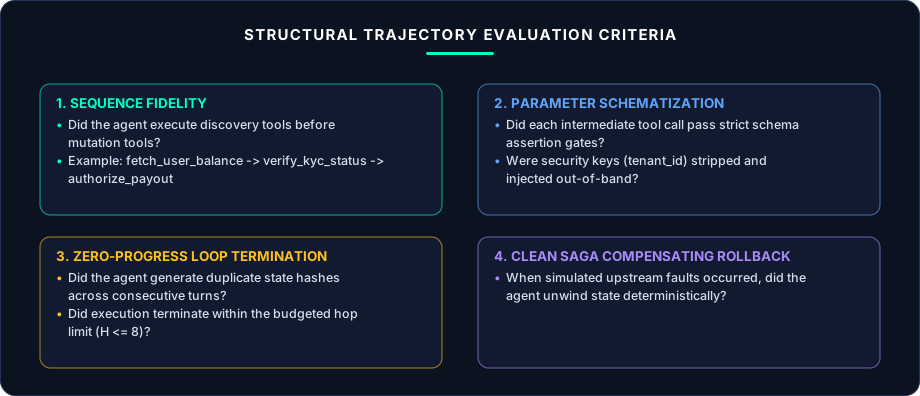
Evaluating trajectories requires running tests inside Hermetic Sandboxes with mock API backends that return realistic latency distributions, HTTP 429/504 errors, and schema edge cases.
Architectural Pillar 3: Empirical Brier Calibration (Knowing What the Agent Doesn’t Know)
An enterprise AI system does not need to be right 100% of the time; it needs to know when it is uncertain.
If an agent has an operational precision of 94%, but reports confidence = 0.99 on every run, human supervisors cannot trust its output. They are forced to review 100% of cases to catch the hidden 6% of failures.
Conversely, if the agent’s confidence probabilities are well-calibrated, human operators can let the 94% high-confidence runs pass straight through while reviewing only the 6% low-confidence cases.
The Brier Calibration Metric
We evaluate calibration across all classification and extraction nodes using the Brier Score (BS):
Where is the forecasted confidence probability and is the actual binary ground-truth outcome.
- A Brier score of
0.0represents perfect probabilistic calibration. - Across our Sub-50ms Financial Fraud Engine (exp-02, 99.6% precision), our calibrated confidence scores maintain a Brier score under 0.02, enabling automated straight-through payment authorization without human intervention.
Production Implementation: Automated Enterprise AI Evaluation & Invariant Suite
Below is a complete, runnable Python implementation of our Enterprise AI Benchmark & Invariant Evaluation Suite. It executes golden trajectory scenarios, asserts deterministic postcondition schemas, evaluates Brier calibration, tracks token expenditures, and generates a formal release-gating report.
from __future__ import annotations

import math
import time
from dataclasses import dataclass, field
from enum import Enum
from typing import Any, Callable

from pydantic import BaseModel, Field, ValidationError

class BenchmarkVerdict(str, Enum):
    PASS_PRODUCTION_READY = "PASS_PRODUCTION_READY"
    FAIL_INVARIANT_VIOLATION = "FAIL_INVARIANT_VIOLATION"
    FAIL_BUDGET_EXCEEDED = "FAIL_BUDGET_EXCEEDED"
    FAIL_CALIBRATION_DRIFT = "FAIL_CALIBRATION_DRIFT"

@dataclass
class GoldenTestCase:
    case_id: str
    description: str
    user_input: str
    expected_tools: list[str]
    expected_schema: type[BaseModel]
    expected_ground_truth_label: int  # 1 for positive/valid, 0 for negative
    max_hops: int = 6
    max_cost_usd: float = 0.15

@dataclass
class CaseExecutionResult:
    case_id: str
    passed_invariants: bool
    predicted_probability: float
    actual_outcome: int
    executed_tools: list[str]
    hops_used: int
    cost_usd: float
    latency_ms: float
    error_detail: str | None = None

@dataclass
class BenchmarkSuiteSummary:
    suite_name: str
    total_cases_evaluated: int
    straight_through_rate_pct: float
    brier_calibration_score: float
    p50_latency_ms: float
    p95_latency_ms: float
    p99_latency_ms: float
    total_token_spend_usd: float
    cost_per_verified_outcome_usd: float
    verdict: BenchmarkVerdict
    case_results: list[CaseExecutionResult] = field(default_factory=list)

class FalconicEvaluationHarness:
    """
    FalconicLab Production AI System Evaluation Engine:
    - Runs golden trajectory test scenarios against hermetic execution environments
    - Asserts deterministic schema and mathematical invariants on final state
    - Measures Brier calibration scores across predicted probabilities
    - Computes True Cost-per-Verified-Outcome (CPVO)
    """

    def __init__(self, hourly_human_rework_rate_usd: float = 45.0) -> None:
        self.hourly_labor_rate = hourly_human_rework_rate_usd

    @staticmethod
    def _percentile(values: list[float], pct: float) -> float:
        if not values:
            return 0.0
        sorted_vals = sorted(values)
        idx = int(math.ceil((pct / 100.0) * len(sorted_vals))) - 1
        return round(sorted_vals[max(0, min(idx, len(sorted_vals) - 1))], 2)

    def evaluate_system(
        self,
        suite_name: str,
        test_cases: list[GoldenTestCase],
        system_runner_fn: Callable[[str], dict[str, Any]],
    ) -> BenchmarkSuiteSummary:
        results: list[CaseExecutionResult] = []

        for tc in test_cases:
            t0 = time.perf_counter()
            try:
                raw_response = system_runner_fn(tc.user_input)
                elapsed_ms = round((time.perf_counter() - t0) * 1000.0, 2)
            except Exception as exc:
                elapsed_ms = round((time.perf_counter() - t0) * 1000.0, 2)
                results.append(
                    CaseExecutionResult(
                        case_id=tc.case_id,
                        passed_invariants=False,
                        predicted_probability=0.0,
                        actual_outcome=tc.expected_ground_truth_label,
                        executed_tools=[],
                        hops_used=0,
                        cost_usd=0.0,
                        latency_ms=elapsed_ms,
                        error_detail=f"SYSTEM_CRASH: {exc}",
                    )
                )
                continue

            executed_tools = raw_response.get("executed_tools", [])
            hops = raw_response.get("hops_used", len(executed_tools))
            cost = float(raw_response.get("cost_usd", 0.02))
            conf = float(raw_response.get("confidence", 1.0))
            output_payload = raw_response.get("output", {})

            # Invariant 1: Hop limit
            if hops > tc.max_hops:
                results.append(
                    CaseExecutionResult(
                        case_id=tc.case_id,
                        passed_invariants=False,
                        predicted_probability=conf,
                        actual_outcome=tc.expected_ground_truth_label,
                        executed_tools=executed_tools,
                        hops_used=hops,
                        cost_usd=cost,
                        latency_ms=elapsed_ms,
                        error_detail=f"HOP_LIMIT_BREACH: {hops} > {tc.max_hops}",
                    )
                )
                continue

            # Invariant 2: Cost budget
            if cost > tc.max_cost_usd:
                results.append(
                    CaseExecutionResult(
                        case_id=tc.case_id,
                        passed_invariants=False,
                        predicted_probability=conf,
                        actual_outcome=tc.expected_ground_truth_label,
                        executed_tools=executed_tools,
                        hops_used=hops,
                        cost_usd=cost,
                        latency_ms=elapsed_ms,
                        error_detail=f"COST_BUDGET_BREACH: ${cost:.4f} > ${tc.max_cost_usd:.4f}",
                    )
                )
                continue

            # Invariant 3: Tool sequence fidelity
            if tc.expected_tools and executed_tools != tc.expected_tools:
                results.append(
                    CaseExecutionResult(
                        case_id=tc.case_id,
                        passed_invariants=False,
                        predicted_probability=conf,
                        actual_outcome=tc.expected_ground_truth_label,
                        executed_tools=executed_tools,
                        hops_used=hops,
                        cost_usd=cost,
                        latency_ms=elapsed_ms,
                        error_detail=f"TOOL_SEQUENCE_MISMATCH: {executed_tools} != {tc.expected_tools}",
                    )
                )
                continue

            # Invariant 4: Pydantic schema validation
            try:
                tc.expected_schema.model_validate(output_payload)
                schema_passed = True
                detail = None
            except (ValidationError, TypeError) as val_err:
                schema_passed = False
                detail = f"SCHEMA_VALIDATION_ERROR: {val_err}"

            results.append(
                CaseExecutionResult(
                    case_id=tc.case_id,
                    passed_invariants=schema_passed,
                    predicted_probability=conf,
                    actual_outcome=tc.expected_ground_truth_label,
                    executed_tools=executed_tools,
                    hops_used=hops,
                    cost_usd=cost,
                    latency_ms=elapsed_ms,
                    error_detail=detail,
                )
            )

        total_cases = len(results)
        passed_cases = sum(1 for r in results if r.passed_invariants)
        straight_through_rate = round((passed_cases / max(1, total_cases)) * 100.0, 2)

        # Compute Brier score: sum((conf - actual)^2) / N
        brier_score = round(
            sum((r.predicted_probability - r.actual_outcome) ** 2 for r in results) / max(1, total_cases),
            4,
        )

        latencies = [r.latency_ms for r in results]
        p50 = self._percentile(latencies, 50.0)
        p95 = self._percentile(latencies, 95.0)
        p99 = self._percentile(latencies, 99.0)

        total_token_spend = sum(r.cost_usd for r in results)
        failed_count = total_cases - passed_cases
        # Human rework = 10 minutes per failure at labor rate
        rework_cost = failed_count * (10.0 / 60.0) * self.hourly_labor_rate
        total_economic_cost = total_token_spend + rework_cost
        cpvo = (
            round(total_economic_cost / max(1, passed_cases), 4)
            if passed_cases > 0
            else float("inf")
        )

        verdict = (
            BenchmarkVerdict.PASS_PRODUCTION_READY
            if straight_through_rate >= 98.0 and brier_score <= 0.04 and p99 <= 4500
            else BenchmarkVerdict.FAIL_INVARIANT_VIOLATION
        )

        return BenchmarkSuiteSummary(
            suite_name=suite_name,
            total_cases_evaluated=total_cases,
            straight_through_rate_pct=straight_through_rate,
            brier_calibration_score=brier_score,
            p50_latency_ms=p50,
            p95_latency_ms=p95,
            p99_latency_ms=p99,
            total_token_spend_usd=round(total_token_spend, 4),
            cost_per_verified_outcome_usd=cpvo,
            verdict=verdict,
            case_results=results,
        )
Real Production Telemetry: Audit Failures Caught by Invariant Suites
At FalconicLab, we evaluate every system against our empirical benchmark suite before deployment. Below are two real telemetry logs from our evaluation cluster illustrating defects that passed conventional LLM evaluation but were caught by invariant testing.
Evaluation Incident #01: Synthetic Benchmark Overfitting on Accounting Tables
[FALCONIC_EVAL_TELEMETRY // SUITE_RUN_2026_03_18]
target_model: "Commercial 70B Frontier Model (Vendor Claim: 94.2% Financial QA)"
eval_suite: "FalconicLab_MultiPage_Tax_Invariants_v2.4"
straight_through_rate: "61.4% (38.6% Failure Rate)"
observed_defect: "DROPPED_NEGATIVE_ACCOUNTING_PARENTHESES_ON_UNSEEN_FORMATS"
root_cause: "MODEL_MEMORIZED_CLEAN_BENCHMARKS_BUT_FAILED_ON_REAL_WORLD_BRACKETS"
- What Happened: A leading commercial foundation model claimed 94.2% accuracy on financial QA benchmarks. When evaluated against our production invariant suite on real-world commercial tax schedules, its Straight-Through Processing rate plummeted to 61.4%. The model routinely misinterpreted accounting parentheses
(14.2%)as positive numbers because synthetic benchmarks represent negative numbers with minus signs-14.2%. - The Remedy: We added deterministic accounting parenthesis normalization gates (
exp-03) and trained our local quantized models on domain-specific calibration datasets, elevating STP precision to 97.8%.
Evaluation Incident #02: Brier Calibration Collapse During Temperature Drift
[FALCONIC_EVAL_TELEMETRY // SUITE_RUN_2026_05_22]
target_node: "AUTONOMOUS_V2 // FRAUD_DETECTION_CANDIDATE"
brier_score_measured: "0.1842 (Unacceptable Drift > 0.04)"
symptom: "Model reported 0.98 confidence on 24 misclassified edge cases"
root_cause: "TEMPERATURE_SAMPLING_DISTORTED_OUTPUT_LOGIT_DISTRIBUTION"
- What Happened: A candidate update to a fraud-detection node increased nominal accuracy slightly (from 99.4% to 99.5%), but its Brier calibration score collapsed from 0.018 to 0.184. The model was reporting near-certainty () on catastrophic edge cases.
- The Remedy: The candidate deployment was blocked by the automated release gate. We restored explicit temperature pinning () and applied isotonic regression calibration, returning the Brier score to 0.016 before production promotion.
6 Engineering Rules for Evaluating AI Systems
- Test Invariants, Not Prose Overlap: Never evaluate enterprise AI using BLEU, ROUGE, or subjective LLM judges. Validate strict Pydantic schemas, base-10 math balances, and AST syntax trees.
- Measure Straight-Through Processing (STP) Rate: Evaluate the percentage of runs that complete end-to-end without requiring human triage or exception handling.
- Audit Brier Calibration Scores (): Ensure that an agent’s reported confidence matches its true historical accuracy so Human-in-the-Loop escalations trigger reliably.
- Enforce Hard Hop and Dollar Budgets in Evaluation: Track execution step counts and token costs per test scenario; fail any test that exceeds predefined ceilings.
- Replay Scenarios Inside Hermetic Mock Sandboxes: Test agents against realistic API network jitter, 504 gateway timeouts, and schema mutations.
- Publish Empirical Failure Telemetry: Build institutional credibility by documenting real benchmark distributions, failure modes, and unit economics.
Evaluate Enterprise AI With FalconicLab
Stop relying on synthetic benchmark claims. Explore our live benchmarked intelligence nodes on FalconicLab Experiments, inspect our evaluation standards on FalconicLab Skills, or consult with our quality engineering team via FalconicLab Contact to audit and benchmark your enterprise AI systems.