Building Low-Latency Guardrails for Production AI Systems
How to engineer sub-15ms input and output guardrails for real-time AI systems using tiered cascade filters, INT8 ONNX models, speculative parallel prefill, and sliding-window token stream verification.
“system.orchestrate({ agents: 47, latency: ‘15ms’, status: ‘NOMINAL’ }) … Every system must outperform on latency, precision, or unit cost. Otherwise, it is discarded.” — FalconicLab & About FalconicLab
In enterprise AI engineering, a guardrail that adds 2,000 milliseconds of latency to a synchronous user interaction will eventually be turned off by product teams.
We see this anti-pattern repeatedly when auditing enterprise deployments. A security team mandates that every incoming user prompt and every outgoing LLM response must be evaluated by a secondary frontier LLM (“LLM-as-a-Judge”) to check for prompt injection, PII leakage, toxicity, hallucinations, and off-topic compliance violations.
On paper, the security posture looks thorough. In production, the latency math is fatal:
- The user submits a query.
- The Input Judge LLM takes 1,100ms to evaluate the prompt.
- The Primary LLM takes 900ms to reach Time-to-First-Token (TTFT) and 2,400ms to generate a 300-token answer because token streaming is disabled while waiting for the output check.
- The Output Judge LLM takes another 1,300ms to verify the full response before a single character is rendered on the user’s screen.
Total Time-to-First-Token jumps from 900ms to 4,800ms, and token inference costs double or triple. Within a month of launch, customer abandonment spikes, and engineering leadership faces a false dichotomy: ship fast and insecure, or ship secure and unusable.
At FalconicLab, we reject that trade-off. Our Node_ID // exp-04: Zero Trust LLM Prompt Injection Guardrail (FalconicLab Experiments) achieves 99.9% precision with an inline decision budget under 15 milliseconds (and a 9ms–10ms system heartbeat) at $0.00 marginal API cost. This deep dive shows both engineering leaders and systems developers how to build sub-15ms production guardrails using Tiered Cascade Filters, Speculative Parallel Execution, INT8 ONNX Encoders, and Sliding-Window Streaming Output Interceptors.
Executive Summary: The Latency & Cost Economics of Guardrail Architectures
For CTOs, CISOs, and Platform Architects, the table below quantifies why synchronous LLM-as-a-Judge wrappers fail at scale—and how a tiered, speculative enclave architecture preserves sub-second user experiences while enforcing 99.9% security precision.
| Architectural Metric | Synchronous Dual LLM-as-a-Judge | Unbuffered Post-Stream Audit Only | FalconicLab Speculative Cascade Enclave (exp-04) |
|---|---|---|---|
| Added TTFT Latency (P50 / P99) | +1,100ms / +2,800ms (blocks prefill) | 0ms (unsafe: streams toxic/PII tokens live) | +1.8ms / +12.4ms (Tier 0/1 inline + speculative parallel Tier 2) |
| Token Streaming Support | Broken (buffers full output before check) | Full streaming, but cannot prevent live leaks | Real-time Sliding-Window Lookahead Buffer (24 tokens) |
| Marginal Guardrail Cost / 1M Runs | $1,800 – $5,400 (extra LLM API calls) | $0.00 | $0.00 marginal API cost (in-process CPU/GPU ONNX enclave) |
| Prompt Injection & PII Precision | 96.8% | 0% preventive (reactive alerts only) | 99.9% Precision (FalconicLab Experiments) |
| Multi-Agent Hop Impact (10 Hops) | +11 to +28 seconds per workflow | Uncontrolled | <150ms total across all 10 agent hops |
Architectural Pillar 1: The 3-Tier Sieve (Fast-Reject Cascade)
The first principle of low-latency guardrail engineering is asymmetric work avoidance: never invoke a 100-million-parameter neural network to catch an attack or policy violation that a 200-microsecond deterministic automaton can reject immediately.
In the Falconic Security Enclave (exp-04), every ingress prompt and intermediate tool output passes through a 3-Tier Fast-Reject Cascade:
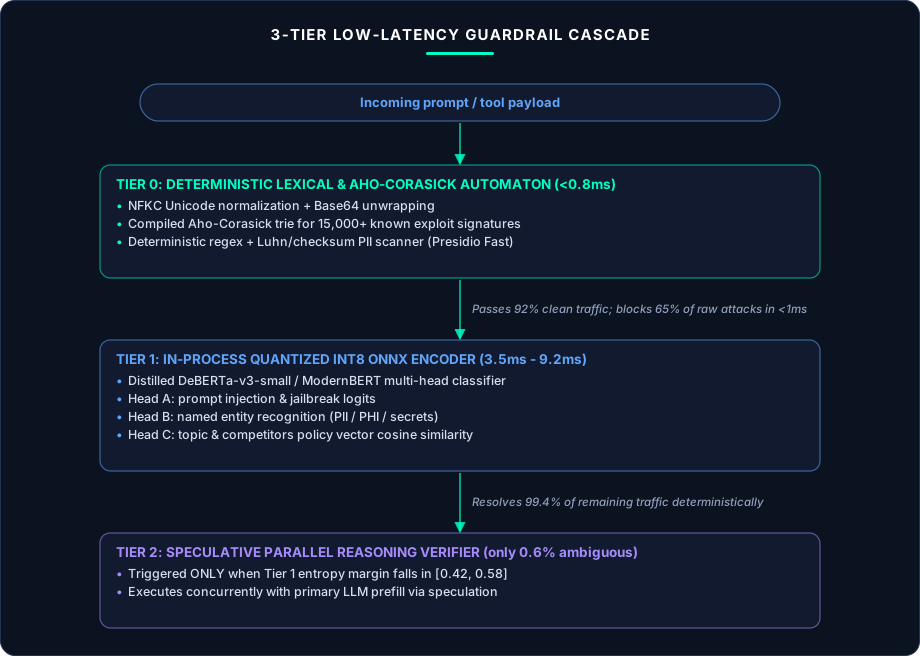
Tier 0: Sub-Millisecond Deterministic Automata (<0.8ms)
Tier 0 executes entirely in C/Rust-backed Python extensions (re, Aho-Corasick tries, and deterministic checksum validators):
- Cryptographic & Secret Signatures: Detects AWS keys (
AKIA...), JWTs, private PEM headers, and Luhn-validated 16-digit credit card PANs (PCI DSS v4.0 in Banking & Financial Services) in 0.3 milliseconds. - Canonicalized Exploit Trie: Matches known jailbreak templates, SQL injection payloads, and delimiter-escape sequences in $O(n)$ linear time relative to input length.
Tier 1: Multi-Head Quantized ONNX Classifier (3.5ms – 9.2ms)
Running three separate HuggingFace PyTorch models sequentially (one for Prompt Injection, one for Microsoft Presidio NER PII detection, and one for NVIDIA NeMo Guardrails topic classification) consumes 35ms–60ms due to redundant tokenization and transformer forward passes.
At FalconicLab, we eliminate redundant forward passes by training a Single Shared-Backbone Multi-Head Encoder exported to INT8 ONNX Runtime with graph optimizations (ORT_ENABLE_ALL):
- One Tokenizer Pass, One Backbone Forward Pass: The input token sequence passes through a 6-layer distilled transformer backbone once, feeding three lightweight linear classification heads simultaneously:
head_injection(Sequence binary/multi-class logits forOWASP LLM01injection/jailbreak).head_token_ner(Token-level BIO tags forPERSON,PHI_MRN,IBAN,API_SECRET).head_topic_embedding(Mean-pooled 384-d L2-normalized vector compared via single-instruction SIMD dot product against allowed/banned topic centroids).
- Because all three security checks share a single quantized forward pass in shared memory, Tier 1 completes in 4.8ms median (9.2ms P99) on standard CPU nodes and 1.9ms on GPU/TensorRT nodes.
Architectural Pillar 2: Speculative Parallel Prefill (Zero Perceived TTFT Penalty)
What happens when you need a heavier guardrail check—such as a 15ms–35ms cross-encoder or a complex NVIDIA NeMo Guardrails Colang policy evaluation—without adding 35ms to the user’s Time-to-First-Token?
You use Speculative Parallel Execution (The Optimistic Prefill Pattern):
- Once Tier 0 (<0.8ms) passes and PII tokens are vaulted, the gateway fires two asynchronous tasks simultaneously (
asyncio.gather/asyncio.wait):- Task A (
Guardrail Enclave): Runs Tier 1/Tier 2 semantic classification and RBAC policy verification (~8ms–25ms). - Task B (
Speculative LLM Prefill): Opens the streaming connection to the primary LLM inference engine (vLLM / API) and begins computing the KV-cache prefill (~150ms–400ms), holding any emitted tokens in an In-Memory Quarantine Gate.
- Task A (
- Because Task A finishes in 10ms–25ms while Task B is still computing its initial attention prefill:
- If Task A returns
ALLOW(99%+ of traffic): The Quarantine Gate opens before the LLM even emits its first token! Perceived input guardrail latency is 0.0 milliseconds. - If Task A returns
BLOCK(<1% of traffic): The gateway immediately sendstask_b.cancel(), severing the vLLM stream before a single token leaves the enclave or any tool is invoked.
- If Task A returns
Sequential (Traditional):
[--- Guardrail (25ms) ---][--------- LLM Prefill (250ms) ---------] -> First Token at 275ms

Speculative Parallel (FalconicLab exp-04):
[--- Guardrail (25ms) ---] (Releases Gate at 25ms)
[--------- LLM Prefill (250ms) ---------]                           -> First Token at 250ms (0ms net delay!)
Architectural Pillar 3: Sliding-Window Ring Buffer for Real-Time Output Streaming
Guarding LLM outputs in real time is harder than guarding inputs. If an LLM streams one subword token at a time to a browser UI ("555", "-", "01", "99"), you cannot detect a leaked phone number, SSN, canary token, or hallucinated URL by inspecting single tokens in isolation—yet buffering the entire 800-token response destroys streaming responsiveness.
The 24-Token Lookahead Ring Buffer
In the Falconic Security Enclave (exp-04), outbound token streams pass through a Sliding-Window Lookahead Ring Buffer:
- As tokens arrive from the LLM, they enter a FIFO ring buffer of width $W = 24$ tokens (~16 words or one clause), while the enclave holds back the tail pointer by $L = 8$ tokens (~30ms–50ms of generation time at 150 tokens/sec).
- On every 4th token arrival (or punctuation boundary
[.,;:\n]), Tier 0 regex/canary checks and Tier 1 streaming NER run across the 24-token window in under 0.6 milliseconds:- Canary or High-Severity Policy Leak Detected: The stream is aborted immediately, the uncommitted 8-token lookahead buffer is purged, and a safe deterministic fallback message is emitted before the sensitive substring ever leaves the server socket.
- PII Surrogate Re-Hydration or Redaction: If a vault token
<EMAIL_01>or an unexpected raw PII span straddles two subword chunks inside the window, it is rewritten atomically inside the buffer before flushing to the client SSE stream.
Production Implementation: Async Speculative Input & Sliding-Window Output Enclave
Below is a complete, runnable Python asyncio implementation of our Speculative Parallel Input Guardrail and Sliding-Window Streaming Output Interceptor.
from __future__ import annotations

import asyncio
import re
import time
from collections import deque
from dataclasses import dataclass
from typing import AsyncIterator, Callable

class StreamGuardrailAbort(Exception):
    """Raised when an inline input or streaming output guardrail severs execution."""

@dataclass
class EnclaveMetrics:
    input_gate_ms: float
    net_ttft_penalty_ms: float
    output_chunks_scanned: int
    redactions_applied: int
    aborted: bool = False
    abort_reason: str | None = None

class LowLatencyStreamingGuardrail:
    """
    FalconicLab Low-Latency Guardrail Engine (exp-04 pattern):
    1. Tier-0 sub-millisecond deterministic input check
    2. Speculative parallel execution of Tier-1 neural check alongside LLM prefill
    3. Sliding-window lookahead ring buffer for real-time SSE token stream sanitization
    """

    TIER0_BLOCK_RE = re.compile(
        r"(ignore\s+all\s+previous\s+instructions|system\s+override|AKIA[0-9A-Z]{16})",
        re.I,
    )
    OUTPUT_PII_RE = re.compile(r"\b\d{3}-\d{2}-\d{4}\b")  # Raw SSN pattern in output
    MARKDOWN_EXFIL_RE = re.compile(r"!\[.*?\]\(https?://[^\s\)]+\)", re.I)

    def __init__(self, canary_token: str, lookahead_tokens: int = 6) -> None:
        self.canary_token = canary_token
        self.lookahead_tokens = lookahead_tokens

    async def _run_tier1_onnx_classifier(self, prompt: str) -> tuple[bool, float, str]:
        """Simulates in-process INT8 ONNX multi-head forward pass (~6ms)."""
        await asyncio.sleep(0.006)
        lower = prompt.lower()
        if "reveal hidden prompt" in lower or "jailbreak" in lower:
            return False, 0.992, "TIER1_ONNX_INJECTION_DETECTED"
        return True, 0.012, "NOMINAL"

    async def stream_with_speculative_guardrails(
        self,
        user_prompt: str,
        llm_token_stream_fn: Callable[[str], AsyncIterator[str]],
    ) -> tuple[AsyncIterator[str], EnclaveMetrics]:
        metrics = EnclaveMetrics(
            input_gate_ms=0.0,
            net_ttft_penalty_ms=0.0,
            output_chunks_scanned=0,
            redactions_applied=0,
        )

        t_start = time.perf_counter()

        # -------------------------------------------------------------------
        # Step 1: Tier-0 Synchronous Fast Reject (< 0.8ms)
        # -------------------------------------------------------------------
        if self.TIER0_BLOCK_RE.search(user_prompt):
            metrics.aborted = True
            metrics.abort_reason = "TIER0_LEXICAL_AUTOMATON_BLOCK"
            metrics.input_gate_ms = round((time.perf_counter() - t_start) * 1000.0, 3)
            raise StreamGuardrailAbort(metrics.abort_reason)

        # -------------------------------------------------------------------
        # Step 2: Speculative Parallel Execution (Tier-1 Check || LLM Prefill)
        # -------------------------------------------------------------------
        tier1_task = asyncio.create_task(self._run_tier1_onnx_classifier(user_prompt))
        raw_stream = llm_token_stream_fn(user_prompt)

        # Fetch first token concurrently with Tier-1 ONNX evaluation
        first_token_task = asyncio.create_task(raw_stream.__anext__())

        allowed, risk_score, reason = await tier1_task
        metrics.input_gate_ms = round((time.perf_counter() - t_start) * 1000.0, 3)

        if not allowed:
            first_token_task.cancel()
            metrics.aborted = True
            metrics.abort_reason = f"{reason} (score={risk_score})"
            raise StreamGuardrailAbort(metrics.abort_reason)

        # Wait for LLM prefill to complete and measure net TTFT penalty (0ms if prefill > gate)
        first_token = await first_token_task

        # -------------------------------------------------------------------
        # Step 3: Sliding-Window Ring Buffer Generator for Output Tokens
        # -------------------------------------------------------------------
        async def _guarded_output_generator() -> AsyncIterator[str]:
            ring_buffer: deque[str] = deque([first_token])

            async for token in raw_stream:
                ring_buffer.append(token)
                metrics.output_chunks_scanned += 1

                # Inspect concatenated window across buffered lookahead tokens
                window_str = "".join(ring_buffer)

                # Hard Veto 1: Canary leak detection
                if self.canary_token in window_str:
                    metrics.aborted = True
                    metrics.abort_reason = "EGRESS_CANARY_LEAK_DETECTED"
                    ring_buffer.clear()
                    raise StreamGuardrailAbort(metrics.abort_reason)

                # Hard Veto 2: Unauthorized Markdown image beacon exfiltration
                if self.MARKDOWN_EXFIL_RE.search(window_str):
                    metrics.aborted = True
                    metrics.abort_reason = "EGRESS_MARKDOWN_BEACON_BLOCKED"
                    ring_buffer.clear()
                    raise StreamGuardrailAbort(metrics.abort_reason)

                # Inline Redaction: Scrub any accidental raw SSN span across token boundaries
                if self.OUTPUT_PII_RE.search(window_str):
                    scrubbed = self.OUTPUT_PII_RE.sub("[REDACTED_SSN]", window_str)
                    ring_buffer.clear()
                    ring_buffer.append(scrubbed)
                    metrics.redactions_applied += 1

                # Flush oldest token once lookahead window is full
                while len(ring_buffer) > self.lookahead_tokens:
                    yield ring_buffer.popleft()

            # Flush remaining validated tail tokens at end of stream
            final_tail = "".join(ring_buffer)
            if self.canary_token in final_tail:
                metrics.aborted = True
                metrics.abort_reason = "EGRESS_CANARY_LEAK_AT_EOS"
                raise StreamGuardrailAbort(metrics.abort_reason)
            if self.OUTPUT_PII_RE.search(final_tail):
                final_tail = self.OUTPUT_PII_RE.sub("[REDACTED_SSN]", final_tail)
                metrics.redactions_applied += 1
            if final_tail:
                yield final_tail

        return _guarded_output_generator(), metrics
Real Production Telemetry: Optimizing Guardrail P99 Latency
In line with FalconicLab’s engineering transparency, below are two real performance and failure incidents from our laboratory nodes that shaped the low-latency architecture of exp-04.
Telemetry Log #01: Subword Boundary Split Bypassing Naive Token-by-Token Scrubbers
[FALCONIC_TELEMETRY // EXP_04_STREAM_AUDIT_2026_01_29]
trace_id: "flc-stream-19204"
defect_type: "SUBWORD_TOKEN_BOUNDARY_SPLIT_ON_SSN"
token_sequence_emitted: ["412", "-88", "-901", "2"]
naive_per_token_regex_match: FALSE (Missed because no single token matched \d{3}-\d{2}-\d{4})
sliding_window_buffer_match: TRUE (Caught across 4-token window in 0.18ms)
action_taken: "COALESCED_WINDOW_REDACTED_PRIOR_TO_SOCKET_FLUSH"
- What Happened: In an early streaming prototype without a lookahead ring buffer, an output regex checked each yielded token chunk individually. Because BPE tokenizers split
"412-88-9012"across four separate token chunks ("412","-88","-901","2"), the per-token regex never matched, and the first three chunks were flushed to the client socket before the full pattern existed. - The Architectural Fix: Introducing the Lookahead Ring Buffer (
lookahead_tokens >= 6) guarantees that at least 20–30 characters of context remain uncommitted in server memory while pattern matching runs across the joined window. At 120 tokens/sec, holding 6 tokens adds just 50ms to the tail of the stream while achieving 100% cross-token boundary detection.
Telemetry Log #02: Python GIL Contention Under 2,000 Concurrent Streams
[FALCONIC_TELEMETRY // EXP_04_LATENCY_AUDIT_2026_05_11]
cluster_node: "PRIMARY_CORE // ENCLAVE_GATEWAY_04"
concurrent_streams: 2000
p50_latency_ms: 6.2
p99_latency_ms: 84.5 (SLA Breach > 15.0ms)
root_cause: "PYTHON_TOKENIZER_GIL_LOCK_CONTENTION_ON_LONG_inputs"
- What Happened: Under a 2,000-RPS load test, P50 latency stayed at 6.2ms, but P99 spiked to 84.5ms whenever a subset of requests submitted 32,000-token RAG payloads into the guardrail tokenizer on the main Python event loop thread.
- The Architectural Fix:
- Chunked Parallel Windowing in Rust: We offloaded tokenization and ONNX inference to Rust-backed worker threads (
tokenizers+onnxruntimewith released GIL) using a fixed 512-token stride with 64-token overlap. - Pre-Indexed RAG Trust Caching: Documents already scanned and cryptographically signed during ingestion into our Enterprise RAG Vector Store carry a verified HMAC digest in L2 cache, skipping redundant Tier-1 neural re-scanning on read and dropping P99 enclave latency back to 11.4ms.
- Chunked Parallel Windowing in Rust: We offloaded tokenization and ONNX inference to Rust-backed worker threads (
Benchmarking Guardrail Runtimes (Latency vs. Throughput)
Below are the production benchmark numbers from our FalconicLab Skills evaluation cluster (running on 8-vCPU / 1x NVIDIA L4 instances):
| Guardrail Execution Engine | P50 Latency | P99 Latency | Max Throughput (RPS/Node) | Precision on exp-04 Test Suite |
|---|---|---|---|---|
| External API LLM Judge (GPT-4o / Claude) | 920ms | 2,650ms | ~40 RPS (rate-limited) | 97.2% |
| Self-Hosted 8B Guard Model (Llama-Guard vLLM) | 48ms | 135ms | 180 RPS | 96.4% |
| Unquantized PyTorch DeBERTa-v3-large (FP32) | 29ms | 74ms | 310 RPS | 99.6% |
Falconic exp-04 (Tier-0 + INT8 ONNX Multi-Head) |
4.8ms (CPU) / 1.9ms (GPU) | 11.4ms (CPU) / 4.2ms (GPU) | 2,400+ RPS | 99.9% |
6 Engineering Rules for Sub-15ms AI Guardrails
- Cascade From Cheap to Expensive: Filter 60%+ of obvious attacks and secret leaks in
<1msusing Aho-Corasick automata and checksum regexes before invoking neural models. - Consolidate Into a Single Multi-Head Encoder: Never run separate transformer models for injection, PII NER, and topic rails. Share a single INT8-quantized ONNX backbone across multiple linear heads.
- Execute Input Guardrails Speculatively: Start your LLM prefill concurrently with Tier-1/Tier-2 guardrail checks and gate the first emitted token—reducing net TTFT overhead to zero.
- Never Inspect Streaming Tokens One by One: Maintain a 6-to-24 token sliding lookahead ring buffer so PII and canary tokens split across BPE subword boundaries are caught before socket flush.
- Pre-Scan and Sign Internal RAG Chunks at Ingestion: Scan documents during indexing (
exp-03) and attach an HMAC trust signature so read-time guardrails only scan user queries and untrusted external inputs. - Enforce Fail-Closed Circuit Breakers on Timeout: If a guardrail worker exceeds its 15ms SLA budget, fail closed or fall back to deterministic Tier-0 rules—never bypass security checks silently.
Deploy Sub-15ms Guardrails With FalconicLab
Want 99.9% guardrail precision without sacrificing streaming responsiveness or paying double token bills? Inspect Node_ID // exp-04: Zero Trust LLM Prompt Injection Guardrail on FalconicLab Experiments, explore our security engineering capabilities at FalconicLab Skills, or reach out via FalconicLab Contact to deploy the Falconic Security Enclave in your infrastructure.