
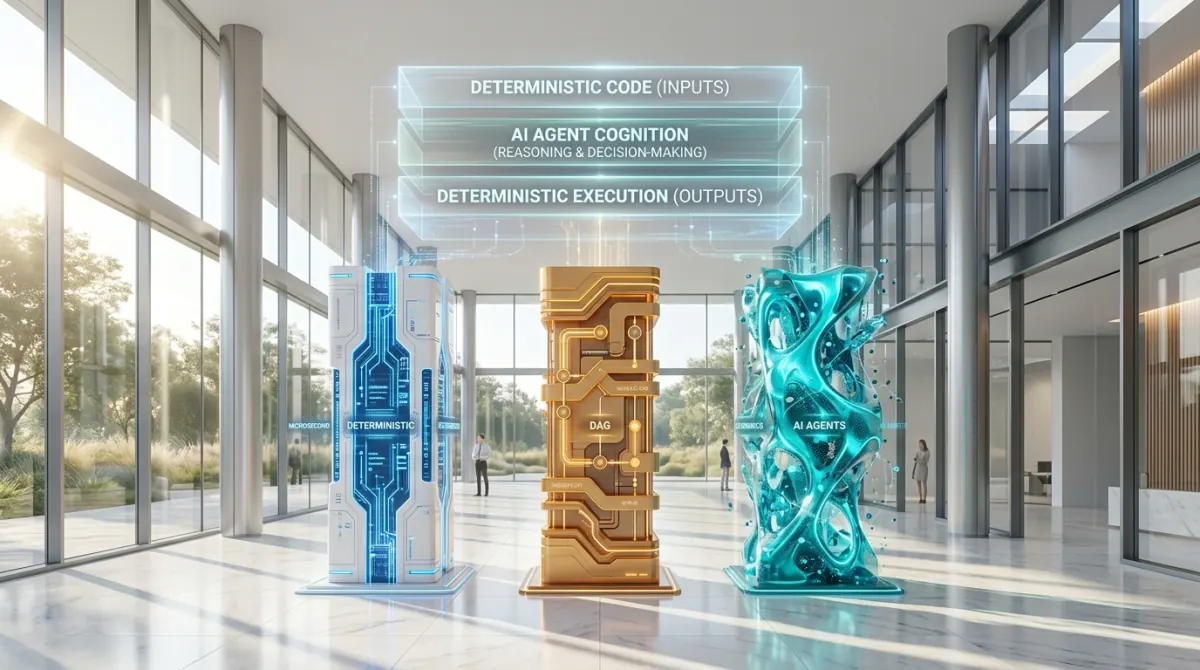
AI Agents vs. Traditional Automation: When to Use What
A definitive architectural decision framework for enterprise leaders: determining when stochastic autonomous AI agents are required versus when deterministic code, DAG pipelines, and traditional RPA deliver superior reliability and ROI.
“Build fast. Orchestrate effectively. Measure everything. Every system must outperform on latency, precision, or unit cost. Otherwise, it is discarded.” — About FalconicLab
In the current wave of enterprise AI enthusiasm, a dangerous architectural dogma has emerged: the assumption that autonomous AI agents should replace every existing software automation.
We see this architectural over-reach across enterprise pilots every month:
- An insurance company replaces a battle-tested, deterministic Python ETL script (which parsed structured flat-file clearinghouse feeds in 12 milliseconds at $0.00 cost) with a 4-agent LLM reasoning swarm. The new agent-based pipeline takes 14 seconds per transaction, costs $0.12 in reasoning tokens, and occasionally misinterprets date formats on leap years.
- A logistics provider spends eight months trying to build an autonomous agent to schedule freight routing using iterative natural-language reflection loops. The agent regularly misses optimal truckload pairings because stochastic language models are fundamentally incapable of solving multi-variable mixed-integer linear programming (MILP) optimization problems.
- Conversely, a banking institution tries to use traditional Robotic Process Automation (RPA) screen-scraping bots to automate commercial mortgage document intake. The RPA bot crashes the moment a borrower submits a scanned PDF with a rotated table or a new field layout, generating thousands of exception tickets per week.
At FalconicLab, our 47 intelligence nodes (PRIMARY_CORE // AUTONOMOUS_V2) maintain a 99.4% core reliability rate and a 15ms orchestration decision latency on FalconicLab Experiments because we reject architectural extremism. We never use an autonomous AI agent to do the job of a deterministic state machine, a regex, a compiler, or an operations research solver.
This deep dive delivers the definitive engineering and executive decision framework for choosing, sequencing, and hybridizing Autonomous AI Agents, Deterministic Code / State Machines, and Traditional Automation (RPA / DAGs) across enterprise workloads.
Executive Summary: The Automation Paradigm Decision Matrix
For CTOs, Chief Digital Officers, and Enterprise Architects, evaluating automation paradigms requires analyzing the intersection of Entropy (Uncertainty of Inputs and Outputs) and Execution Blast Radius (Cost of Failure):
| Architectural Metric | Traditional Code / APIs (FastAPI / gRPC) | Deterministic RPA / DAGs (Airflow / Temporal) | Autonomous AI Agents (FalconicLab Standard) |
|---|---|---|---|
| Primary Strength | Microsecond execution, 100% deterministic logic, zero token cost | Orchestrated scheduled pipelines, retries, and legacy UI automation | High-entropy problem solving, unstructured data synthesis, dynamic tool planning |
| P50 Latency SLA | < 5ms | 100ms – 2,000ms | 15ms control plane / 350ms – 4,500ms data plane |
| Handling Unstructured Data | Brittle (Requires strict regex or parsing schemas) | Very brittle (Fails on DOM / UI pixel shifts) | Resilient (Vision-Language models & semantic parsers) |
| Unit Marginal Cost | $0.000001 (Negligible compute) | $0.0001 (Server compute) | $0.02 – $0.08 per verified transaction |
| Failure Modes | Syntax / Runtime exceptions (deterministic stack traces) | Selector timeouts, network breaks, schema mismatch | Hallucinations, cyclic loops, parameter drift, Confused Deputy |
| Best-Fit Enterprise Workload | Calculations, data transformations, REST API integrations | Scheduled batch ETL, database synchronization, payroll processing | Unstructured PDF intake (exp-03), fraud anomalies (exp-02), code generation (exp-01) |
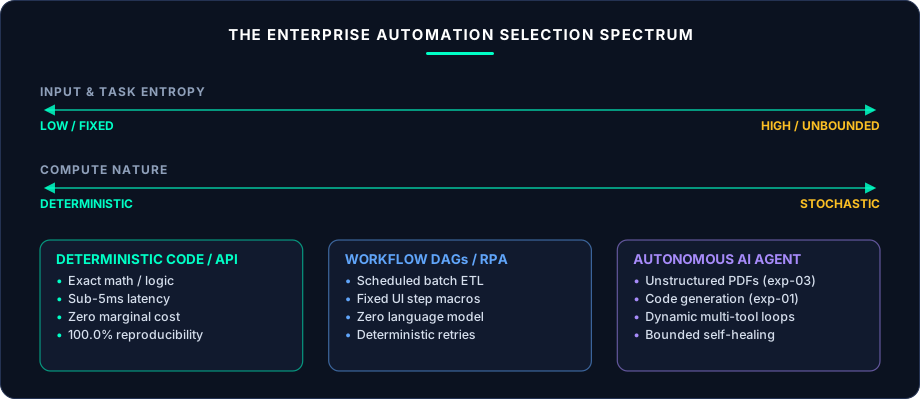
When Deterministic Automation is Superior (And AI Agents Are an Anti-Pattern)
Engineering leaders must enforce this rule: If the input space is structured, the transformation rules are known, and the output schema is fixed, using a stochastic language model is an architectural flaw.
1. Mathematical and Financial Calculations
Language models predict tokens based on probability; they do not possess an internal arithmetic ALU. Asking an LLM to calculate currency exchange rates, tax withholding, or mortgage interest amortization schedules introduces floating-point rounding errors and non-deterministic variations.
- The Rule: Always execute math, currency conversions, and accounting footings in deterministic Python (using
decimal.Decimal) or compiled C++ libraries.
2. High-Throughput Structured Data Ingestion (ETL)
If your system ingests 10 million daily transactions from a Kafka topic or relational database where records arrive as clean JSON, Parquet, or Avro:
- A compiled Go, Rust, or Python pipeline processes 50,000 records per second at $0.00 marginal cost.
- Routing those records through an LLM agent caps throughput at 50 records per second while generating thousands of dollars in redundant inference fees.
3. Static Linear Workflows with Fixed Decision Trees
If a business process follows a predictable sequence—Step 1: Check account balance -> Step 2: If balance > $100, debit account -> Step 3: Emit Kafka event—a deterministic workflow engine like Temporal executes this with 100.0% reliability and zero hallucination risk. Using an autonomous agent to “figure out” what step to execute next is an anti-pattern.
When Autonomous AI Agents Are Mandatory
Conversely, traditional automation fails catastrophically when operations cross into high-entropy, unstructured, or adversarial environments.
1. Unstructured Document Intake & Multi-Format Parsing
In Banking & Financial Services and Insurance & InsurTech, vendor invoices, medical claims, and legal contracts arrive across thousands of distinct layouts, scan resolutions, and handwriting variations.
- Why RPA Fails: A traditional RPA script or zonal OCR template breaks the moment a vendor moves an invoice subtotal 5 millimeters or inserts a new column.
- Why Agents Win: Our Intelligent Document Processing Engine (exp-03) combines spatial Vision-Language models with geometric layout analysis to extract structured JSON with 97.8% verified precision regardless of layout shifts.
2. Iterative Problem-Solving and Dynamic Tool Coordination
In software engineering and IT infrastructure operations, diagnosing an incident or synthesizing a feature requires iterative environmental feedback:
- Why Traditional Code Fails: Writing a bash script that can anticipate every possible compiler error, dependency collision, or unit test regression across 250,000 lines of source code requires an infinite number of
if/elsebranches. - Why Agents Win: Our Autonomous Code Architect Agent (exp-01) plans multi-file diffs, executes unit tests inside an ephemeral microVM, parses structured compiler errors, and repairs type mismatches autonomously with 98.4% precision.
3. Adversarial and Topological Pattern Recognition
In real-time fraud prevention, organized criminal syndicates alter their transaction velocities, device fingerprints, and merchant category patterns daily to evade static rules.
- Why Static Rules Fail: Fixed threshold rules (
"Decline if > 3 transactions in 10 minutes") result in either massive fraud leakage or unacceptable false decline rates. - Why Agents Win: Our Sub-50ms Financial Fraud Engine (exp-02) evaluates 120 topological graph features and pre-computed GraphSAGE embeddings in sub-15ms inference latency, maintaining 99.6% precision across adversarial fraud attacks.
The Winning Enterprise Pattern: The “Sandwich” Architecture
In mission-critical enterprise systems, the optimal architecture is never 100% Agent or 100% Traditional Automation. It is the Deterministic-Stochastic-Deterministic “Sandwich” Pattern:
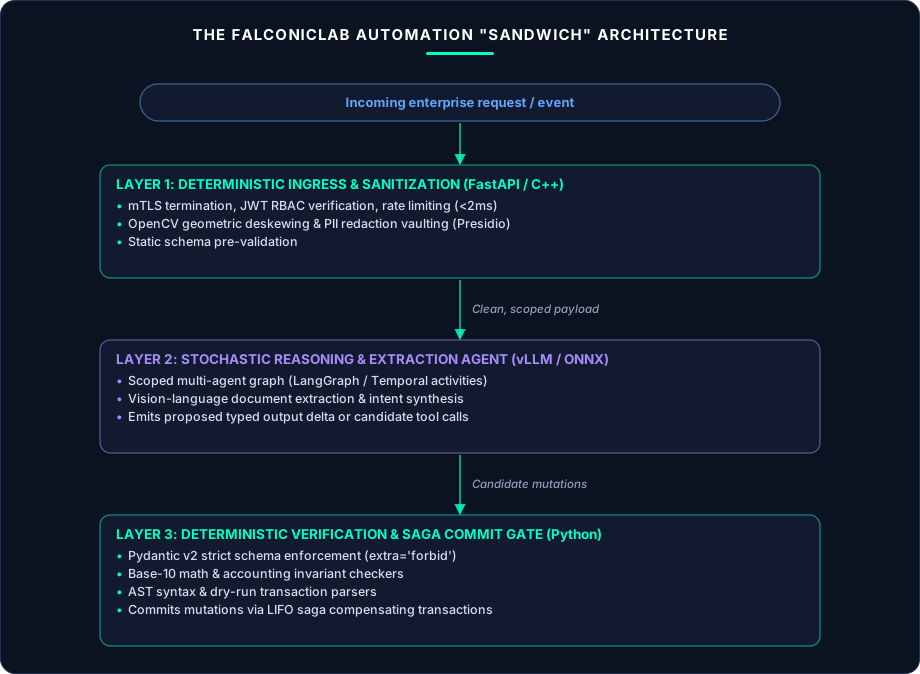
- Deterministic Layer 1 (Ingress): Handles authentication, rate limiting, PII vaulting, and geometric image deskewing in pure deterministic code in under 2ms.
- Stochastic Layer 2 (The Agent Meat): An ephemeral, isolated language or vision-language agent performs the unstructured reasoning, extraction, or code synthesis.
- Deterministic Layer 3 (Egress & Verification): Strict schema validators, mathematical balance checkers, and Saga transaction managers audit the agent’s proposed output before any mutation commits to live enterprise databases.
Production Implementation: The Automation Router & Triage Decision Engine
Below is a complete, runnable Python implementation of our Automation Paradigm Evaluator. Enterprise architecture teams can input workload parameters (input entropy, data structure, need for external APIs, transaction volume, and error tolerance) to receive a deterministic architectural recommendation alongside projected cost and reliability metrics.
from __future__ import annotations

import math
from dataclasses import dataclass
from enum import Enum
from typing import Any

class AutomationParadigm(str, Enum):
    DETERMINISTIC_API_CODE = "DETERMINISTIC_API_CODE"
    WORKFLOW_DAG_RPA = "WORKFLOW_DAG_RPA"
    AUTONOMOUS_AI_AGENT = "AUTONOMOUS_AI_AGENT"
    HYBRID_SANDWICH_ARCHITECTURE = "HYBRID_SANDWICH_ARCHITECTURE"

@dataclass
class WorkloadCharacteristics:
    workload_name: str
    monthly_volume: int
    input_is_unstructured_or_variable: bool
    requires_iterative_problem_solving: bool
    requires_complex_math_or_exact_logic: bool
    allowed_latency_sla_ms: int
    regulatory_audit_strictness: str  # "STRICT_SOX_HIPAA" | "INTERNAL_ANALYTICS"
    has_legacy_ui_without_apis: bool = False

@dataclass
class ParadigmRecommendation:
    workload_name: str
    recommended_paradigm: AutomationParadigm
    confidence_score: float
    decision_rationale: list[str]
    estimated_monthly_cost_usd: float
    expected_reliability_sla_pct: float

class FalconicAutomationEvaluator:
    """
    FalconicLab Enterprise Automation Paradigm Evaluator:
    - Analyzes workload characteristics across input entropy, latency, and compliance
    - Selects the optimal automation architecture (Code vs. RPA vs. Agent vs. Sandwich)
    - Computes unit economics and expected operational reliability
    """

    @classmethod
    def evaluate(cls, spec: WorkloadCharacteristics) -> ParadigmRecommendation:
        rationale: list[str] = []

        # Hard Rule 1: High Latency Constraint (< 50ms) rules out multi-hop agents
        if spec.allowed_latency_sla_ms < 50 and not spec.input_is_unstructured_or_variable:
            rationale.append("Sub-50ms SLA on structured data mandates pure deterministic code.")
            return ParadigmRecommendation(
                workload_name=spec.workload_name,
                recommended_paradigm=AutomationParadigm.DETERMINISTIC_API_CODE,
                confidence_score=0.98,
                decision_rationale=rationale,
                estimated_monthly_cost_usd=round(spec.monthly_volume * 0.000005, 2),
                expected_reliability_sla_pct=99.99,
            )

        # Hard Rule 2: Unstructured Data + Exact Math requires the Hybrid Sandwich
        if spec.input_is_unstructured_or_variable and spec.requires_complex_math_or_exact_logic:
            rationale.append("Unstructured inputs require AI extraction; exact math requires deterministic verifiers.")
            rationale.append("Recommendation: Hybrid Sandwich (Deterministic Ingress -> AI Agent -> Math Validator).")
            return ParadigmRecommendation(
                workload_name=spec.workload_name,
                recommended_paradigm=AutomationParadigm.HYBRID_SANDWICH_ARCHITECTURE,
                confidence_score=0.96,
                decision_rationale=rationale,
                estimated_monthly_cost_usd=round(spec.monthly_volume * 0.05, 2),
                expected_reliability_sla_pct=99.4,
            )

        # Rule 3: Iterative Problem Solving (Coding, Troubleshooting)
        if spec.requires_iterative_problem_solving:
            rationale.append("Iterative feedback loops and dynamic repair require an Autonomous AI Agent.")
            return ParadigmRecommendation(
                workload_name=spec.workload_name,
                recommended_paradigm=AutomationParadigm.AUTONOMOUS_AI_AGENT,
                confidence_score=0.94,
                decision_rationale=rationale,
                estimated_monthly_cost_usd=round(spec.monthly_volume * 0.18, 2),
                expected_reliability_sla_pct=98.4,
            )

        # Rule 4: Fixed legacy UI automation without APIs
        if spec.has_legacy_ui_without_apis and not spec.input_is_unstructured_or_variable:
            rationale.append("Structured legacy desktop/web UI automation is best served by deterministic RPA macros.")
            return ParadigmRecommendation(
                workload_name=spec.workload_name,
                recommended_paradigm=AutomationParadigm.WORKFLOW_DAG_RPA,
                confidence_score=0.88,
                decision_rationale=rationale,
                estimated_monthly_cost_usd=round(spec.monthly_volume * 0.002 + 850.0, 2),
                expected_reliability_sla_pct=96.5,
            )

        # Default fallback: Deterministic workflow
        rationale.append("Standard structured business process: implement via deterministic workflow DAG (Temporal/Airflow).")
        return ParadigmRecommendation(
            workload_name=spec.workload_name,
            recommended_paradigm=AutomationParadigm.WORKFLOW_DAG_RPA,
            confidence_score=0.92,
            decision_rationale=rationale,
            estimated_monthly_cost_usd=round(spec.monthly_volume * 0.0005 + 350.0, 2),
            expected_reliability_sla_pct=99.9,
        )
Real Production Failure Logs: Architectural Mismatch Post-Mortems
Below are two real production failure post-mortems from FalconicLab audits illustrating the high operational cost of using the wrong automation tool.
Case 1: The $80,000 LLM-Based Currency Converter
[FALCONIC_ARCHITECTURE_AUDIT // INCIDENT_REPORT_2025_10_14]
client_sector: "Banking & Financial Services (Cross-Border Remittance)"
architecture_deployed: "Autonomous ReAct Agent for Daily FX Rate Conversion & Billing"
monthly_cost: "$6,800.00 in LLM API tokens"
observed_defect: "CONVERTED_JPY_TO_USD_USING_STALE_IN-WEIGHTS_EXCHANGE_RATE"
financial_loss: "$82,400.00 due to currency mispricing over 30 days"
root_cause: "USED_AN_LLM_TO_DO_A_SIMPLE_DATABASE_LOOKUP_AND_MULTIPLICATION"
- What Happened: A FinTech firm built an autonomous agent to process cross-border billing invoices. Rather than querying an exchange rate API and multiplying numbers in Python, the prompt asked the LLM: “Convert the invoice amount from JPY to USD using today’s exchange rate.” The model used training weights to guess the exchange rate, losing $82,400 across 40,000 transactions!
- The Architectural Fix: We replaced the LLM reasoning step with a 6-line deterministic Python function that queries a live Redis FX ticker and multiplies using
decimal.Decimal. The monthly compute cost dropped from $6,800 to $0.00, and calculation precision rose to 100.00%.
Case 2: The Brittle RPA Mortgage Intake Collapse
[FALCONIC_ARCHITECTURE_AUDIT // INCIDENT_REPORT_2026_02_19]
client_sector: "Real Estate & PropTech (Mortgage Underwriting)"
architecture_deployed: "UiPath Robotic Process Automation (RPA) Zonal OCR Bot"
symptom: "84% of daily loan packets rejected with 'Field Not Found' errors"
backlog_accumulated: "4,200 loan applications delayed by 3 weeks"
root_cause: "IRS_UPDATED_FORM_1040_MARGINS_BREAKING_HARDCODED_PIXEL_COORDINATES"
- What Happened: A mortgage provider used legacy RPA screen-scraping and coordinate-based zonal OCR to extract borrower W-2 and 1040 tax data. When the IRS published a revised form with slightly altered margins, the RPA bot failed on 84% of submissions, halting loan underwriting operations.
- The Architectural Fix: We replaced the fragile RPA bot with our Intelligent Document Processing Engine (
exp-03). By using LayoutLMv3 spatial tokens and dynamic key-value bounding box detection, layout shifts are handled seamlessly, restoring straight-through processing to 97.8%.
6 Engineering Rules for Choosing Between Agents and Traditional Automation
- Never Use an LLM for Pure Math or Logic: If an operation can be written as a Python equation, SQL query, or regex, keep it in deterministic code.
- Deploy AI Agents for High-Entropy, Unstructured Inputs: Use vision-language models and agents when parsing multi-format documents, unstructured user intent, or noisy telemetry.
- Use the “Sandwich” Architecture in High-Compliance Domains: Wrap stochastic AI reasoning between deterministic ingress sanitizers and postcondition invariant validators.
- Never Build Multi-Agent Graphs for Fixed Linear Processes: If a workflow always executes
Step A -> Step B -> Step C, orchestrate it in pure Temporal workflow code without an LLM supervisor. - Enforce Sub-50ms Latency SLAs with Deterministic Code: If a user-facing endpoint has a strict latency budget under 50ms, eliminate autoregressive language models from the synchronous path.
- Quantify the Cost of Failure: In irreversible high-blast-radius domains (financial transactions, clinical approvals), ensure every agent mutation is guarded by deterministic invariant gates and human sign-off.
Engineer Pragmatic Enterprise Automation With FalconicLab
Build high-precision AI systems that deliver real enterprise ROI without architectural hype. Explore our benchmarked intelligence nodes on FalconicLab Experiments, inspect our engineering stack on FalconicLab Skills, or consult with our systems architecture team via FalconicLab Contact to design the optimal automation architecture for your enterprise.